To restrict apps on a Windows 11 laptop, use Microsoft Family Safety for a child’s account, the app’s own lock feature when it provides one, or an administrator’s application-control policy. If you simply want to stop someone using your open apps while you step away, press Windows key + L to lock your Windows session.
These methods do different jobs. Blocking an app for a family member does not add a password prompt to that app in your own account. Locking Windows protects access to your session, while a folder-protection program protects the folders you select. Choose the result you need before installing anything.
Choose the right type of lock
| Your goal | Method to consider | What it changes |
|---|---|---|
| Keep visitors out of your open session | Windows key + L and separate Windows accounts | Access to your signed-in workspace |
| Stop a child opening an app | Family Safety app blocking | App access for that family member |
| Allow a game only at certain times | Family Safety app and game limits | Usage time and schedule |
| Require a lock inside a particular app | The app’s documented lock feature | Only the content or access that feature covers |
| Control approved programs on managed PCs | AppLocker or another managed policy | Which applications users can run |
Protect your open apps when you leave the laptop
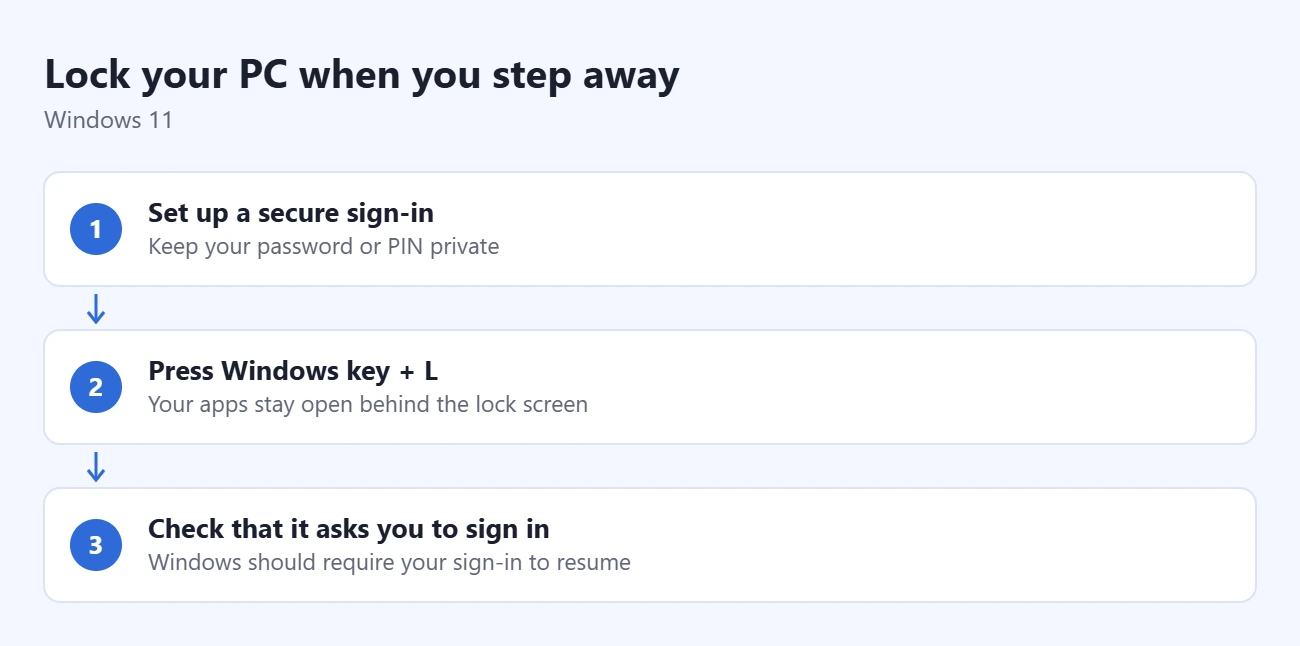
- Set up a secure Windows sign-in and keep its password or PIN private. A shared credential defeats the purpose of locking your session.
- Press Windows key + L when you step away. Your applications stay open behind the lock screen.
- Return to the laptop and confirm it requires your Windows sign-in to resume. This checks the session lock; it does not test a separate app password.
Microsoft documents locking, signing out, and switching users in User account access in Windows. If you want to close the session instead, follow how to sign out of Windows 11 and save your work first.
Give other people their own Windows account
For a shared laptop, separate accounts are more useful than letting everyone use your unlocked desktop. In Settings > Accounts > Other users, select Add account and complete the setup for the other person. Family members can also be added through Accounts > Family. See Microsoft’s account-management instructions.
Use a Standard user account for ordinary day-to-day access. Administrators have broad control, including access to files and changes to system settings, so separate accounts are not an absolute barrier against an administrator. Lock or sign out of your own account before handing over the laptop. Windows account separation also does not guarantee that every installed app is unavailable to the other account.
Block an app for a child with Family Safety
You need Microsoft accounts in a family group and a Family organizer account to manage blocking. Start with Microsoft’s Family Safety setup guide. Add the child’s account to Windows through Accounts > Family and have them sign in. Check that the laptop appears among their connected devices; Microsoft’s device-connection instructions also specify that the child should be a standard user.
- Sign in to account.microsoft.com/family as the organizer.
- Select the family member’s card, then the Windows platform tab.
- Open Apps, features, and games and find the app you want to restrict.
- Open the menu on the right of that app and select Block app.
- On the laptop, use the child’s Windows account and check that the selected app cannot be opened. Check an app you intend to allow as well.
To reverse this, return to the same app’s menu and select Unblock app. Repeat for each intended app, member, and platform. These controls follow Microsoft’s block and unblock instructions; a successful check in the organizer’s account would not demonstrate the child’s restriction.
Use time limits when you do not want a complete block
For scheduled access, select the family member’s Windows platform, open Apps, features, and games, and turn on App and game limits. Select the app and set its daily allowance and permitted times. Microsoft’s app-limit instructions explain daily schedules and duplicate device listings. App time limits do not automatically limit the website version of the same service; review related website controls separately.
For example, an organizer might block one game for a child while allowing a different game for an hour after school. Check both outcomes in the child’s account. Neither setting makes the organizer enter an app password on every launch. This example illustrates the controls rather than reporting a hands-on test.
For a password inside one app, check that app’s help
Some applications provide their own lock or protected-content feature. Look for its exact name in the developer’s documentation, then check what it covers: the entire app, one document, a private vault, or a particular account. Follow that app’s recovery instructions before relying on a new password. Do not assume a feature in one program works in another.
Treat third-party folder tools as a separate choice. For example, the My Lockbox overview describes folder protection and says it does not encrypt or relocate files. Its quick-start guide describes unlocking a protected folder, not a universal password prompt for every Windows application. Selecting an installation folder does not establish that all copies of an app or all of its saved data are protected. Back up important data and verify the precise scope before choosing such a tool.
AppLocker controls execution; it is not an app password
Microsoft’s AppLocker documentation describes rules for which apps and files users or groups can run. It is intended for managed application control. Administrators should plan rules, test them, and use audit-only mode to assess their effects before enforcing them. A badly designed policy can block necessary applications. Ask the administrator of a work or school laptop about its policy instead of changing it to imitate a consumer app lock.
If the expected restriction does not work
Wrong account or device: confirm you selected the child, the Windows platform, and the connected laptop. Check from the restricted account, not the organizer’s account. Confirm the child is a standard user and can see the device connection before troubleshooting the app rule.
App versus website: check whether the service is being opened through a browser rather than the blocked program. An app restriction and a web restriction address different access routes. Also confirm you selected the intended app listing when several devices report it.
Privacy switches: camera, microphone, and location permissions control capabilities rather than adding a launch password. Microsoft’s Windows privacy-settings guide also explains that desktop apps have exceptions. Turning off camera access is not a substitute for preventing someone from opening the app.
Choose one method that matches your goal, test it with the intended user, and keep a documented way to reverse it. For basic shared-laptop privacy, start with separate accounts and a locked Windows session; use app blocking or a specific app’s lock only when you need that additional behavior.

Matthew Burleigh is the founder, head writer, and editor of Solve Your Tech, which he launched in 2012. He has written technology tutorials since 2008 and worked in IT since 2003, including small-business support, IT management, and consulting. He holds Bachelor’s and Master’s degrees in Computer Science from Arizona State University.
Matthew writes practical guides for Windows, iPhone and iPad, Microsoft Office, Outlook, Google apps, and Android. Solve Your Tech’s guides are tested on current devices or checked against official product documentation, with clear steps, sources, and update dates.
Read more about Matthew and how Solve Your Tech writes and updates its guides, or report a correction.