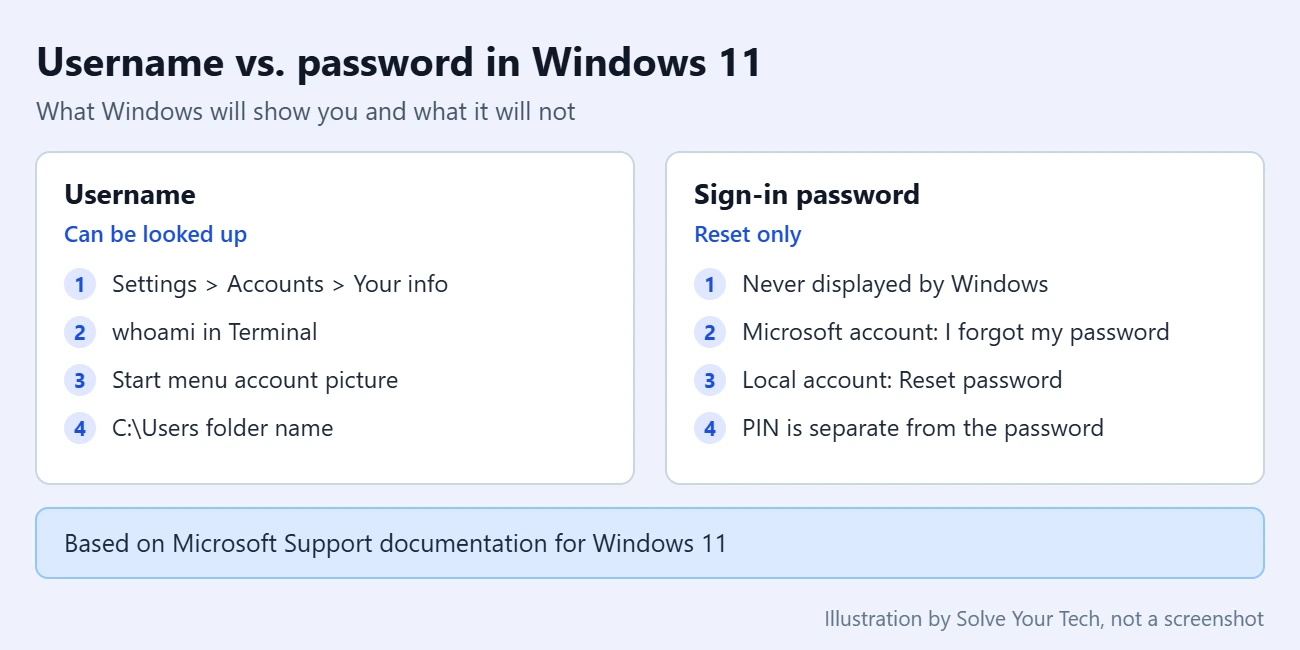
To find your username in Windows 11, open Settings > Accounts > Your info. Your account name is at the top, with your email address if you use a Microsoft account. Windows never shows your sign-in password, so a forgotten password has to be reset.
This guide covers Windows 11 Home and Pro: other ways to see your username, changing your display name, and resetting a forgotten password or PIN for a Microsoft account or a local account. On a work or school PC, your IT administrator handles resets.
What You Need to Know First
Windows 11 uses two main kinds of personal accounts, and knowing which one you have decides everything else in this guide.
- Microsoft account: tied to an email address and password that also work with services such as Outlook.com, OneDrive, and Xbox. You sign in with that email address, and the password is stored by Microsoft online, not only on your PC.
- Local account: created on one device and used only there. It does not need an internet connection to sign in, and its password exists only on that PC.
A third kind, a work or school account, is managed by an organization. Its name and password come from that organization.
The word “username” can also mean two different things. Your display name is the friendly name on the sign-in screen and in Settings. Your user name is the short name Windows uses behind the scenes, such as the one in your profile folder path. They are often different, so use the method below that matches what you need.
Find Your Username in Settings
This is the easiest route, and it also tells you your account type.
- Press Windows key + I to open Settings.
- Select Accounts in the left pane.
- Select Your info.
- Read the top of the page. You will see your display name and, for a Microsoft account, the email address you sign in with. The same area says whether the account is a local account and whether it is an administrator.
To confirm the account type, scroll to Account settings on the same page. Microsoft notes that the link Sign in with a local account instead appears only when you are using a Microsoft account, and Sign in with a Microsoft account instead appears only when you are using a local account. You do not need to select either link. Just read which one is there.
Find Your Username With the whoami Command
Use this method when an app, a network share, or a remote connection asks for the exact user name instead of the display name.
- Right-click the Start button and select Terminal.
- Type
whoamiand press Enter.
Microsoft describes whoami as a command that returns the current domain and user name. On a home PC the result looks like computername\username. The part before the backslash is the name of your PC, and the part after it is your user name. On a work PC joined to a domain, the first part is the domain name.
If you only want the user name without the computer name, type echo %USERNAME% in a Command Prompt window and press Enter. In PowerShell, which is what Terminal opens by default, whoami is the simpler choice.
Other Places Your Username Appears
- Start menu: select Start, then select your user picture. The account menu shows the name you are signed in with.
- Sign-in screen: press Windows key + L to lock the PC. The name above the password or PIN box is your display name. If more than one person uses the PC, the other accounts are listed in a corner of the screen.
- File Explorer: open File Explorer and go to
C:\Users. Each account that has signed in has a folder there. The folder name is the profile name Windows created when the account was first set up, so it may be a shortened version of your name or email address.
Locking the PC does not close your apps, so you can sign straight back in. Do not lock it if you are not sure of your password or PIN.
Change Your Display Name in Windows 11
For a local account, open Control Panel > User Accounts > User Accounts > Change your account name, type the new name, and select Change Name. For a Microsoft account, select Edit name on your online Microsoft account Your info page. Microsoft says the change can take up to 24 hours to show everywhere. On a work or school PC, ask IT.
Changing the display name doesn’t rename your C:\Users folder or change your password. For full steps, see how to change your user name in Windows 11.
Can You See Your Windows 11 Password?
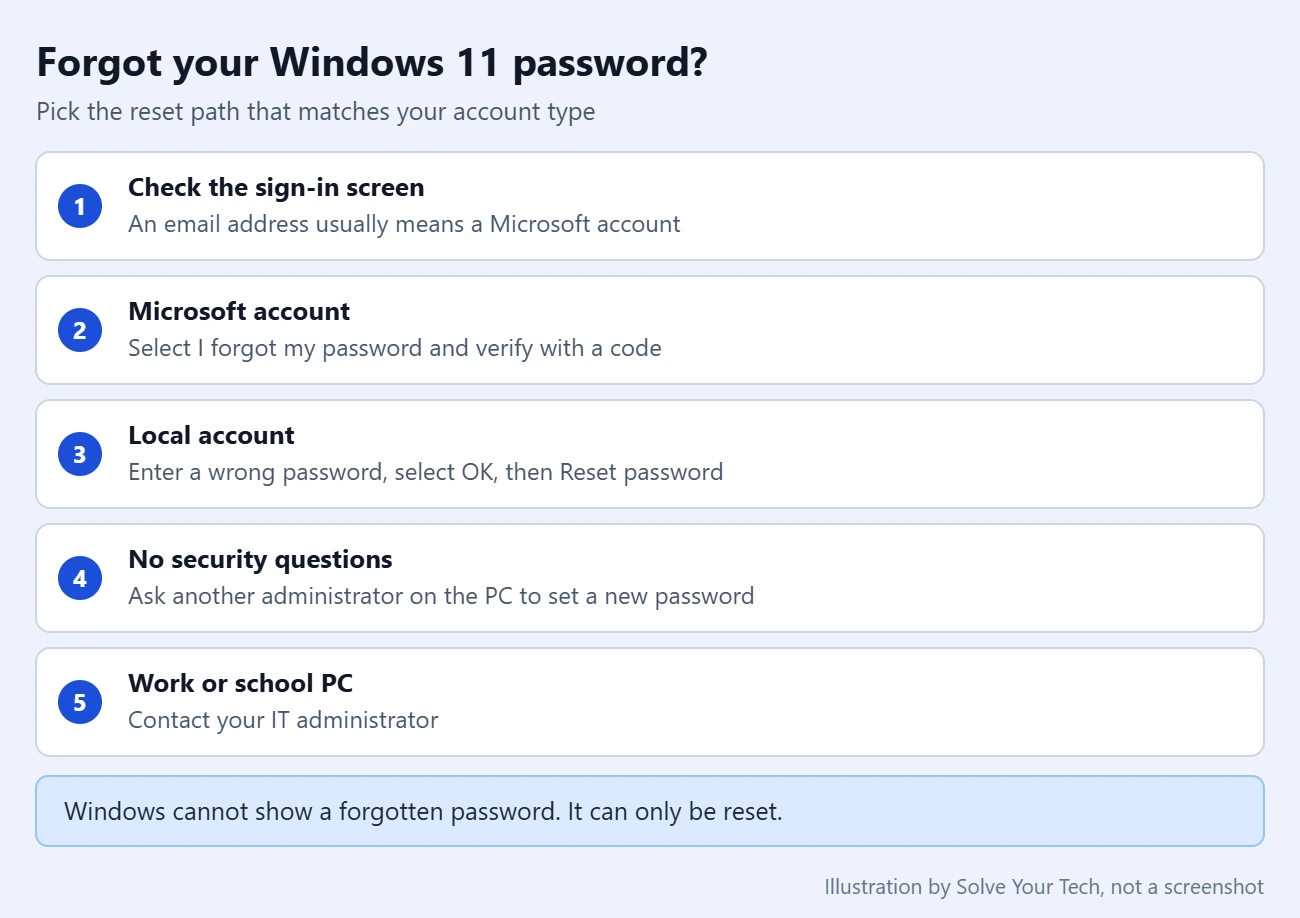
No. Windows never displays your sign-in password, and there is no setting, command, or built-in tool that reveals it. Microsoft also states that its support agents cannot retrieve or bypass a lost password. Some guides point to Credential Manager, but Microsoft describes that tool as a place to view and delete saved credentials for websites, connected apps, and networks. It is not a way to read the password you use to sign in to the PC.
That leaves two honest options: remember it or reset it. If you still know the password and only want a different one, see how to change your password on Windows 11 instead.
Reset a Forgotten Microsoft Account Password
Before you start: this changes the password for your whole Microsoft account, so the new password also applies to Outlook.com, OneDrive, Xbox, and any other device that uses the same account. You need access to the recovery email address or phone number on the account to receive a verification code.
- On the Windows 11 sign-in screen, select I forgot my password under the password box.
- Choose where Microsoft should send a verification code, then confirm the email address or phone number when asked.
- Enter the code you receive.
- Type a new password and select Next.
- Sign in to Windows with the new password. The PC needs an internet connection to pick up the change.
You can also do this from a browser on any phone or computer. Microsoft’s guide to resetting a forgotten Microsoft account password has the Reset password button and the same four steps. If you no longer have any of the listed verification options, that page links to Microsoft’s sign-in helper tool.
If you are already signed in with a PIN and only the password is forgotten, open Settings > Accounts > Sign-in options, select Password > Change, and then select Forgot my current password. Microsoft lists every route in Change or reset your Microsoft account password in Windows.
Reset a Forgotten Local Account Password
A local account has no online recovery. The reset depends on the security questions you answered when the account was created.
- On the sign-in screen, enter a password and select the arrow button next to the password box.
- When Windows says the password is incorrect, select OK.
- Select Reset password.
- Answer the security questions.
- Enter a new password.
If you made a password reset disk in the past, which is a USB drive prepared for this purpose, select Use a password reset disk instead and follow the instructions.
If you cannot answer the questions, an administrator on this PC may be able to reset your local-account password. On editions that include Local Users and Groups, Microsoft documents Computer Management > Local Users and Groups > Users, right-clicking the account and choosing Set Password. Windows Home does not include that console. This sets a new password; it does not reveal the old one. An administrator reset can affect access to encrypted files and saved credentials, so read the warning and save any data you can reach first. See Microsoft’s local-account recovery instructions for other options; a managed account needs IT.
Warning: if there is no other administrator account and no reset disk, Microsoft says you will need to reset the Windows device. A reset reinstalls Windows and removes your apps and settings, and the Remove everything option also deletes your personal files. Read Microsoft’s Reset your PC page before you go that far, and treat it as a last resort.
Forgot Your PIN Instead?
A PIN is a Windows Hello sign-in method that works only on the device where you created it. It is not your password. On the sign-in screen, look under the PIN box for I forgot my PIN and follow the instructions. Microsoft notes that this link is available only for Microsoft accounts, not local accounts.
If the link is not there, select Sign-in options, choose the password option, and sign in with your password. Then go to Settings > Accounts > Sign-in options > PIN (Windows Hello) and select I forgot my PIN. See Microsoft’s page on how to change or reset your PIN in Windows for the details.
How to Confirm It Worked
- Username: check Settings > Accounts > Your info for the display name. Use
whoamiwhen you need the exact signed-in account name; it can differ from the display name and the existing profile-folder name. - Password: press Windows key + L and sign back in with the new password. If you normally use a PIN, select Sign-in options first so that Windows asks for the password.
A password reset cannot be undone, and the old password is not restored. You can change the password again at any time from Settings > Accounts > Sign-in options > Password.
Troubleshooting
- There is no “I forgot my password” link. The account is probably a local account or a work account. For a local account, the Reset password link appears only after you enter a wrong password and select OK.
- “Reset password” never appears. The local account may have been created without security questions. Use another administrator account on the PC.
- The new Microsoft account password is rejected. Check that the PC is online. Select the network icon on the sign-in screen to connect to Wi-Fi, then try again.
- The whoami name is not the name you see on screen. That is normal. The command returns the user name, and the sign-in screen shows the display name.
- The PC belongs to your job or school. Password resets are controlled by the organization. Contact your IT administrator instead of trying the steps above.
- A website or tool promises to reveal your Windows password. Do not use it. Windows does not store the password in a readable form, and such tools are a common way to pick up malware.
Frequently Asked Questions
Is my PIN the same as my password?
No. Microsoft states that the PIN you use to access your device is different from your Microsoft account password. The PIN works only on the PC where you set it up, while the password belongs to the account. You can switch between them on the sign-in screen by selecting Sign-in options.
Why is my user folder name different from my account name?
Windows creates the folder in C:\Users when the account first signs in, and for a Microsoft account it is often based on the first part of the email address. Changing your display name later does not rename the folder.
How do I find my computer’s name?
Open Settings > System > About. The device name is at the top of the page. It is also the part before the backslash in the whoami result on a home PC.
Where can I see other saved passwords?
Passwords for websites and Wi-Fi networks are stored separately from your Windows password, and some of them can be viewed. See how to find saved passwords on Windows 11. If Windows is asking for a user name and password to reach another computer, see how to find network credentials.
Can I sign in to Windows 11 without a password?
You can sign in with a PIN, a fingerprint, or facial recognition if Windows Hello is set up on the PC. The account still has a password behind it, so keep your recovery email address and phone number up to date on a Microsoft account.
How do I change the name that Windows shows?
The display name can be changed without creating a new account. See how to change your user name in Windows 11, or how to change the name on the Windows 11 lock screen if that is the only place you want it to look different.
Next Step
Once you are back in, write down which type of account you use and make sure the recovery details are current. For a local account, confirm that your security questions are ones you can still answer. On a work PC, your sign-in comes from your organization, and this guide on how to join a domain in Windows 11 explains how that connection is set up.

Matthew Burleigh is the founder, head writer, and editor of Solve Your Tech, which he launched in 2012. He has written technology tutorials since 2008 and worked in IT since 2003, including small-business support, IT management, and consulting. He holds Bachelor’s and Master’s degrees in Computer Science from Arizona State University.
Matthew writes practical guides for Windows, iPhone and iPad, Microsoft Office, Outlook, Google apps, and Android. Solve Your Tech’s guides are checked step by step against the device or app maker’s own documentation and tested on his own devices whenever he has the hardware or software, with clear steps, sources, and update dates.
Read more about Matthew and how Solve Your Tech writes and updates its guides, or report a correction.