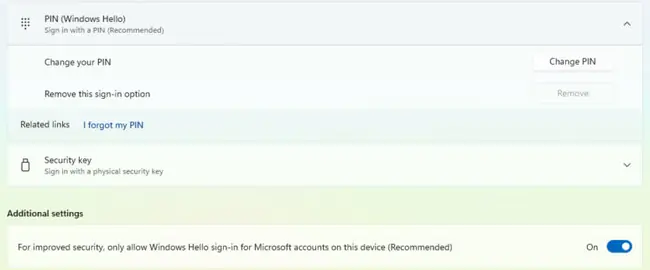
To turn off your PIN in Windows 11, open Settings > Accounts > Sign-in options, select PIN (Windows Hello), and select Remove. Confirm, then enter your account password. If Remove is grayed out, first turn off For improved security, only allow Windows Hello sign-in for Microsoft accounts on this device under Additional settings.
After that, you sign in with your password. If you just want a different PIN, see how to change your PIN on Windows 11 instead. These steps apply to Windows 11 Home and Pro with a Microsoft account or a local account.
Before You Remove the PIN
- Know your password. Windows asks for it to confirm, and you’ll use it to sign in afterward. For a Microsoft account, that’s your Microsoft account password.
- Face and fingerprint go too. Windows Hello face and fingerprint sign-in depend on the PIN, so removing it turns those off.
- Work or school PCs may require a PIN by policy. Check with IT before changing sign-in settings.
How to Remove Your PIN in Windows 11
- Press Windows + I to open Settings.
- Select Accounts, then Sign-in options.
- Under Ways to sign in, select PIN (Windows Hello) to expand it.
- Next to Remove this sign-in option, select Remove.
- Select Remove again to confirm.
- Type your account password and select OK. The PIN section now offers Set up instead of Change PIN.
- Lock the PC with Windows + L to check. The sign-in screen should ask for your password.
Microsoft’s Configure Windows Hello page explains the PIN, face, and fingerprint options on the Sign-in options page.
What to Do If the Remove Button Is Grayed Out
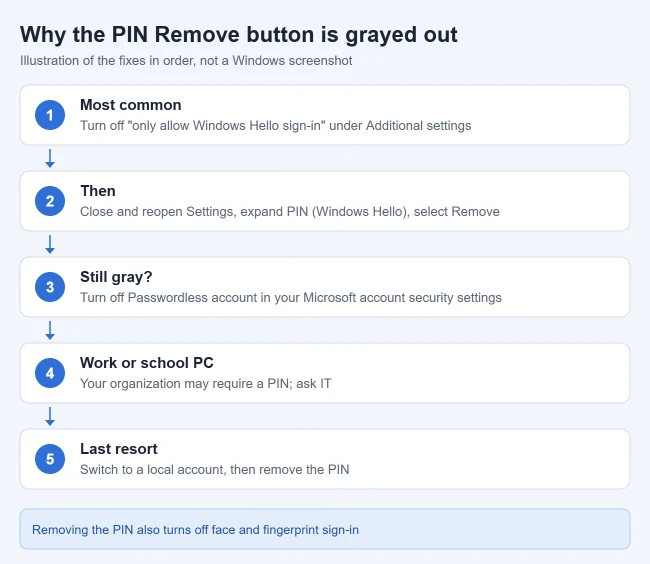
Fix 1: Turn off Windows Hello-only sign-in
This is the usual cause. Microsoft explains that with this setting on, Microsoft accounts can sign in only with Windows Hello (face, fingerprint, or PIN), not a password, so Windows won’t let you remove the PIN.
- Go to Settings > Accounts > Sign-in options.
- Scroll to Additional settings.
- Turn off For improved security, only allow Windows Hello sign-in for Microsoft accounts on this device.
- Close Settings, open it again, and go back to PIN (Windows Hello). Remove should now be clickable.
Fix 2: Turn off passwordless on your Microsoft account
If you made your Microsoft account passwordless, Windows has no password to fall back on.
- Go to Settings > Accounts > Your info and, under Related settings, select Accounts (Manage my accounts). Your browser opens your Microsoft account.
- Select Security, then Manage how I sign in.
- Under Additional security, turn Passwordless account off and follow the prompts to create a password.
- Restart the PC, then remove the PIN.
Remember the new password; you’ll need it to sign in.
Fix 3: Check for a work or school account
Open Settings > Accounts > Access work or school. If an organization account is connected, its policies can require a PIN and even force you to change it regularly. On your own PC, you can disconnect an account you no longer use. On a company PC, ask IT, since disconnecting can remove access to work apps and email.
Fix 4: Switch to a local account
As a last resort, switching to a local account also removes the Windows Hello-only requirement. Go to Settings > Accounts > Your info and select Sign in with a local account instead, if your version shows it. See how to switch to a local account in Windows 11 for the full steps and tradeoffs.
Other Problems When Removing the PIN
“This option is currently unavailable”
This message under PIN usually points to a work or school account or a device policy. Check Access work or school (Fix 3). On a company PC, the PIN requirement is set by IT.
Windows rejects your password
Use your account password, not the PIN. For a Microsoft account, that’s the password you use at account.microsoft.com. Check Caps Lock and the keyboard layout shown near the clock. If you’ve forgotten it, reset it at account.live.com/password/reset from another device, then try again.
What changes after you remove it
| With a PIN | Without a PIN | |
|---|---|---|
| Sign-in screen | Asks for the PIN | Asks for your password |
| Face and fingerprint | Available if supported | Turned off |
| Remote Desktop and other devices | PIN works only on this PC | Your password works as before |
| Files and apps | Unchanged | Unchanged |
Stop Windows Asking for a PIN After Sleep
If what bothers you is the prompt each time the PC wakes, you may not need to remove the PIN at all. In Settings > Accounts > Sign-in options, look under Additional settings for If you’ve been away, when should Windows require you to sign in again? and choose a longer time, or Never if it’s offered. Some Microsoft account setups don’t show Never. The lock screen after pressing Windows + L always asks.
Sign In Without a PIN or a Password
Removing the PIN only swaps it for your password. Skipping sign-in completely is possible on a home PC, but anyone who opens the laptop gets into your files and saved passwords. If you still want that, see how to remove the password from Windows 11. The Windows Hello-only setting must be off first.
How to Add a PIN Back Later
- Open Settings > Accounts > Sign-in options.
- Select PIN (Windows Hello), then Set up.
- Enter your password, then type and confirm a new PIN.
Setting up the PIN also lets you turn face or fingerprint sign-in back on, if your PC supports them.
To remove only face or fingerprint sign-in and keep your PIN, open Settings > Accounts > Sign-in options, expand Facial recognition (Windows Hello) or Fingerprint recognition (Windows Hello), and select Remove.
Frequently Asked Questions
Is it safe to remove my PIN?
It’s safe as long as you have a strong password. Microsoft recommends a PIN because it only works on that one device, while your Microsoft account password works anywhere. If you use passkeys in Windows 11 for websites or apps, check where they are stored before removing your PIN; locally saved Windows Hello passkeys need a working Hello verification method.
Will removing my PIN delete any files?
No. It only changes how you sign in. Your files, apps, and settings stay the same.
I forgot my PIN. Do I have to remove it?
No. On the sign-in screen, select I forgot my PIN and follow the steps to reset it. Microsoft notes this option works only for Microsoft accounts. With a local account, sign in with your password and reset the PIN in Settings.
Why does Windows say my organization requires a PIN?
That message means a work or school account is connected to the PC, and its policy sets PIN rules such as expiry. Check Access work or school as described in Fix 3. On a home PC, registry and Group Policy workarounds found online are risky and often don’t apply to Windows 11 Home.

Matthew Burleigh is the founder, head writer, and editor of Solve Your Tech, which he launched in 2012. He has written technology tutorials since 2008 and worked in IT since 2003, including small-business support, IT management, and consulting. He holds Bachelor’s and Master’s degrees in Computer Science from Arizona State University.
Matthew writes practical guides for Windows, iPhone and iPad, Microsoft Office, Outlook, Google apps, and Android. Solve Your Tech’s guides are checked step by step against the device or app maker’s own documentation and tested on his own devices whenever he has the hardware or software, with clear steps, sources, and update dates.
Read more about Matthew and how Solve Your Tech writes and updates its guides, or report a correction.