This post contains affiliate links. As an Amazon Associate, solveyourtech.com earns from qualifying purchases, at no extra cost to you.
To screen mirror an Android phone to a TV, put both on the same Wi-Fi network, swipe down twice to open Quick Settings, and tap the cast tile. It is called Screen Cast or Cast on many phones and Smart View on Samsung Galaxy phones. Pick your TV from the list. With a Chromecast, Google TV Streamer or TV with Google Cast, you can also open the Google Home app, touch and hold the TV’s tile, and tap Cast > Cast my screen.
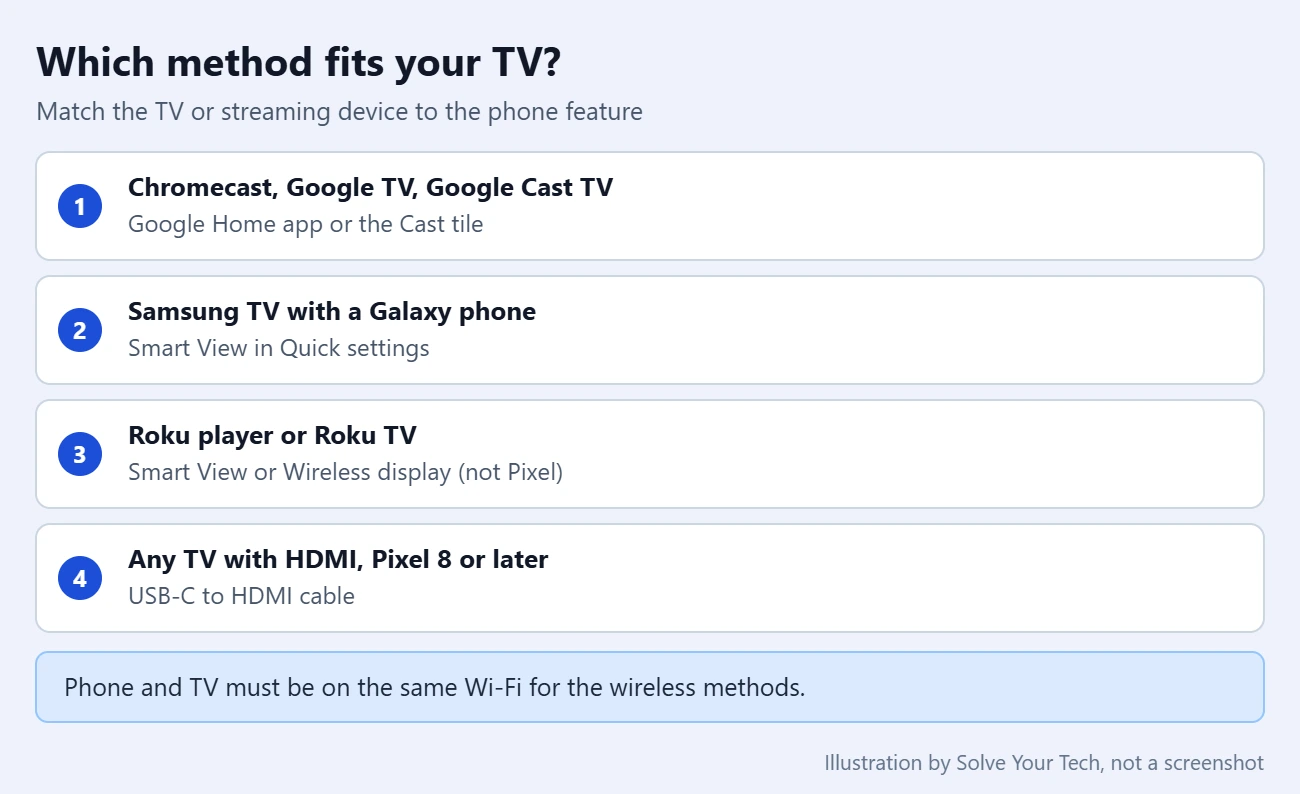
Which route works depends on the TV more than the phone. The sections below cover Google Cast devices, Samsung phones, Roku devices and a cable, each on its own, followed by how to stop mirroring and what to check when the TV does not appear.
Mirroring vs. casting: pick the right one
Screen mirroring copies everything on your phone’s display to the TV, live. Whatever you open, scroll or type shows up on the big screen, including notifications. Casting is narrower: an app with a Cast button hands one video or song to the TV, the TV plays it, and your phone becomes the remote.
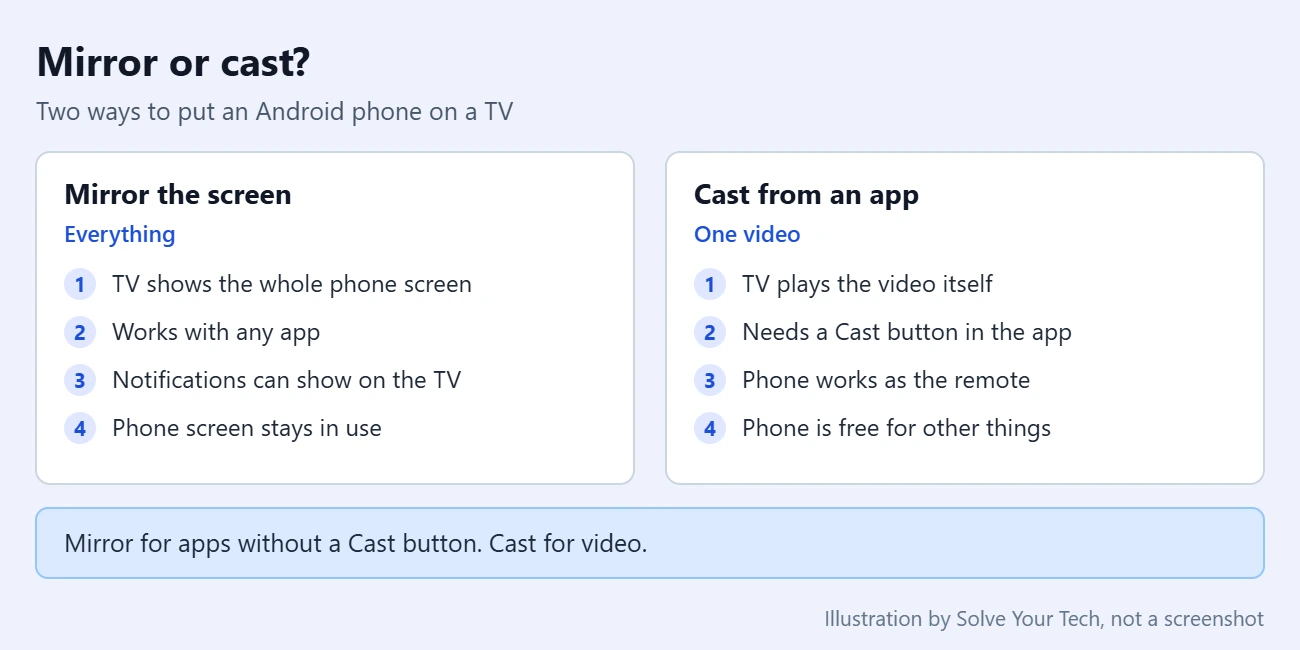
Use mirroring for things that have no Cast button, such as a photo gallery, a game, a website or a presentation. Use casting for video apps. Casting leaves your phone free for other things, and nothing else on your phone appears on the TV.
What you need before you start
- A phone on Android 8.0 or later for Google’s own mirroring feature. Google’s Cast your Android screen help page lists this as the minimum.
- The same Wi-Fi network on the phone and the TV or streaming device. A guest network or a second network in the house counts as a different network.
- A TV or streaming device that can receive the picture. That means a Chromecast, a Google TV Streamer, a TV with Google Cast, a Samsung smart TV, or a Roku player or Roku TV.
- Microphone permission for Google Play services if you use the Google Home app. Google lists it as the first step. You can check it in the phone’s Settings app under the app permissions for Google Play services.
If your TV has none of these built in, you can add Google Cast with a Google TV Streamer. It connects to your TV with an HDMI cable, which you buy separately. Our guide to whether Chromecast is discontinued explains how the Streamer replaced the older Chromecast sticks.
Mirror with the Google Home app
This is Google’s documented method for a Chromecast, a Google TV Streamer or a TV with Google Cast. The streaming device must already be set up in the Google Home app.
- Check that the phone is on the same Wi-Fi network as the TV or streaming device.
- Open the Google Home app.
- Tap Favorites or Devices.
- Touch and hold the tile for the TV or streaming device you want to use. Its control screen opens.
- Tap Cast, then Cast my screen.
- Tap Cast screen to send the whole display. To show only one app, tap Cast one app and choose the app.
Your phone’s screen should appear on the TV after a moment. Before you confirm, remember that a full-screen mirror shows everything, including incoming messages and anything you type. Casting one app keeps the rest of your phone private.
To stop, touch and hold the same tile in the Google Home app and tap Stop mirroring.
Mirror from Quick Settings or the Settings app
Quick Settings is the panel of tiles you get by swiping down from the top of the screen. Most Android phones can start mirroring from here without opening an app, but the tile name changes from one phone maker to the next.
- Swipe down from the top of the screen. Swipe down a second time to see all the tiles.
- Look for a tile named Screen Cast, Cast, Smart View or Wireless display.
- If the tile is not there, tap Edit (the pencil), scroll down to the tiles you have not added yet, and add the cast tile. Google’s Quick Settings help page covers adding and moving tiles.
- Tap the tile, then tap your TV in the list.
- Confirm on the phone, and accept the prompt on the TV if one appears.
On a Google Pixel, you can start from the Settings app instead. Google’s Project your Pixel phone’s screen page gives this path: open Settings, tap Connected devices > Connection preferences > Google Cast, choose a single app or your entire screen, then tap the device. Menu names on other brands can differ, so use the search box at the top of Settings and search for “cast” if you cannot find it.
Mirror a Samsung Galaxy phone with Smart View
Samsung’s name for screen mirroring is Smart View. It is built into the phone, so there is nothing to download. These steps follow Samsung’s screen mirroring support page.
- Turn on the TV and connect the phone to the same Wi-Fi network.
- Swipe down from the top right of the screen to open the Quick settings panel.
- Tap Smart View.
- Tap your TV under Available devices, then tap Start now.
- If the TV asks, select Allow or enter the PIN it shows.
If the picture has black bars at the sides, tap the Smart View icon on the phone, tap More options (the three dots), then Settings > Phone aspect ratio. Samsung says most TVs look best at 16:9. To stop, tap the Smart View icon and tap Disconnect.
Smart View is designed around Samsung TVs. Samsung notes that it may work differently, or not at all, with TVs from other brands.
Mirror to a Roku player or Roku TV
Roku devices receive a mirrored screen directly from the phone, with no Google Home app involved. Roku’s screen mirroring article says a phone running Android 10.0 or later likely supports it, with one big exception: Google-branded phones such as the Pixel. A Pixel cannot mirror its screen to a Roku this way.
- Connect the phone to the same network as the Roku.
- Open Quick Settings and tap your phone’s mirroring tile. Roku lists names such as Smart View, Quick Connect, SmartShare, Wireless display, Display mirroring, Screen casting and Cast.
- Tap your Roku in the list.
- On the TV, use the Roku remote to answer the prompt. Allow accepts this one session, Always allow remembers the phone, and Block or Always block refuses it.
Be careful with Always block. It tells the Roku to refuse that phone from then on, so choose it only for a device you do not recognize. To stop mirroring, press Home on the Roku remote or disconnect from the mirroring menu on the phone.
Not every Roku model supports mirroring. Roku’s article lists the few older Roku Express models that do not. If you are choosing a streaming device, see our comparison of the Fire TV Stick and Google TV Streamer.
Use a cable instead of Wi-Fi
A wired connection skips the network entirely, which helps in a hotel room or anywhere the Wi-Fi is unreliable. It only works if the phone can send video through its USB-C port, and many phones cannot.
Google documents this for the Pixel 8 and later. You need a USB-C to HDMI or USB-C to DisplayPort cable.
- Plug the HDMI or DisplayPort end into the TV.
- Plug the USB-C end into the phone.
- Tap the Mirror display dialog that appears on the phone and follow the on-screen instructions.
- Switch the TV to the HDMI input you used.
For other brands, check the phone maker’s specifications for video output over USB-C before you buy a cable or adapter. If nothing happens when you plug in, the phone most likely does not support it.
Cast just a video instead
If all you want is a show or a video on the TV, casting is usually the better choice. Google’s casting help page says it works on Android 6.0 or later with the latest version of the app.
- Connect the phone to the same Wi-Fi network as the TV.
- Open a Cast-enabled app such as YouTube or Netflix.
- Tap the Cast button, a rectangle with curved lines in one corner. Its position varies between apps.
- Tap your TV. The Cast button turns solid when you are connected.
To stop, tap the Cast button again and tap Disconnect. To save a video of your screen instead of showing it on a TV, see how to screen record on Android.
How to confirm it worked and stop mirroring
Mirroring is working when the TV shows your phone’s Home screen and follows along as you open apps.
While you are connected, the phone shows a cast notification. To end the session on any phone:
- Notification: swipe down from the top of the screen and tap Disconnect on the Cast notification.
- Google Home app: touch and hold the TV’s tile and tap Stop mirroring.
- Samsung: tap the Smart View icon and tap Disconnect.
- Roku: press Home on the Roku remote.
If your TV doesn’t show up
- Check the network on both devices. The phone and TV must be on the same Wi-Fi network, not a guest network. If your home has two networks, Google notes that an Android phone can switch between them on its own. Forgetting the second network on the phone keeps it on the right one.
- Turn off Adaptive connectivity for a moment. Google suggests switching it off in the phone’s Network & internet settings when the Cast button is missing, then turning it back on once you are connected.
- Match the method to the TV. The Google Home method only finds Google Cast devices. A Pixel will not find a Roku for screen mirroring, and Smart View may not find a TV from another brand.
- Add the missing tile. If there is no cast tile in Quick Settings, tap Edit and add it, or search the Settings app for “cast”.
- Check the TV’s own settings. Some TVs and streaming devices have a screen mirroring option that must be turned on, or a list of blocked devices. If you chose Always block on a Roku by mistake, look in the Roku’s settings for its screen mirroring options.
- Restart both devices. Turn the phone and the TV or streaming device off and on, then try again.
- Update the apps. Install any updates for Google Home and the app you are casting from in the Play Store.
Mirroring keeps the phone’s screen on, so the battery drains faster than usual. Google’s help page recommends turning on battery saver before a long session so the phone lasts.
Frequently asked questions
Why can’t I find Screen Cast on my Android phone?
The tile is probably hidden or has a different name. Swipe down twice, tap Edit, and look through the tiles you have not added. On a Samsung phone look for Smart View. On a Pixel, the setting lives at Settings > Connected devices > Connection preferences > Google Cast.
Can I mirror my Android phone to a TV without Wi-Fi?
The Google Home, Quick Settings and Smart View methods in this guide all need the phone and TV on the same network. Without Wi-Fi, the dependable option is a cable, and only on phones that support video output over USB-C, such as the Pixel 8 and later.
Can I use my phone for something else while it is mirrored?
Not privately. A full-screen mirror shows whatever you do. To keep using your phone, cast a single app from the Google Home app or use the Cast button inside a video app, which lets the TV play the video on its own.
Can a Google Pixel mirror to a Roku?
Not with Roku’s built-in screen mirroring. Roku’s support article excludes Google-branded phones. You can still use the Cast button in apps that list the Roku as a device, or mirror a Pixel to a Google Cast device instead.
Next step
Start with the Quick Settings tile, since it takes two taps. If your TV is not in the list, use the method that matches your TV from the sections above. For other devices, see how to screen mirror an iPad or iPhone to a TV, how to cast a laptop to a TV in Windows 11, or how to cast a Chrome tab to a Chromecast from a Mac.

Matthew Burleigh is the founder, head writer, and editor of Solve Your Tech, which he launched in 2012. He has written technology tutorials since 2008 and worked in IT since 2003, including small-business support, IT management, and consulting. He holds Bachelor’s and Master’s degrees in Computer Science from Arizona State University.
Matthew writes practical guides for Windows, iPhone and iPad, Microsoft Office, Outlook, Google apps, and Android. Solve Your Tech’s guides are tested on current devices or checked against official product documentation, with clear steps, sources, and update dates.
Read more about Matthew and how Solve Your Tech writes and updates its guides, or report a correction.