To dry an iPhone, unplug any cable, wipe the outside with a soft lint-free cloth, tap the phone gently against your hand with the charging port facing down, and leave it in a dry spot with some airflow. Don’t charge through the port until it’s completely dry, and skip rice, heat and compressed air.
The phone slipped into the sink, came out of a rain-soaked bag, or showed a liquid alert when you plugged in the charger. Here’s what Apple recommends for the whole phone and the charging port.
First Steps When Your iPhone Gets Wet
Speed matters less than doing the right things in the right order. Work through these before you think about charging.
- Unplug everything. Disconnect the charging cable at both ends, and remove any accessory plugged into the port. Apple says not to charge or connect accessories while the connector is wet.
- Take off the case. Water trapped between a case and the phone keeps the frame and buttons wet much longer.
- Turn the iPhone off if it’s been submerged. Apple doesn’t require this for a splash or a liquid alert, but switching off a phone that went fully underwater is a sensible precaution while it dries. On models with Face ID, press and hold the side button and either volume button until the sliders appear, then drag the top slider. On iPhone SE, press and hold the side button, then drag the slider. You can also go to Settings > General > Shut Down. For model-specific buttons, see turning off or force restarting an iPhone.
- Wipe the outside. Use a soft, lint-free cloth (a microfiber glasses cloth works) to dry the screen, back, buttons and speaker grilles.
- Leave the SIM tray closed. Apple’s handling guidance says to make sure the iPhone is dry before you open the SIM tray. Opening it while wet gives water a path inside.
If the liquid was anything other than clean water, there’s an extra step in the section on salt water, soap and drinks below.
How to Dry the iPhone Charging Port
The charging port (Lightning on older models, USB-C on iPhone 15 and later) holds water in a narrow space, which is why it’s usually the last part to dry. Apple’s page on the liquid-detection alert gives these steps:
- Hold the iPhone with the charging port facing down.
- Tap the phone gently against the palm of your other hand to shake out excess liquid. Gentle is the key word; you’re tapping out drops, not shaking hard.
- Set the iPhone down in a dry area with some airflow. A table near an open window or in a room with a running ceiling fan works well.
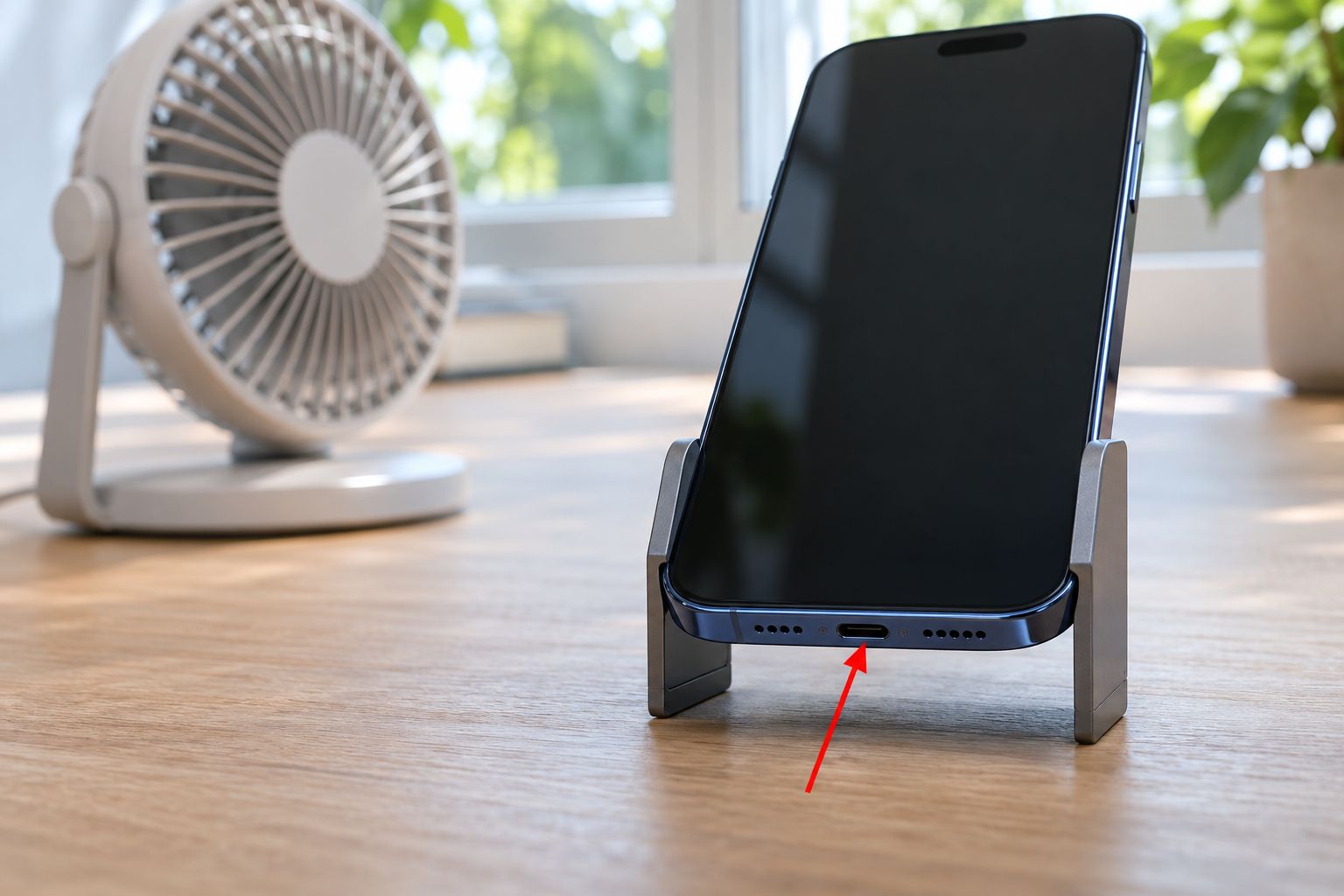
- Wait at least 30 minutes, then try charging with a Lightning or USB-C cable, or connecting an accessory.
- If the alert appears again, there’s still liquid in the port or under the pins. Leave the iPhone in the dry, airy spot for up to a day, retrying now and then. Apple notes it can take up to 24 hours for the port to dry completely.
Apple’s iPhone handling and water resistance guidance adds that pointing a fan blowing cool air directly into the connector may help. Keep it to cool air from a regular fan. A hair dryer, even on a “cool” setting, is a different matter (see the list of things to avoid).
Don’t put anything in the port
Apple specifically says not to insert a foreign object, such as a cotton swab or a paper towel, into the connector. Toothpicks, tissue corners and paper clips belong in the same category. They can push water deeper, leave fibers behind, or bend the contacts. The same goes for a charger tip that snaps off inside a port, where metal tools can short the contacts, as explained in how to get a broken charger out of an iPad.
What the Liquid-Detection Alert Means
On iPhone XS, iPhone XS Max, iPhone XR and later, the iPhone can sense liquid in the charging port and stop charging to protect it. When that happens, you’ll see one of these alerts:
| Alert | When Apple says it appears |
|---|---|
| Charging not available | You connect an iPhone with a Lightning connector to a charger and liquid is detected |
| Liquid Detected in USB-C Connector | You connect an accessory or charger with a USB-C to USB-A cable and liquid is detected (Apple says to disconnect the cable immediately) |
| Liquid detected in Lightning Connector | You connect a Lightning accessory that doesn’t charge the iPhone and liquid is detected |
| Liquid Detected | You connect a USB-C accessory and liquid is detected |
The alert means the port is turned off for charging and accessories until it’s dry. Apple explains why: charging while the pins or cable are wet can corrode them, which can cause permanent damage or connection problems. Tapping out the liquid and waiting, as described above, is the fix.
Wireless charging while you wait
If you need power and your iPhone supports wireless charging, you can usually use a MagSafe or Qi-certified charger while the port dries. Dry the back of the phone completely with a lint-free cloth first. More on how wireless charging works on iPhone is in iPhone wireless charging and power sharing.
Overriding the Alert in an Emergency
When you reconnect the cable, your iPhone gives you the option to override liquid detection and charge anyway. Use it only in a genuine emergency, such as needing to make a call with a nearly dead battery and no wireless charger. Overriding the warning means charging with liquid in the port, which is exactly the situation that can corrode the pins.
How Long to Wait Before Charging
Apple’s pages give two different times, and each fits a different situation:
- The liquid-detection alert page says to try again after at least 30 minutes, and to allow up to a day if the alert keeps coming back. That’s the guidance for a port that got wet and a phone that’s telling you so.
- The handling and water resistance page says to allow at least 5 hours before charging or connecting a Lightning or USB-C accessory after the iPhone has been exposed to liquid.
In practice, the two fit together. The 30-minute check tells you whether the port is still wet when the alert has appeared; the handling page’s 5-hour minimum applies any time the iPhone has been exposed to liquid, splash or soak. If you can, wait the full 5 hours before using the port, and use wireless charging in the meantime.
The phone is dry but still won’t charge
Apple suggests unplugging the cable from the power adapter, unplugging the adapter from the wall, and then connecting everything again. If it still won’t charge, try a different cable and adapter before deciding the port is damaged.
What Not to Do
Many of the popular tricks for a wet phone are on Apple’s list of things to avoid.
- Don’t put the iPhone in a bag of rice. Apple says this can let small particles of rice damage the iPhone. Apple’s advice is a dry area with some airflow instead.
- Don’t use an external heat source. That includes hair dryers, ovens, radiators and leaving the phone on a sunny dashboard. Apple notes that iPhone can be damaged and battery life shortened when it’s stored or used outside its temperature range.
- Don’t use compressed air. Apple lists it alongside heat as a drying method not to use, and a strong blast can push water deeper.
- Don’t insert cotton swabs, paper towels or other objects into the charging port.
- Don’t use alcohol or cleaning products in or near the port. Apple’s handling page says to clean the connector with a soft, dry, lint-free cloth and no liquids.
- Don’t keep plugging the cable in to “test” it. Every attempt with liquid present risks the pins. Wait the recommended time between tries.
Silica gel packets come up a lot in advice online. Apple doesn’t mention them; what Apple recommends is a dry room with airflow, which works without any extra supplies.
If It Went Fully Underwater or Got Hit With Something Other Than Water
Salt water, pool water, soap and drinks
Apple’s handling page tells you to minimize contact with liquids such as salt water, soapy water, pool water, sunscreen and lotion, and to clean the iPhone if it touches one of them. Disconnect all cables and turn off the phone, then wipe it with a soft, slightly damp, lint-free cloth. Avoid getting moisture in openings, and don’t use cleaning products or compressed air. After that, dry the port as described above.
Picture a beach day where the phone gets knocked into a wave: the salt will dry into a crust on the speaker grille and the port if it’s left alone, so the wipe with a slightly damp, lint-free cloth matters more than with a splash from the kitchen tap.
Muffled speakers or microphone
Water sitting in the speaker or microphone openings can make calls sound muffled. Place the iPhone speaker-side down on a lint-free cloth and let it drain and dry. If the sound is still poor after the phone is fully dry, the tips in fixing an iPhone you can’t hear unless it’s on speaker are worth a look.
What water resistance does and doesn’t mean
Apple’s page on iPhone splash, water and dust resistance explains that iPhone 7 and later models are rated IP67 or IP68 under IEC standard 60529, depending on the model. Those ratings come from controlled lab tests, and resistance isn’t permanent: it can decrease as a result of normal wear. Apple also advises against swimming or bathing with an iPhone, exposing it to pressurized or high-velocity water (showering, water skiing, surfing), and using it in a sauna or steam room.
When to Contact Apple Support
Drying works most of the time, but some signs point to a problem drying won’t solve:
- The liquid alert still appears after a full day of drying.
- You get the alert every time you use one particular cable or accessory, even though the phone is dry. Apple says the cable or accessory may be damaged; contact its maker, or get service if it’s an Apple cable.
- The phone won’t turn on, or it behaves oddly after getting wet (for example, the screen, sound or camera doesn’t work properly).
Apple’s warranty doesn’t cover liquid damage. Per Apple’s page on liquid damage and Liquid Contact Indicators, iPhones have indicators that are usually white or silver and turn red after contact with water or a liquid containing water. Humidity and temperature changes within the phone’s operating range don’t trip them. You may still have rights under consumer law, so ask Apple or an Apple Authorized Service Provider to inspect the phone. Before any repair, make sure your data is safe; if the phone needs to be replaced, restoring an iPhone from a backup gets your data onto the new one.
After the Phone Gets Wet
Can I charge my iPhone if it says liquid detected?
Not through the port, unless you override the alert in a real emergency. Wireless charging is the safer way to get power while the port dries, once the back of the phone is dry.
Why do I get the liquid alert when the phone is completely dry?
Liquid can stay trapped under the pins after the outside looks dry, so give it more time first. If the alert appears every time with the same cable or accessory, that accessory may be faulty. Try a different, known-good cable.
Is it safe to use my iPhone while it’s drying?
For a splash or a port alert, you can generally keep using the phone; only the port is out of action. For a phone that went fully underwater, keeping it off while it dries is the cautious approach, since you can’t see whether liquid got inside.
Does rice or a sealed bag of silica gel speed things up?
Apple advises against rice, and it doesn’t list silica gel. A dry room with airflow and a cool fan is what Apple recommends.
My iPhone works after drying. Should I still worry?
Keep an eye on charging, sound and the camera for a few days. Corrosion can show up later as charging problems. If anything changes, contact Apple Support with the date the phone got wet.
Unplug the phone now, tap the port dry, set it near some airflow and give it time. If the alert is still there tomorrow, that’s the point to book an inspection.

Matthew Burleigh is the founder, head writer, and editor of Solve Your Tech, which he launched in 2012. He has written technology tutorials since 2008 and worked in IT since 2003, including small-business support, IT management, and consulting. He holds Bachelor’s and Master’s degrees in Computer Science from Arizona State University.
Matthew writes practical guides for Windows, iPhone and iPad, Microsoft Office, Outlook, Google apps, and Android. Solve Your Tech’s guides are checked step by step against the device or app maker’s own documentation and tested on his own devices whenever he has the hardware or software, with clear steps, sources, and update dates.
Read more about Matthew and how Solve Your Tech writes and updates its guides, or report a correction.