To create a local account on Windows 11, open Settings > Accounts > Other users, select Add account, then select “I don’t have this person’s sign-in information” and “Add a user without a Microsoft account.” Enter a user name, password, and security questions, then select Next. You need to be signed in as an administrator.
A local account exists only on this PC and signs in with a user name instead of an email address. It’s useful for a family member, a guest, or a second account for testing. For a visitor login specifically, there are separate steps for creating a guest account in Windows 11.
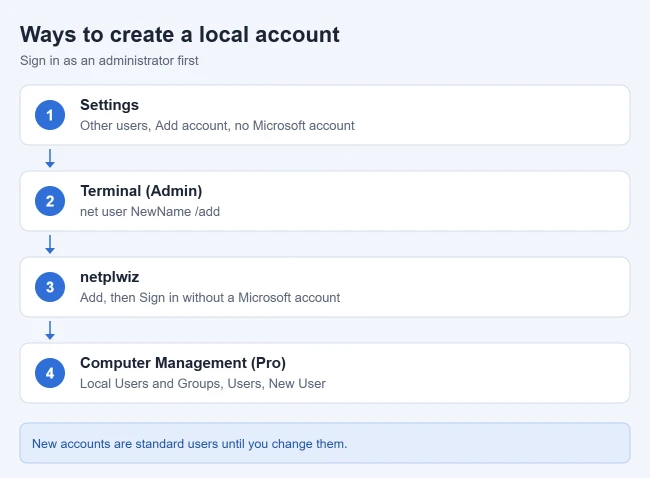
Create a Local Account in Settings
- Press Windows key + I to open Settings.
- Select Accounts, then Other users. On some versions this page is called Family & other users.
- Select Add account next to Add other user.
- In the Microsoft account window, select I don’t have this person’s sign-in information.
- Select Add a user without a Microsoft account.
- Type a user name. Add a password if you want one, then type it again.
- Pick three security questions and answer them. Windows uses these if you forget the password. That reset, along with finding a forgotten user name, is explained in finding your username and resetting a password in Windows 11.
- Select Next.
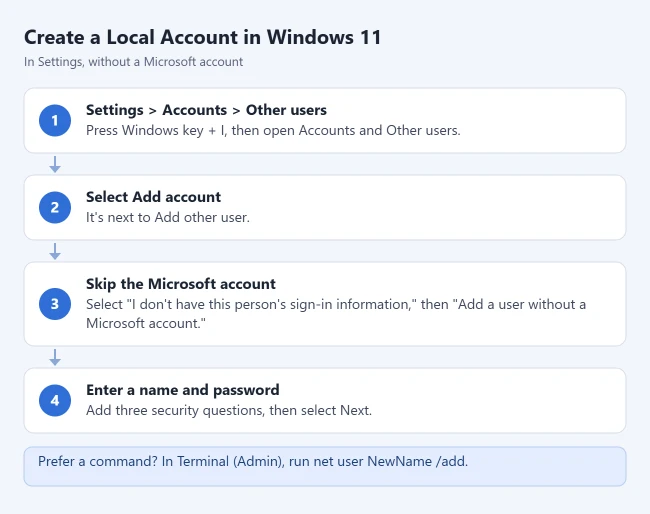
These are the steps in Microsoft’s guide to managing user accounts. The new account appears under Other users. It’s a standard account unless you change it. You can give the account administrator rights if it needs full control of the PC.
The new user can pick a different password later with these steps to change your password on Windows 11.
Other PCs can use this account to open your shared folders; here is how to enter network credentials in Windows.
Create a Local Account With a Command
- Right-click the Start button and select Terminal (Admin). Select Yes if Windows asks.
- Run this command, replacing NewName with the user name you want:
net user NewName /add- To set a password, run the next command, then type the password twice. The password doesn’t show as you type.
net user NewName *In PowerShell, New-LocalUser does the same job, as described in Microsoft’s New-LocalUser reference.
Create a Local Account With netplwiz
- Press Windows key + R, type netplwiz, and press Enter.
- Select Add.
- Select Sign in without a Microsoft account (not recommended), then Local account.
- Enter a user name, password, and password hint, then select Next and Finish.
Create a Local Account in Computer Management (Pro)
- Right-click Start and select Computer Management.
- Open Local Users and Groups > Users.
- Right-click an empty area and select New User.
- Fill in the user name and password, choose the password options, and select Create.
Local Users and Groups isn’t available in Windows 11 Home, so use one of the other methods there.
Want to Turn Your Own Account Into a Local Account?
These steps add a second account. Converting the account you’re signed in with from a Microsoft account to a local one is a separate process: switching to a local account in Windows 11.
You can switch users in Windows 11 to move between the accounts without signing out.
A local account is also the bridge you use to change the Microsoft account on Windows 11 on your existing profile.
What about during Windows setup?
Recent versions of Windows 11 setup push you to sign in with a Microsoft account. The simplest route is to finish setup with one, then add a local account or switch to one using the steps in this guide.
Create or Choose a Standard User Account
New local accounts are standard accounts by default. To change an existing account’s type, sign in as an administrator, open Settings > Accounts > Other users, select the account, and choose Change account type. Keep at least one administrator account you can sign in to. Microsoft’s account-management guide covers this setting.
To also block installers downloaded from the web on a child’s PC, set Windows to only allow Microsoft Store apps.
Disable a Local Account Without Deleting It
On Windows 11 Pro:
- Right-click Start > Computer Management.
- Open Local Users and Groups > Users.
- Right-click the account and select Properties.
- Check Account is disabled and select OK.
Clear the box to turn the account back on. Don’t disable the only administrator account you can use. Windows 11 Home doesn’t include this tool, so use the command below.
On any edition, open Terminal (Admin) and run net user “ExactName” /active:no, replacing ExactName with the account name shown by net user. Run net user “ExactName” /active:yes to turn it back on. Microsoft documents the net user syntax. Disabling an account keeps its files and profile.
Frequently Asked Questions
What’s the difference between a local account and a Microsoft account?
A local account only exists on this PC. A Microsoft account signs you in with an email address and can sync settings, OneDrive files, and Store purchases across devices.
Can a local account be an administrator?
Yes. Select the account in Settings > Accounts > Other users, choose Change account type, and pick Administrator.
Why don’t I see Add account?
Only administrators can add accounts. On a work or school PC, your organization may also block it. If a family group is limiting an account, turn off Microsoft Family Safety.
How do I delete a local account?
Sign in with an administrator account, open Settings > Accounts > Other users, select the account, and choose Remove. The full steps are in how to delete a user profile in Windows 11. Windows warns you that this deletes the account’s files. There is more on removing accounts from Windows 11 as well.
Setting up a new PC? Here’s whether you can skip the Microsoft account sign-in on Windows 11.
Using a work or school network instead? Here’s how to join a domain in Windows 11.

Matthew Burleigh is the founder, head writer, and editor of Solve Your Tech, which he launched in 2012. He has written technology tutorials since 2008 and worked in IT since 2003, including small-business support, IT management, and consulting. He holds Bachelor’s and Master’s degrees in Computer Science from Arizona State University.
Matthew writes practical guides for Windows, iPhone and iPad, Microsoft Office, Outlook, Google apps, and Android. Solve Your Tech’s guides are checked step by step against the device or app maker’s own documentation and tested on his own devices whenever he has the hardware or software, with clear steps, sources, and update dates.
Read more about Matthew and how Solve Your Tech writes and updates its guides, or report a correction.