To change the brightness of a second monitor in Windows 11, open Settings > System > Display, select the monitor at the top of the page, and move the Brightness slider. Windows only shows that slider for displays that let it control brightness, so for most external monitors you’ll use the monitor’s own buttons or a free app such as Microsoft PowerToys.
These steps are for Windows 11 with a laptop or desktop and one or more external monitors, checked against Microsoft’s support pages in October 2026.
Which Method Should You Use?
| Method | Works on | Changes the real backlight? | Best for |
|---|---|---|---|
| Brightness slider in Settings | Monitors that report brightness control to Windows | Yes | A quick change when the slider is there |
| Monitor buttons | Every monitor with an on-screen menu | Yes | Any setup, no software needed |
| PowerToys Power Display or a similar app | Monitors with DDC/CI turned on | Yes | Changing brightness often, or several screens at once |
| Graphics control panel | Any monitor on that graphics card | No, it adjusts the picture signal | Monitors with no buttons and no DDC/CI |
Use the Brightness Slider in Settings
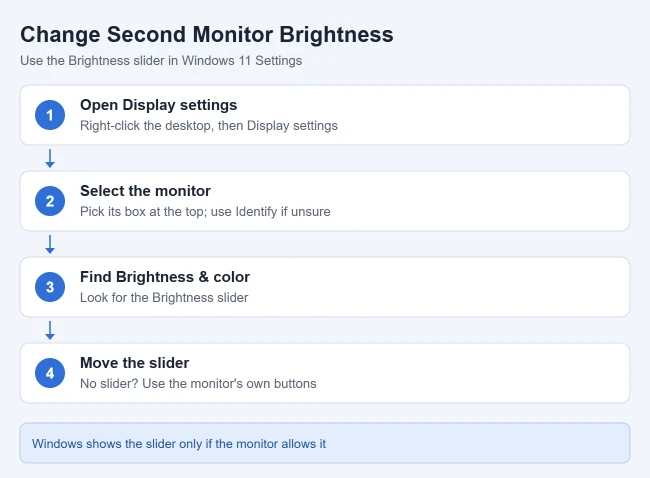
- Right-click the desktop and select Display settings. You can also press Windows key + I and go to System > Display.
- At the top of the page, select the numbered box for your second monitor. Select Identify if you aren’t sure which number it is, and each screen shows its number for a few seconds.
- Look for Brightness under Brightness & color and move the slider.
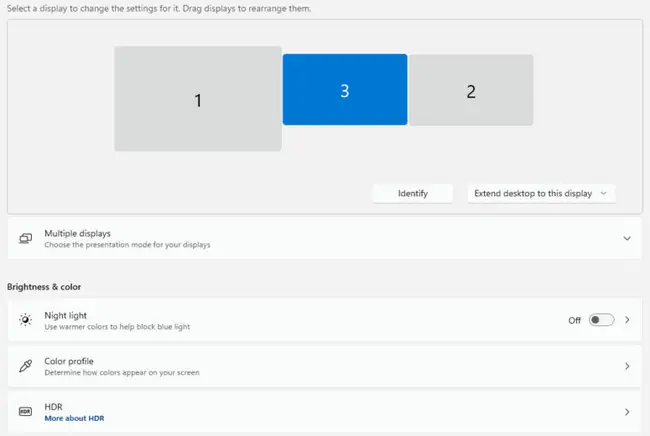
In the screenshot above, an external monitor (3) is selected, and Windows shows no Brightness slider for it. That means the monitor doesn’t let Windows control its brightness, so use one of the options below. Microsoft’s brightness and color guide notes that desktop PCs with an external monitor might not show the slider.
If the slider is there, the second monitor dims or brightens as you drag it, and the other screens stay the same.
Use the Monitor’s Buttons
This works on every monitor, and it’s what Microsoft recommends when the slider is missing.
- Press the menu button on the monitor. It’s usually on the bottom edge, side, or back, and on many newer monitors it’s a small joystick.
- Find Brightness, often inside a Picture or Display menu.
- Adjust it with the monitor’s arrow or joystick buttons, then close the menu.
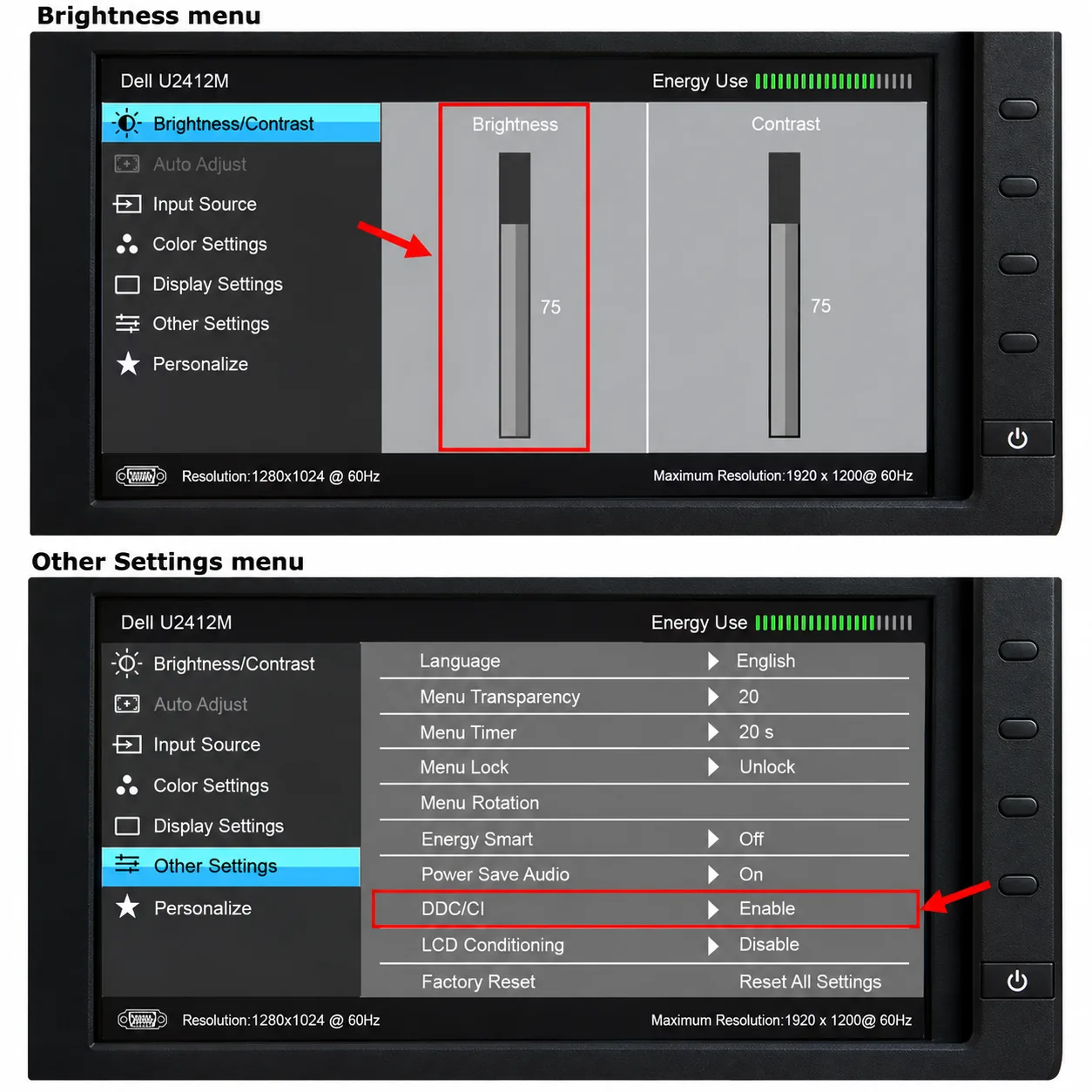
The change is saved in the monitor itself, so it stays the same no matter which PC or input you connect. While you’re in the menu, look for a DDC/CI option (often under Setup, System, or Other) and turn it on if you want to use an app later. If the monitor is in an Eco, Power saving, or Dynamic contrast mode, the brightness control may be locked or limited until you switch to a Standard or User picture mode.
If both monitors have built-in speakers, you can also play sound through two outputs at once.
Use an App for External Monitors
DDC/CI (Display Data Channel Command Interface) is a standard that lets your PC send commands, like brightness changes, to the monitor over the same video cable. Microsoft’s free PowerToys app includes Power Display, which uses DDC/CI to change the real brightness of external monitors.
Before you turn it on, be aware that Power Display can trigger a Windows crash (a blue screen) on some monitors that report malformed capability data. If that happens, Power Display turns itself off the next time it starts and adds that monitor to an exclusion list.
To set up Power Display, per Microsoft’s Power Display guide:
- Install Microsoft PowerToys and open PowerToys Settings.
- Turn on Power Display and confirm the warning.
- Press the activation shortcut, or select Open Power Display in Settings, to open the flyout.
- Move the brightness slider for the monitor you want to change.
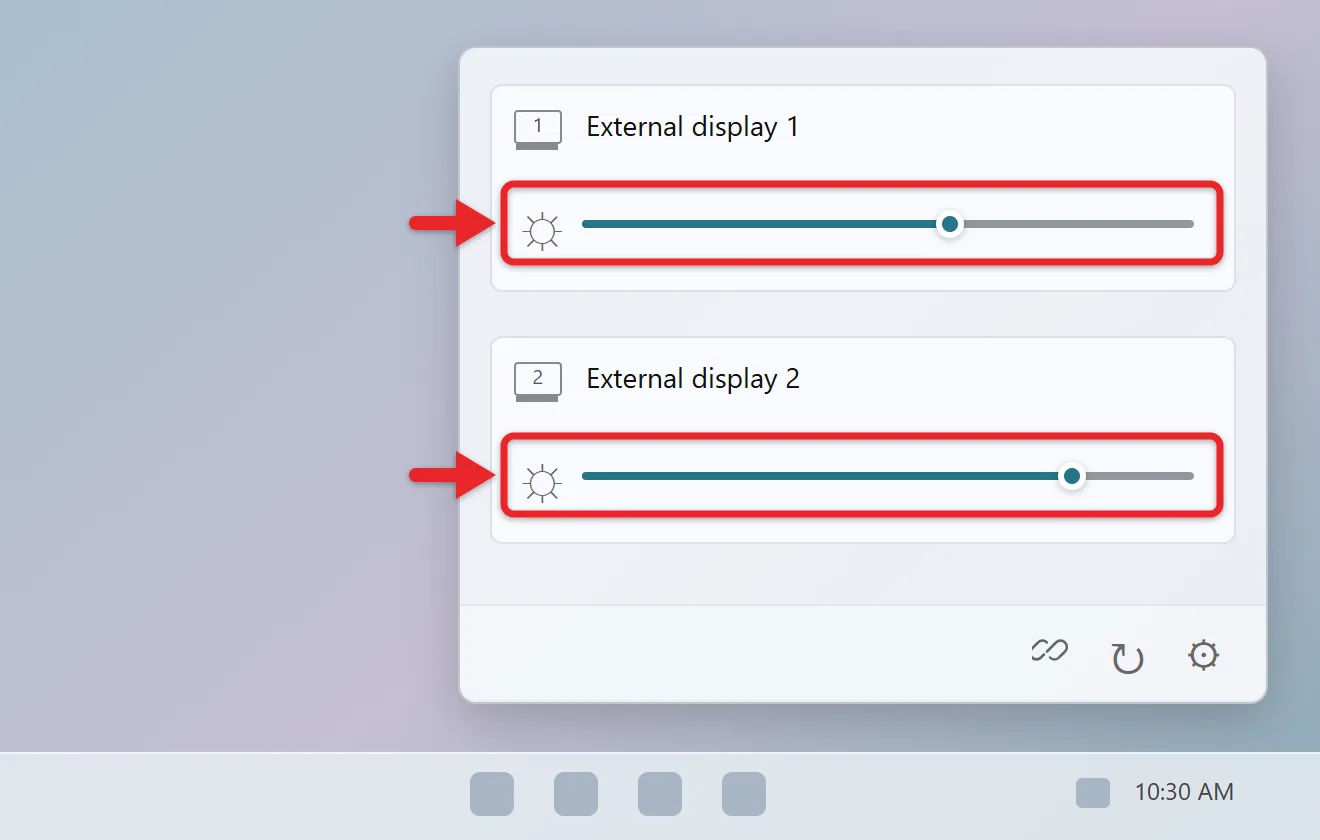
The flyout lists each connected DDC/CI monitor. If at least two support brightness, a Link brightness levels option replaces the separate sliders with one All displays slider, and you can keep a monitor separate with Exclude from linked brightness. You can also save settings as profiles, or set the tray icon so the mouse wheel changes brightness. Depending on what your monitor reports, Power Display can also change contrast, volume, input source and color temperature.
Other DDC/CI apps do the same job. Twinkle Tray and Monitorian, both in the Microsoft Store, add a brightness slider for each monitor to the taskbar tray, and some monitor makers offer their own utilities, such as Dell Display Manager or LG OnScreen Control, for their models. Download these only from the Microsoft Store or the maker’s site.
Use Your Graphics Control Panel
If your monitor has no buttons you can reach and doesn’t support DDC/CI, the graphics driver can brighten or darken the picture it sends. This changes the image, not the backlight, so a dim monitor won’t get truly brighter and dark scenes can look washed out.
- NVIDIA: Open NVIDIA Control Panel, select Adjust desktop color settings under Display, pick the monitor, select Use NVIDIA settings, and move the Brightness slider, per NVIDIA’s help page.
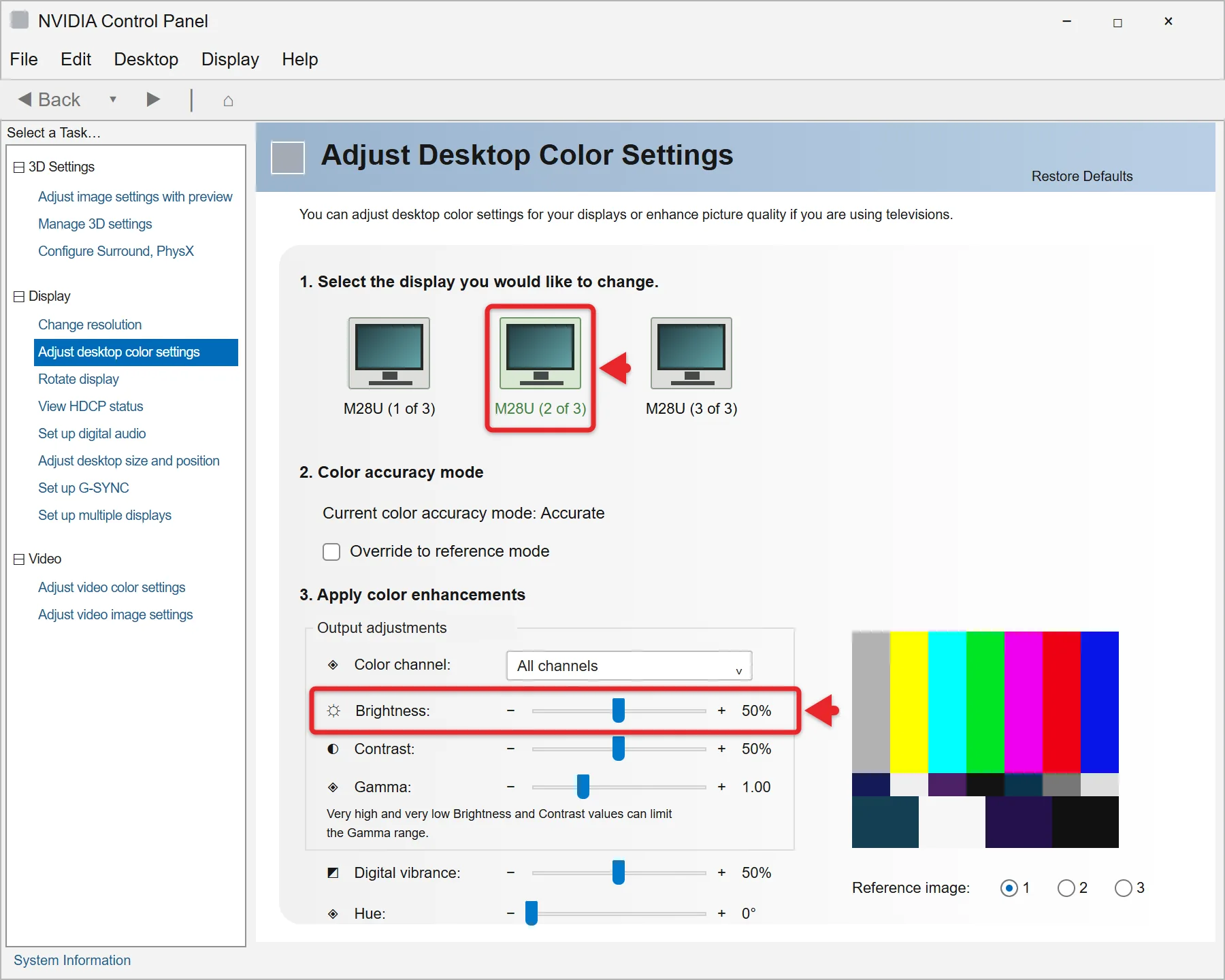
- AMD: Open AMD Software: Adrenalin Edition, go to Display, select the monitor, turn on Custom Color, and adjust Brightness, per AMD’s Custom Color article.
- Intel: Intel’s graphics app has similar color controls for each display.
If Your Second Monitor Supports HDR
With HDR turned on, Windows adds a separate setting for everyday content. Per Microsoft’s HDR guide:
- Go to Settings > System > Display and select the HDR monitor at the top.
- Select HDR.
- Drag the SDR content brightness slider.
On an external HDR display, this changes how bright regular (SDR) content looks compared with HDR content. Moving the Settings window onto that monitor while you adjust it lets you see the change. Desktop windows and apps on the HDR monitor look brighter or dimmer without changing HDR video.
Troubleshooting
The app doesn’t find my monitor. Turn on DDC/CI in the monitor’s menu, then restart the app. If the monitor connects through a dock, adapter, or switch box, try a direct HDMI or DisplayPort cable, since some of these don’t pass DDC/CI commands. In Power Display, raising Monitor refresh delay helps with monitors that aren’t detected after you plug them in.
Brightness keeps changing on its own. That’s usually the laptop screen, not the external monitor. In Settings > System > Display > Brightness, turn off the automatic lighting option and set Change brightness based on content to Off. Also check the monitor’s own menu for an automatic brightness or eco sensor.
Night light is grayed out. Update your display driver; Night light isn’t available with DisplayLink or Basic Display drivers, which some USB docks use.
Settings look wrong after experimenting. Use the monitor’s Factory reset or Reset option in its menu, turn off Custom Color in AMD Software or select Other applications control color settings in NVIDIA Control Panel, or apply a saved Power Display profile. For scaling or resolution problems, follow the steps for resetting display settings in Windows 11.
Frequently Asked Questions
Why does the brightness slider only change my laptop screen?
The slider in Quick Settings and your laptop’s brightness keys only control the built-in display. External monitors need Display settings, their own buttons, or an app. For the built-in screen, follow the steps to adjust brightness in Windows 11, or make it even dimmer.
Can Night light work on the second monitor?
Usually. Night light, in Settings > System > Display, applies a warmer color to your connected displays, though setups using DisplayLink or Basic Display drivers don’t support it. It changes color, not brightness.
Why is my second monitor dimmer than my laptop?
The two screens have different panels, maximum brightness and settings. Adjust each one separately until they look similar, and check whether the monitor is in an eco picture mode. To fine-tune color as well, follow the steps for changing monitor color in Windows 11.
Can I make both monitors the same brightness at once?
Yes, if both support DDC/CI. In PowerToys Power Display, turn on Link brightness levels to control them with one slider. To match their size and layout too, read about adjusting screen size on a second monitor.
Is it safe to turn on DDC/CI?
Yes. It’s a standard monitor feature, and you can turn it off again in the monitor’s menu. The main documented risk is with Power Display on monitors that report bad data, which can crash Windows once before Power Display blocks that monitor.

Matthew Burleigh is the founder, head writer, and editor of Solve Your Tech, which he launched in 2012. He has written technology tutorials since 2008 and worked in IT since 2003, including small-business support, IT management, and consulting. He holds Bachelor’s and Master’s degrees in Computer Science from Arizona State University.
Matthew writes practical guides for Windows, iPhone and iPad, Microsoft Office, Outlook, Google apps, and Android. Solve Your Tech’s guides are checked step by step against the device or app maker’s own documentation and tested on his own devices whenever he has the hardware or software, with clear steps, sources, and update dates.
Read more about Matthew and how Solve Your Tech writes and updates its guides, or report a correction.