To add a printer to a Mac, connect the printer by USB or to the same Wi-Fi network as your Mac, then open Apple menu > System Settings > Printers & Scanners and click Add Printer, Scanner, or Fax. Select the printer in the list, check the software shown next to Use, and click Add.
That route covers most home printers. The rest of this guide explains what to prepare first, each connection type on its own, the older System Preferences path, and what to do when the printer does not show up. The steps were checked against Apple’s Mac User Guide on October 5, 2026.
What You Need Before You Start
These steps apply to Macs that use System Settings, which means macOS Ventura 13 and later, including the current release. Macs on macOS Monterey 12 or earlier use System Preferences instead, and that path has its own section below.
- A printer that is ready to print. Apple’s instructions start with the printer itself: install ink or toner, load paper, turn it on, and clear any error on its display.
- A connection. For wireless printing, the printer and the Mac must be on the same Wi-Fi network. For a wired setup you need the right USB cable, and possibly an adapter if your Mac only has USB-C ports.
- The printer’s exact model number. You will need it if you have to download software from the manufacturer or check whether the model supports your macOS version.
- Up-to-date software. Apple suggests installing macOS updates in System Settings > General > Software Update and asking the printer maker whether updates exist for your model.
One term comes up throughout: AirPrint. It is Apple’s printing technology that lets a Mac, iPhone or iPad print without a driver, which is the software a computer normally needs to talk to a printer. Apple says AirPrint is built into most popular printer models, and its About AirPrint page links to a search tool where you can look up yours.
Add a Printer in System Settings
Use these steps for a Wi-Fi, network or USB printer once it is powered on and connected.
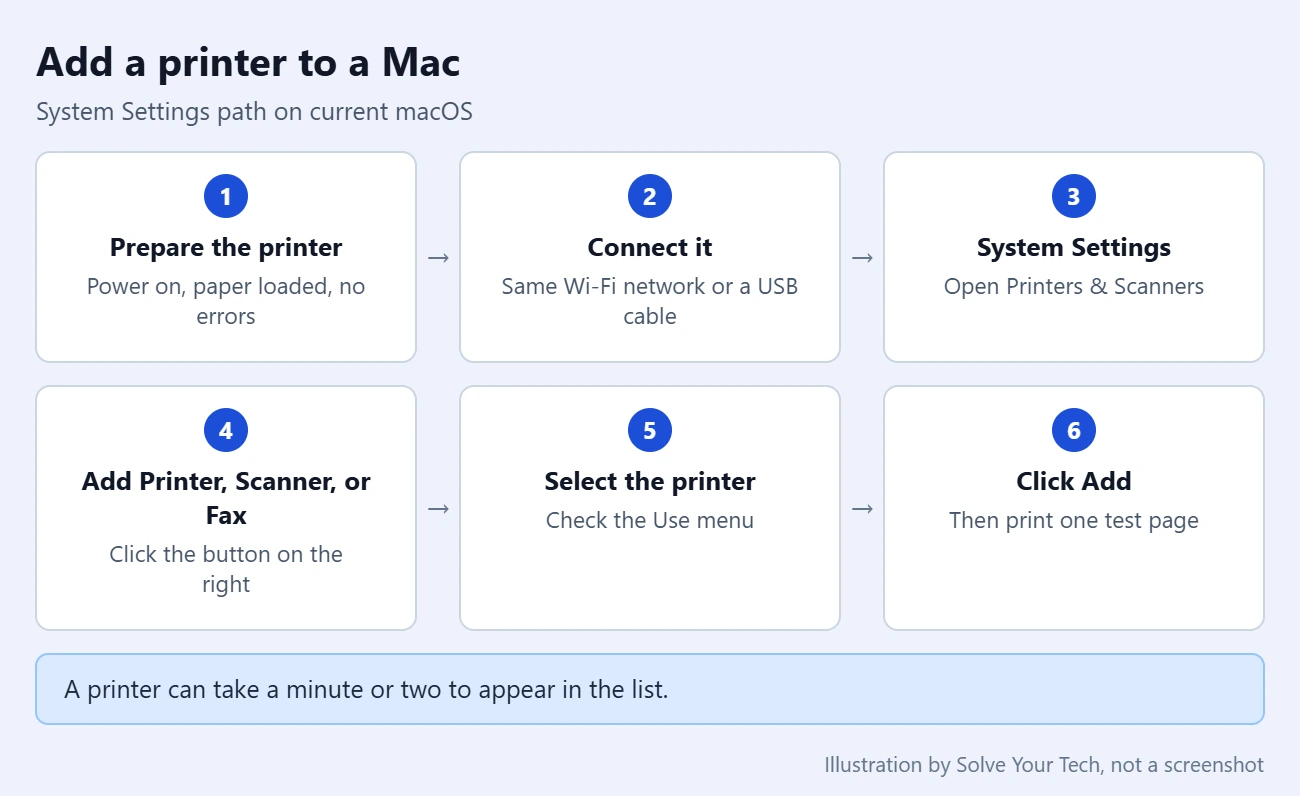
- Click the Apple menu in the top-left corner of the screen and choose System Settings.
- Click Printers & Scanners in the sidebar. You may need to scroll down to find it. Printers that are already set up appear in the Printers list on the right.
- Click Add Printer, Scanner, or Fax. A window opens and lists the printers your Mac can find. Apple notes that a printer can take a minute or two to appear.
- Select your printer. If several similar names are listed, compare the model name and connection type so you pick the right one.
- Look at the Use menu. It shows the software your Mac plans to use for this printer. For an AirPrint printer it shows AirPrint. If nothing suitable is shown, choose Select Software and pick your model from the list.
- Click Add. If a message asks you to download new software, allow it to download and install.
If macOS cannot tell which accessories the printer has, such as an extra paper tray or a duplex unit for two-sided printing, a dialog asks you to specify them. Set these to match the real hardware so the options appear when you print.
Apple’s full instructions are in Add and manage printers on Mac.
A Shortcut for AirPrint Printers
An AirPrint printer on the same Wi-Fi network may not need any setup in System Settings. Open a document, choose File > Print, click the Printer pop-up menu and choose the printer. If it is not listed, choose Add Printer from that same menu.
Connect a Wi-Fi Printer
Your Mac can only find a wireless printer after the printer has joined your Wi-Fi network. That part happens on the printer, not on the Mac, and the method depends on the model. Apple describes the common ones in Connect an AirPrint printer to a Wi-Fi network:
- Built-in display. Printers with a touchscreen or control panel usually let you pick your network name and type the password there.
- USB first, then Wi-Fi. Some printers are connected to the Mac by USB so the manufacturer’s setup assistant can pass along the Wi-Fi details. Afterward you unplug the cable and the printer should stay on the network.
- The printer’s own temporary network. Some models create a setup network that you join from the Wi-Fi menu. While your Mac is on it, the Mac cannot reach the internet, so switch back to your normal network when you finish.
- WPS. If the printer supports Wi-Fi Protected Setup, a button-based way to join a network, Apple directs you to your router’s documentation.
Once the printer is on the network, follow the System Settings steps above. For a brand-specific example, see our Canon wireless printer guide for Mac.
Connect a USB Printer
Turn the printer on and plug its USB cable into the Mac. Then open System Settings > Printers & Scanners. If the printer is not already in the Printers list, click Add Printer, Scanner, or Fax, select it and click Add.
Apple gives one specific caution for laptops with a single USB-C port: use a multiport adapter, connect the printer to it, and connect a USB-C cable to a power supply so the battery lasts longer.
A USB printer only works while the cable is attached. If you want to print from another room, or from an iPhone or iPad as well, a Wi-Fi connection is the better choice.
Add a Bluetooth Printer
Follow the printer’s instructions to get it ready to connect over Bluetooth. Then click Add Printer, Scanner, or Fax in Printers & Scanners, select the printer in the list and click Add. If it does not appear, Apple’s advice is to make sure the latest Bluetooth driver for that printer is installed, which comes from the manufacturer.
Add a Network Printer by IP Address
Use this method when a printer is on your network but never shows up in the Add window. An IP address is the numeric address a device uses on a network, such as 192.168.20.11. Apple says the printer must support one of four protocols: AirPrint, HP Jetdirect (Socket), Line Printer Daemon (LPD) or Internet Printing Protocol (IPP).
You need the printer’s IP address or host name, its printing protocol, and its model number or software name. Our guide on how to find a printer’s IP address shows where to look. For an office printer, ask the person who manages it.
- Open System Settings > Printers & Scanners and click Add Printer, Scanner, or Fax.
- Click the IP button at the top of the window.
- Fill in the fields using the table below.
- Click Add, then print a single page to confirm it works.
| Field | What to enter |
|---|---|
| Address | The printer’s IP address or host name |
| Protocol | AirPrint for AirPrint printers; IPP for modern printers and print servers; LPD for some older ones; HP Jetdirect – Socket for HP and many other brands |
| Queue | The queue name, if the printer uses one. Apple suggests leaving it blank if you do not know it, or asking your network administrator |
| Name and Location | Labels of your choice that help you recognize the printer in the Print dialog |
| Use | The software for the printer. Choose Select Software if the right one is not shown |
Two limits are worth knowing. Apple notes that printers added through these generic protocols may offer limited features. And because the Mac is pointed at one specific address, a printer added this way may stop responding if its address changes later. See how to change a printer’s IP address for more on that.
Printers that need a configuration profile. Some workplace printers can only be discovered after you install a configuration profile, a small settings file supplied by your organization. Only install a profile that comes from your own IT administrator. Double-click the file, click Continue, then Install. Apple says the profile is stored under System Settings > General > Device Management. After that, the printer appears in the Add window, listed as an AirPrint Profile.
A printer shared by a Windows computer. The owner of the PC must turn on sharing for the printer first. On the Mac, click Add Printer, Scanner, or Fax, click the Windows button, then click the workgroup, the print server and the printer. Choose the printer software in the Use menu and click Add. Apple notes that the printer and computer names may only contain letters and numbers, with no spaces.
If Your Mac Uses System Preferences
On macOS Monterey 12, open Apple menu > System Preferences and click Printers & Scanners. If your printer is not listed on the left, click the Add button, shown as a plus sign at the bottom of the list. Select the printer when it appears and click Add.
The same window has Default, IP and Windows buttons along the top, so the IP address and Windows methods above work in much the same way. Apple’s Monterey printer instructions show this older layout.
Confirm It Works and Set Your Default Printer
Open any document, choose File > Print, pick the new printer in the Printer pop-up menu and print one page. On recent macOS versions you can also open the Print Center app, select the printer in the sidebar and choose Printer > Print Test Page.
Three related settings live in System Settings > Printers & Scanners:
- Default printer. Click the Default printer pop-up menu and choose a printer, or choose Last Printer Used so the Mac follows whichever one you printed to most recently.
- Rename. Click the printer in the Printers list and type a new Name or Location. Apple notes that this information is visible to others on your network.
- Remove. Control-click the printer, choose Remove Printer, then click Remove Printer again to confirm. This is how you undo an add. It only removes the printer from this Mac, and you can add it again at any time.
If the Printer Does Not Appear or Will Not Print
Start with the simple causes. Apple’s own troubleshooting list begins with power, cables, paper and ink before any software step.
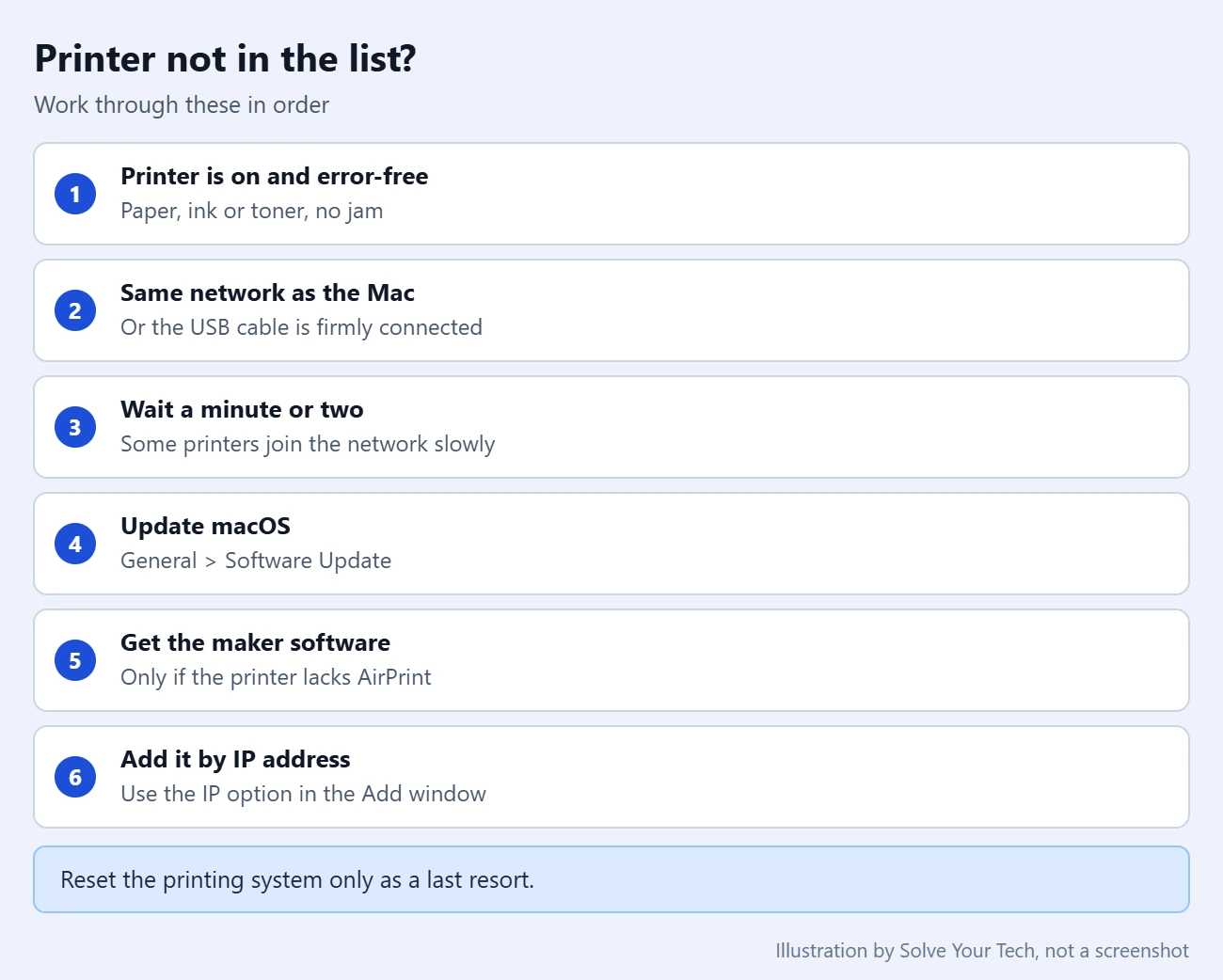
- Check the printer. It should be on, showing normal status lights, with paper loaded, no jam, and enough ink or toner.
- Check the network. The Mac and printer must be on the same network. A printer on a guest network or a different Wi-Fi name may not be found. On a work network, ask the administrator instead of changing network protections.
- Give it time. Apple says some printers need a minute or two after being turned on before they join the network.
- Check a USB connection. Hold the Option key and choose Apple menu > System Information. If the printer’s name is in the hardware list, the Mac can see it over USB and the problem lies elsewhere.
- Get the right software. If the printer does not support AirPrint, install the latest software from the manufacturer for your exact model. Do not pick an unrelated model just to finish setup.
- Try another app. Print from TextEdit. If that works, the problem is with the first app, not the printer.
A Print Job Is Stuck
On recent macOS versions, a Print Center icon appears in the Dock while you print. Click it to see the queue, which is the list of jobs waiting to print. If the printer is paused, click the resume button in the toolbar. If one job has an error and is blocking the others, select it and delete it, then print again. Apple’s Print Center guide explains each control.
If your job is not in the queue at all, it may have gone to a different printer. Check the other queues, or print again and look carefully at the Printer menu.
An Error Says the Software Is Not Compatible
Apple notes that some printer software needs Rosetta, its tool for running Intel-based apps on Macs with Apple silicon. If the manufacturer offers a newer version for your Mac, install that first.
Add the Printer Again
If a printer that used to work has stopped, add it a second time with the steps above. This creates a fresh queue. If you can print to the new entry, remove the old one.
Last Resort: Reset the Printing System
Warning: Apple states that this deletes all printers, completed print jobs and printer presets on the Mac. You will have to add every printer again, so write down any IP addresses, queue names and custom settings first.
If nothing else has worked, open System Settings > Printers & Scanners, Control-click anywhere in the Printers list and choose Reset Printing System. Then add your printers again. The details are in Apple’s printing troubleshooting guide.
Frequently Asked Questions
Do I Need to Install a Driver to Add a Printer to a Mac?
Not for an AirPrint printer. Apple says AirPrint lets you print without installing an app, driver or other software. If your printer is not compatible with AirPrint, install the latest software that came with it or from the manufacturer’s website, and confirm it supports your macOS version.
Why Is My Printer Not Showing Up on My Mac?
The usual causes are that the printer is off or showing an error, it is on a different network from the Mac, or it has not finished joining the network yet. Wait a minute or two, confirm both devices use the same Wi-Fi network, and try again. If it still does not appear, add it by IP address.
Can I Add More Than One Printer?
Yes. Add each printer separately and choose the one you want in the Printer pop-up menu when you print. Set a default in Printers & Scanners so the printer you use most is selected first, and check the selection before printing something confidential or a large job.
How Do I Remove a Printer From My Mac?
Open System Settings > Printers & Scanners, Control-click the printer in the Printers list, choose Remove Printer and confirm. Other printers and their settings are not affected.
Can My iPhone or iPad Use the Same Printer?
Yes, if the printer supports AirPrint and all the devices are on the same Wi-Fi network. Nothing you add on the Mac carries over, but an AirPrint printer needs no setup on those devices. See how to add a printer to an iPad for the steps.
Next Step
Print one test page, then set your default printer so every app selects it first. If you add a second printer later, repeat the same steps and check the Printer menu before each job.

Matthew Burleigh is the founder, head writer, and editor of Solve Your Tech, which he launched in 2012. He has written technology tutorials since 2008 and worked in IT since 2003, including small-business support, IT management, and consulting. He holds Bachelor’s and Master’s degrees in Computer Science from Arizona State University.
Matthew writes practical guides for Windows, iPhone and iPad, Microsoft Office, Outlook, Google apps, and Android. Solve Your Tech’s guides are tested on current devices or checked against official product documentation, with clear steps, sources, and update dates.
Read more about Matthew and how Solve Your Tech writes and updates its guides, or report a correction.