The iPhone doesn’t have a clipboard app you can open. The clipboard is built into iOS, holds only the last item you copied, and the way to see it is to paste it: touch and hold in any text field, such as a new note, and tap Paste. iOS doesn’t keep a history of older copied items, but a shortcut can show the current item, and some keyboards and apps can save past copies.
This guide covers pasting to view the clipboard, a Shortcuts shortcut that shows it, keeping a clipboard history, Universal Clipboard between Apple devices, and clearing the clipboard. The same steps work on an iPad.
How the iPhone Clipboard Works
- One item at a time: when you tap Copy or Cut, the text, link, or image replaces whatever was there before.
- No viewer: there’s no clipboard screen in Settings or on the Home Screen.
- Temporary: the copied item sits in memory, so restarting your iPhone clears it.
- Shared across apps: anything you copy in one app can be pasted into another, and apps may ask your permission before they paste content copied in a different app.
How to See What’s on Your iPhone Clipboard
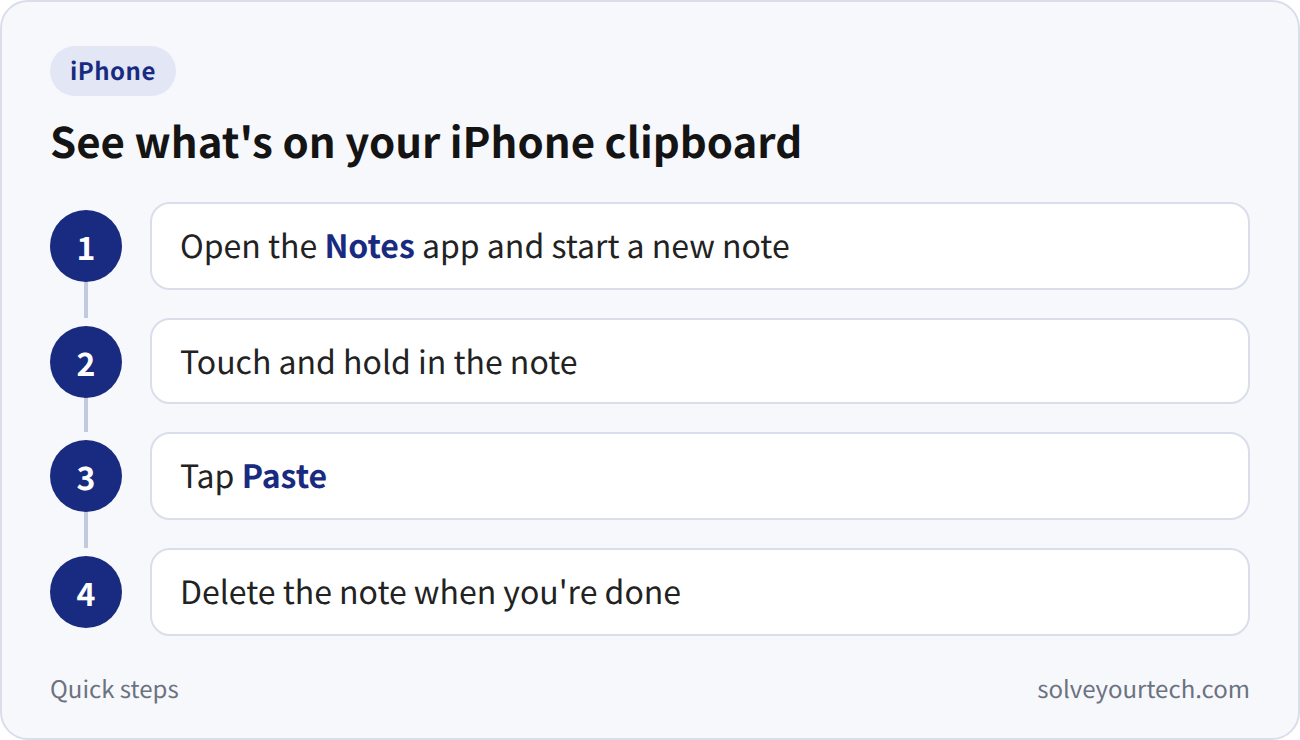
- Open Notes and tap the new note button. Any app with a text box, such as Messages or the Safari address bar, also works.
- Touch and hold in the empty note. Expected result: a menu appears above your finger.
- Tap Paste. Expected result: the text, link, or image you copied last appears in the note. The same trick pastes a copied GIF into Messages; see how to send GIFs on iPhone.
- Delete the note if you don’t need to keep it.
If Paste doesn’t appear in the menu, the clipboard is empty, or the spot you touched isn’t an editable text field.
Show the Clipboard With a Shortcut
Apple’s Shortcuts app includes a Get Clipboard action that brings whatever you copied into a shortcut, as described in Apple’s Shortcuts User Guide. Pair it with an action that displays the result and you get a one-tap clipboard viewer:
- Open the Shortcuts app and tap the + button to start a new shortcut.
- Search for Get Clipboard and add it.
- Search for Show Result and add it below the first action. Action names can differ slightly between iOS versions.
- Rename the shortcut, for example “View Clipboard,” and tap Done.
- Run the shortcut from the Shortcuts app, a widget, or the Home Screen. Expected result: a pop-up shows what you copied last.
This still shows only the current item. It doesn’t save a history.
Keep More Than One Copied Item
Because the clipboard holds one item, copying something new replaces the last one. You have a few ways around that:
- Paste as you go: keep one note open and paste each item into it before you copy the next.
- Use a keyboard with a clipboard: third-party keyboards such as Microsoft SwiftKey include a clipboard manager that saves recent copies.
- Install a clipboard manager app: these apps save items you copy so you can reuse them later.
Be careful what you trust with your clipboard. Copied text can include passwords, codes, and addresses, and a third-party keyboard needs Full Access for some features. Only use apps from developers you trust, and don’t copy passwords when a password manager can fill them in instead.

Copy on Your iPhone, Paste on Your Mac or iPad
With Universal Clipboard, something you copy on your iPhone can be pasted on your iPad or Mac, and the other way around. According to Apple’s iPhone User Guide, it works when:
- Both devices have Wi-Fi, Bluetooth, and Handoff turned on.
- Both devices are signed in to the same Apple Account.
- Both devices meet the minimum system requirements, and any VPN you use allows local networking.
Copy as usual on one device, then tap or click Paste on the other. Apple notes the copied content is available only for a short time, so paste soon after you copy. Apple’s Universal Clipboard page lists the supported devices.
How to Clear the Clipboard on iPhone
- Copy something harmless: type a single space or a word in a note, select it, and tap Copy. That replaces what was there.
- Restart your iPhone: the clipboard doesn’t survive a restart.
- Use a shortcut: build a shortcut with the Copy to Clipboard action and an empty or placeholder Text action. Apple says Copy to Clipboard also has an Expire At option that erases the content at a set time, plus a Local Only option that keeps it from being shared to your other devices.
Troubleshooting
- Paste is missing: make sure you tapped inside a text field you can type in. If it’s still missing, copy the item again.
- An app keeps asking to paste: iOS asks for permission when an app pastes content copied in a different app. Tap Allow Paste to continue, or Don’t Allow Paste to keep the clipboard private.
- Universal Clipboard doesn’t work: check that Wi-Fi, Bluetooth, and Handoff are on for both devices, that you’re signed in to the same Apple Account, and that the devices are close together. Then copy the item again.
- The wrong thing pastes: you or an app copied something more recently. Copy the item you want again.
Frequently Asked Questions
Where is the clipboard on iPhone?
It’s part of iOS, not an app, so you can’t open it. Paste into a text field or run a Get Clipboard shortcut to see what’s on it.
Does the iPhone have a clipboard history?
No. iOS keeps only the last item. For a history, use a keyboard or app with a clipboard manager.
How long does the iPhone keep what I copied?
Until you copy something else or restart the phone. Items sent to another device with Universal Clipboard are available there only briefly.
Can I copy an image to the clipboard?
Yes. Touch and hold an image, tap Copy, and then paste it into Notes, Messages, Mail, or another app that accepts images.
Is it the same on Android and Windows?
No. Some Android keyboards show recent copies; see where the clipboard is on Android. Windows 11 has a built-in clipboard history; see how to view the clipboard in Windows 11.
Typing on an iPad instead? Here’s how to turn on Caps Lock on an iPad.

Matthew Burleigh is the founder, head writer, and editor of Solve Your Tech, which he launched in 2012. He has written technology tutorials since 2008 and worked in IT since 2003, including small-business support, IT management, and consulting. He holds Bachelor’s and Master’s degrees in Computer Science from Arizona State University.
Matthew writes practical guides for Windows, iPhone and iPad, Microsoft Office, Outlook, Google apps, and Android. Solve Your Tech’s guides are tested on current devices or checked against official product documentation, with clear steps, sources, and update dates.
Read more about Matthew and how Solve Your Tech writes and updates its guides, or report a correction.