Windows 11 doesn’t show your laptop’s screen size in inches. To find it, open Settings > System > About, note the model name under your device name, and search for that model plus “screen size.” Or measure the screen diagonally from one corner to the opposite corner. The model lookup is the most accurate, because it gives you the exact size the maker lists, such as 14 or 15.6 inches.
These steps work in current versions of Windows 11, and the same tools exist in Windows 10, which reached end of support on October 14, 2025. Screen size is the diagonal length of the visible display, not counting the frame (bezel) around it. It’s different from resolution, which is the number of pixels, such as 1920 x 1080. Windows shows resolution, so you need one of the methods below for size.
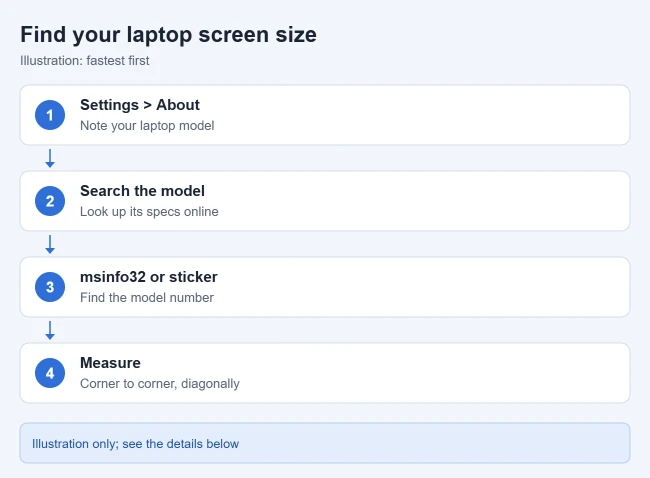
Method 1: Look Up Your Laptop Model
- Right-click the Start button and select Settings, or press Windows key + I.
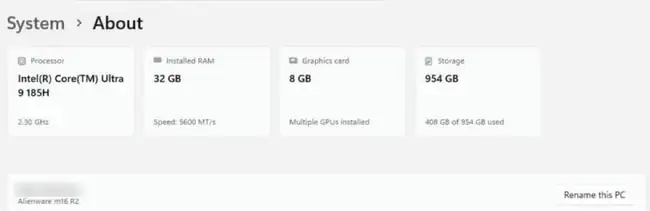
- Select System, then scroll down and select About. As a shortcut, press Windows key + R, type
ms-settings:about, and press Enter. - Look at the top of the page. Microsoft notes that the model name appears just below your device name, for example Dell Inspiron 15 3520 or HP Laptop 14-dq5xxx.
- Search the web for that model name plus screen size, or look it up on the maker’s support site.
- Find the Display or Screen size line in the specifications.
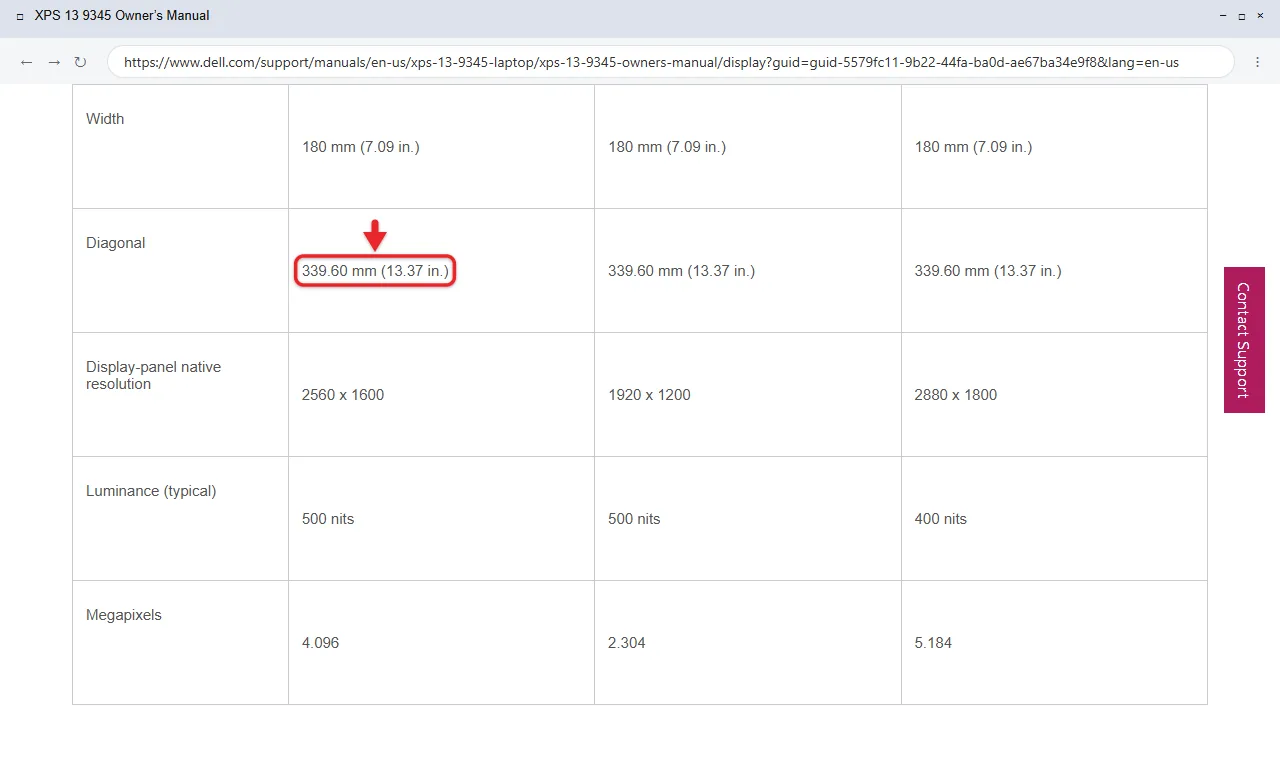
Many model names include the size. A number like 14, 15, or 16 in the name, such as Pavilion 15 or IdeaPad 5 14, usually matches the screen size, though you should confirm it in the specs because 15 often means 15.6 inches. Some makers sell one model with more than one screen option, so if the spec sheet lists two sizes, use the serial number steps below to see the exact configuration.
If the About page doesn’t show a model
- Press Windows key + R, type
msinfo32, and press Enter. - In System Summary, find System Model and System Manufacturer. The same window lists the rest of your hardware, as explained in how to check system configuration in Windows 11.
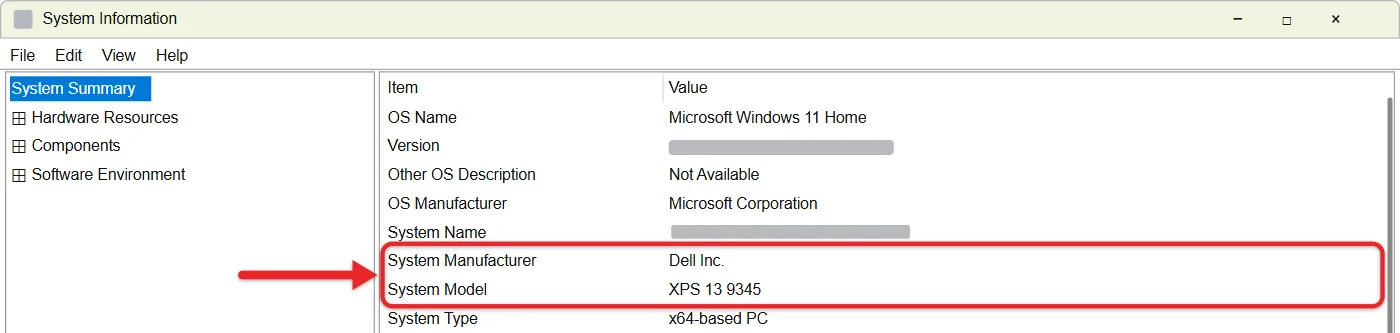
- Search for those two together online.
If both lines show a placeholder such as System Product Name instead of a real model, Windows can’t read the model from the hardware. Check the sticker on the bottom of the laptop, the original box, or your receipt instead.
Use your serial number on the maker’s support site
If the model name is vague, the serial number shows your exact configuration. It’s printed on the bottom sticker, and you can also read it in Windows:
- Right-click Start and select Terminal.
- Paste the command below and press Enter.
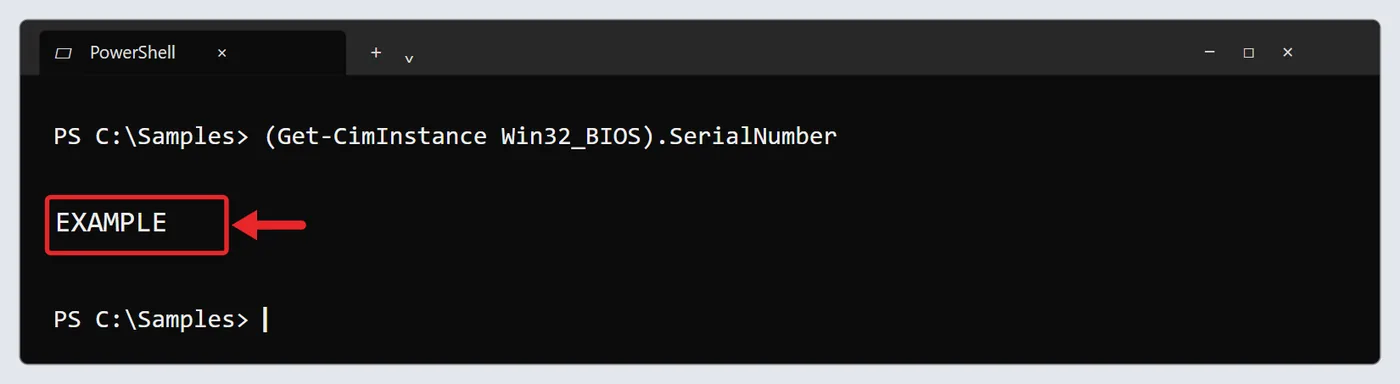
(Get-CimInstance Win32_BIOS).SerialNumberEnter that number on your maker’s support site. On Dell, it’s called the Service Tag. HP and Lenovo call it the serial number. Then open the specifications or configuration page for your device and find the display size.
If the command comes back blank, the steps for finding your PC serial number list the label, app and BIOS locations to check.
Check the display name Windows reports
Windows can also show the name of the screen itself, which helps most with external monitors.
- Go to Settings > System > Display, then select Advanced display under Related settings.
- If more than one screen is connected, pick the one you want from the menu at the top.
- Read the name under Display information. For an external monitor, it’s usually the brand and model, which you can search for its size.
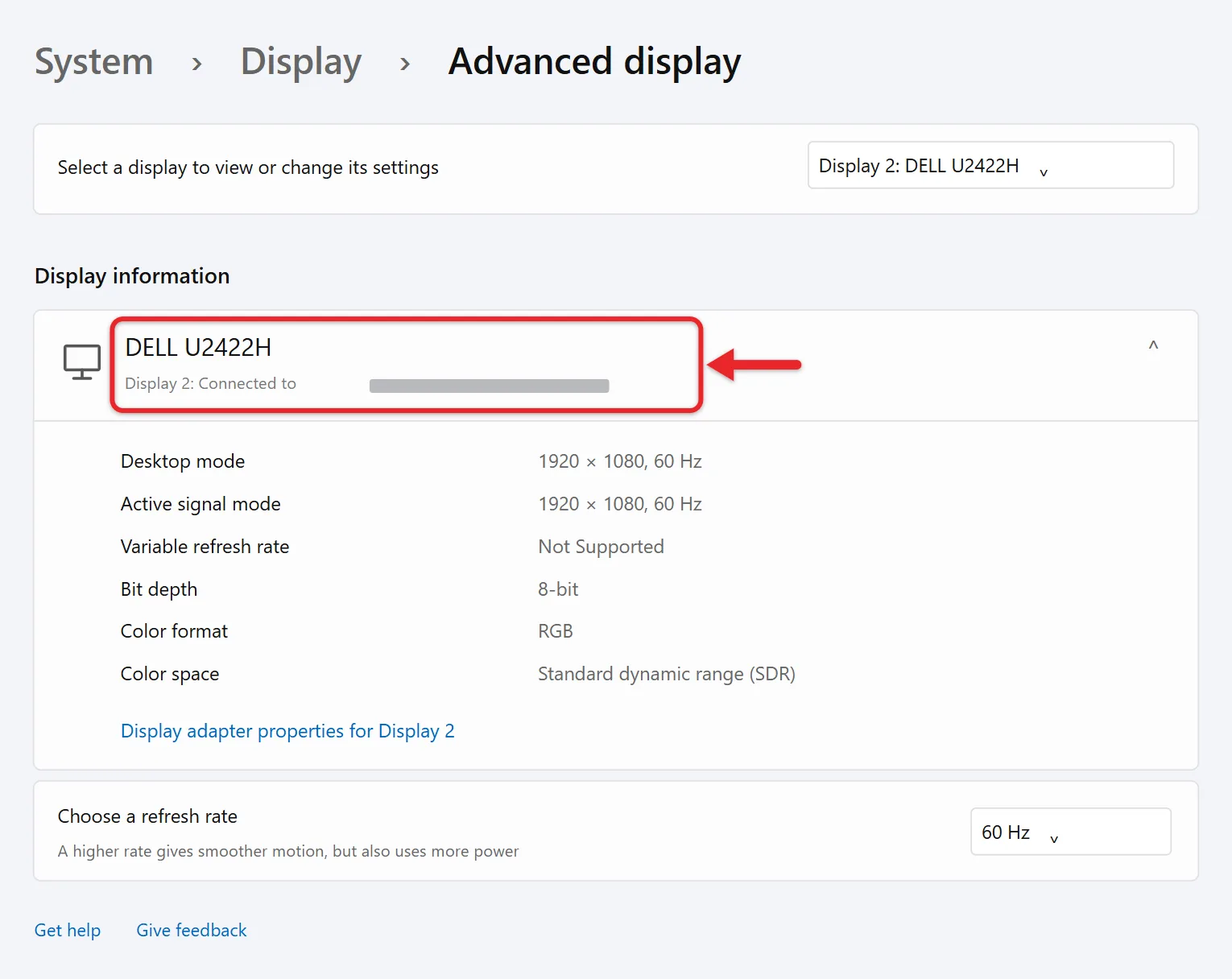
A built-in laptop screen often shows a generic or coded panel name here, so use the laptop model from Method 1 instead. The DirectX Diagnostic Tool (press Windows key + R, type dxdiag, and open the Display tab) shows similar monitor details, but neither tool lists the size in inches.
Method 2: Measure the Screen
- Turn off the laptop so the screen is dark and the edges are easy to see.
- Put the end of a tape measure at the bottom-left corner of the visible screen, where the picture starts, not the plastic frame.
- Stretch it to the top-right corner of the visible screen. Keep the tape straight and flat, and don’t press on the screen.
- Read the number in inches. That’s your screen size.
If you get something like 15.4 inches, your laptop is almost certainly a 15.6-inch model, since makers list a standard size. If your tape only shows centimeters, divide by 2.54 to get inches. For example, 39.6 cm divided by 2.54 is about 15.6 inches. Some guides say to include the bezel, but that gives a larger number than the size the maker lists, so measure only the visible screen.
Method 3: Estimate It With PowerShell
Windows can read the physical width and height your display reports to the PC. It’s rounded to the nearest centimeter, so treat the result as an estimate within about half an inch.
- Right-click Start and select Terminal.
- Paste the command below and press Enter.
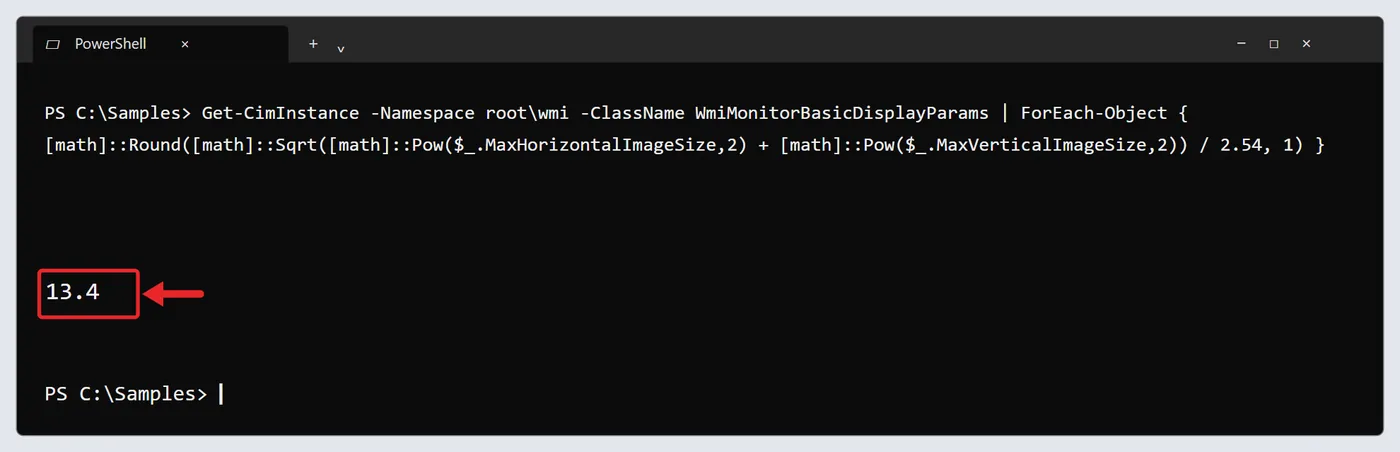
Get-CimInstance -Namespace root\wmi -ClassName WmiMonitorBasicDisplayParams | ForEach-Object { [math]::Round([math]::Sqrt([math]::Pow($_.MaxHorizontalImageSize,2) + [math]::Pow($_.MaxVerticalImageSize,2)) / 2.54, 1) }The number that appears is the estimated diagonal in inches. If you have an external monitor connected, you’ll see one number per screen.
The command uses the MaxHorizontalImageSize and MaxVerticalImageSize values defined in Microsoft’s WmiMonitorBasicDisplayParams reference. Some displays report 0 or wrong values, so confirm with Method 1 or 2 before buying anything that has to fit exactly. If you see an error instead of a number, the display driver isn’t sharing these details; use the other methods.
Common Laptop Screen Sizes
| Screen size | Typical laptop type |
|---|---|
| 11.6 inches | Small budget laptops and Chromebooks |
| 13.3 to 13.6 inches | Thin and light laptops |
| 14 inches | Everyday portable laptops |
| 15.6 inches | The most common mainstream size |
| 16 inches | Larger premium and creator laptops |
| 17.3 inches | Gaming and desktop-replacement laptops |
If your measurement lands between two sizes, pick the closest standard size from this list, then confirm it with your model number.
How to Check Your Screen Resolution
Resolution is the number of pixels across and down, which affects how sharp the screen looks. It doesn’t tell you the size in inches.
- Go to Settings > System > Display.
- Look at Display resolution under Scale & layout. The option marked (Recommended) is your screen’s native resolution.
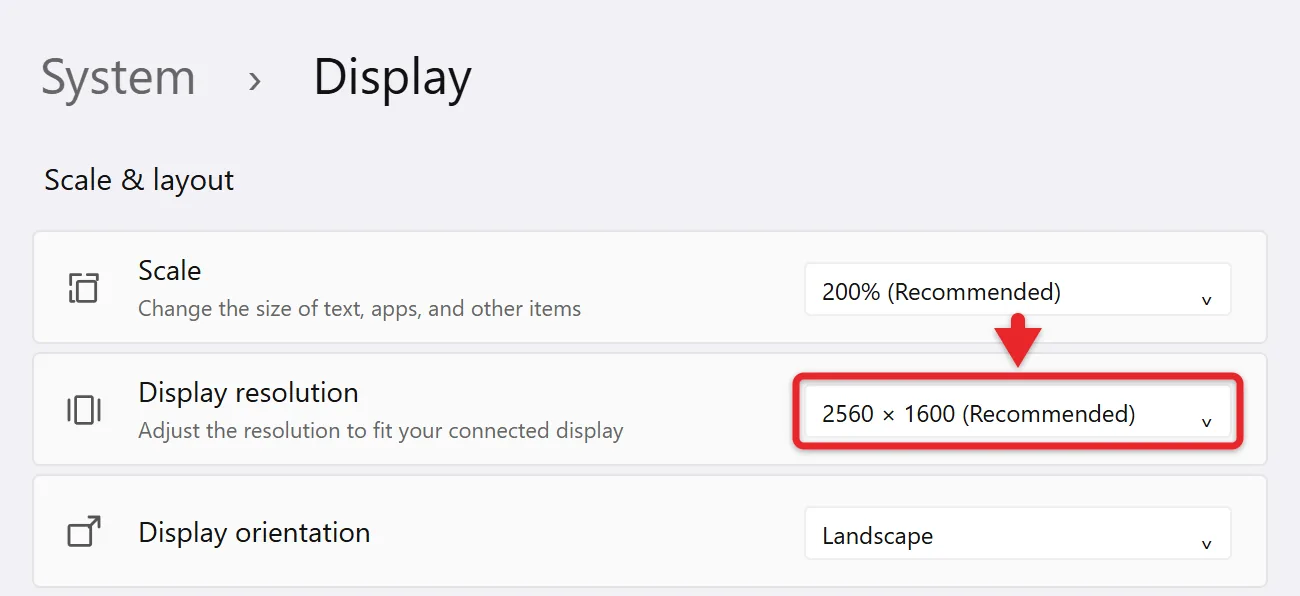
- For more details, select Advanced display to see the display model, refresh rate, and bit depth.
Two 15.6-inch laptops can have very different resolutions, so check both when comparing screens. If everything looks too big or too small, change the Scale setting instead of the resolution. To make only the text bigger, increase text size in Windows 11.
Frequently Asked Questions
Why do I need to know my screen size?
It’s the number that matters when you buy a sleeve, case, screen protector, or privacy filter, or when you list the laptop for sale. For a sleeve or bag, also check the laptop’s full dimensions in the specs, since bezels vary.
Is screen size the same as laptop size?
No. A 15.6-inch laptop has a screen that measures 15.6 inches diagonally. The laptop itself is wider because of the frame and body.
Can I change my laptop’s screen size?
No, the physical size is fixed. You can make things on the screen bigger or smaller with the Scale setting. If the display looks wrong, you can get your screen back to normal size.
How do I check the size of an external monitor?
Look up the model number on the sticker on the back, check Advanced display in Settings for the model name, or measure it the same way. For setup help, follow the steps for setting up multiple monitors on Windows 11.
Does a Mac show screen size?
Yes, in the model name. On a Mac, choose Apple menu > About This Mac. Apple’s guide to identifying your MacBook Air model shows that laptop model names include the size, such as MacBook Air (13-inch, M3, 2024). Windows doesn’t have an equivalent, which is why you need the methods above.

Matthew Burleigh is the founder, head writer, and editor of Solve Your Tech, which he launched in 2012. He has written technology tutorials since 2008 and worked in IT since 2003, including small-business support, IT management, and consulting. He holds Bachelor’s and Master’s degrees in Computer Science from Arizona State University.
Matthew writes practical guides for Windows, iPhone and iPad, Microsoft Office, Outlook, Google apps, and Android. Solve Your Tech’s guides are checked step by step against the device or app maker’s own documentation and tested on his own devices whenever he has the hardware or software, with clear steps, sources, and update dates.
Read more about Matthew and how Solve Your Tech writes and updates its guides, or report a correction.