You’re at a concert and want to tag the venue in a Facebook post, but you’d rather not tell every friend of a friend where you are right now. A check-in is a post with a place attached: tap What’s on your mind?, choose Check in, pick the place, set the audience, then tap Next and Share (on a computer, click Post). The audience you pick before posting is what limits who sees it.
A check-in shows the place you chose, plus anything else in the post (text, photos, tagged friends). Who sees it depends on the audience you set in the post’s audience selector. Meta’s Help Center describes these options:
| Audience | Who can see the check-in | Watch out for |
|---|---|---|
| Public | Anyone, including people who are not on Facebook | If you are tagged in a Public post, people who manage the location’s Page can see it |
| Friends | Your friends, plus the friends of anyone tagged in the post | Tagging three friends can put the post in front of hundreds of people you don’t know |
| Only Me | Only you; it appears on your profile but nobody else sees it | Tagging someone does not expand this audience |
| Custom | Specific people or lists you choose, or everyone except people you exclude | Useful for removing “Friends of those tagged” |
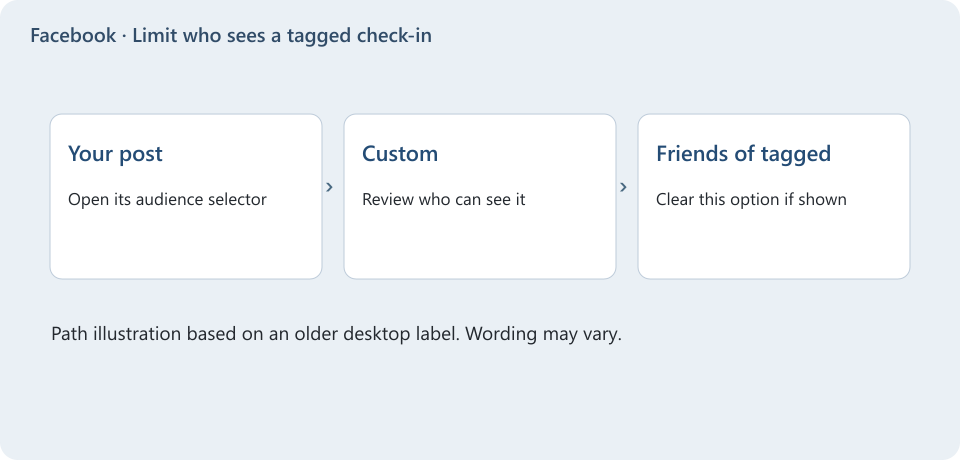
Two details surprise people. First, tagging a friend widens a Friends post to that friend’s friends. To stop that, open the audience selector, choose Custom, and uncheck Friends of those tagged. Second, Meta says that when a post you are tagged in is Public, people who manage the location’s Facebook Page can see it; with any other audience, it is not shared with the Page managers. Meta’s explanation of audience options covers each one.
If you want broader control over what strangers can find on your profile, these steps to make your Facebook account private pair well with careful check-ins.
Check In From the Facebook App
Meta documents these steps for the Facebook app for iPhone. The Android app follows the same idea, though button positions and labels can differ slightly by app version.
- Open Facebook and scroll to the top of your Feed.
- Tap What’s on your mind?
- Tap Check in. Search for the place by name, or tap one from the nearby list. Check the city or address shown so you don’t tag a different branch or a similarly named place.
- Add anything else you want: Photo/Video, Feeling/activity, Tag friend, or a status message. Ask before tagging someone at a location, because it shares where they are too.
- Tap the audience selector and choose who can see the post. For a concert you’re still at, Friends with “Friends of those tagged” unchecked, or a small Custom list, keeps it close.
- Tap Next, then Share.
The full Meta wording is on its iPhone check-in help page.
Check In on a Computer
- Go to Facebook in a web browser and click What’s on your mind, [your name]? at the top of your Feed.
- Click Check in, then select a place from the list or search for it.
- Add tags, a photo or video, or a feeling or activity if you like.
- Select an audience.
- Click Post.
Meta’s computer check-in steps include the same Page-manager note about Public tagged posts.
Change Who Can See a Check-In You Already Posted
Shared it with the wrong audience? Meta’s Help Center has an article titled “Change the audience of a post on Facebook,” which confirms this is possible for your own posts. The general approach: find the post on your profile, open the audience control on that post (the small icon next to the date), and pick a narrower audience such as Friends, Only Me or Custom. Exact labels in this flow vary by device, so look for the audience icon rather than a specific menu name.
Changing the audience works going forward. Anyone who already saw the post, took a screenshot or got a notification still has what they saw. Meta’s help center also lists a Facebook Privacy Checkup, which may be another place to review who can see your future posts.
Edit or Remove the Location on a Post
Sometimes the post is fine but the place isn’t. Meta lets you edit or remove a location only on your own post or photo. On a computer:
- Go to the post on your profile and click Options (the three dots) on the post.
- Click Edit post.
- Click the current location.
- To change it, enter a new place. To remove it, click Remove next to the location.
- Click Next if prompted, then Save.
You can also add a location to an older post the same way: Options, Edit post, then Check in (you may need to click Options at the bottom right of the edit box first), type the place in Where are you?, and click Save. Meta notes that for photos, editing or removing a location works only in the Facebook mobile apps. These steps come from Meta’s Facebook and location help.
If you were tagged at a place in someone else’s post, you can’t edit their location. Ask them to change it. You may also be able to remove the tag from your side; Meta’s tagging help has the current steps. Meta also has a “Review tags that people add to your Facebook posts” article for approving tags before they appear; check Facebook’s Settings for tag review options on your account.
Control Facebook’s Access to Your Phone’s Location
A check-in doesn’t need your phone’s GPS; you can search for a place by name. Location access on your phone mostly affects the nearby places list and other location features. Meta’s Location Services help gives these paths (the setting exists only in the Facebook app for iPhone, iPad and Android):
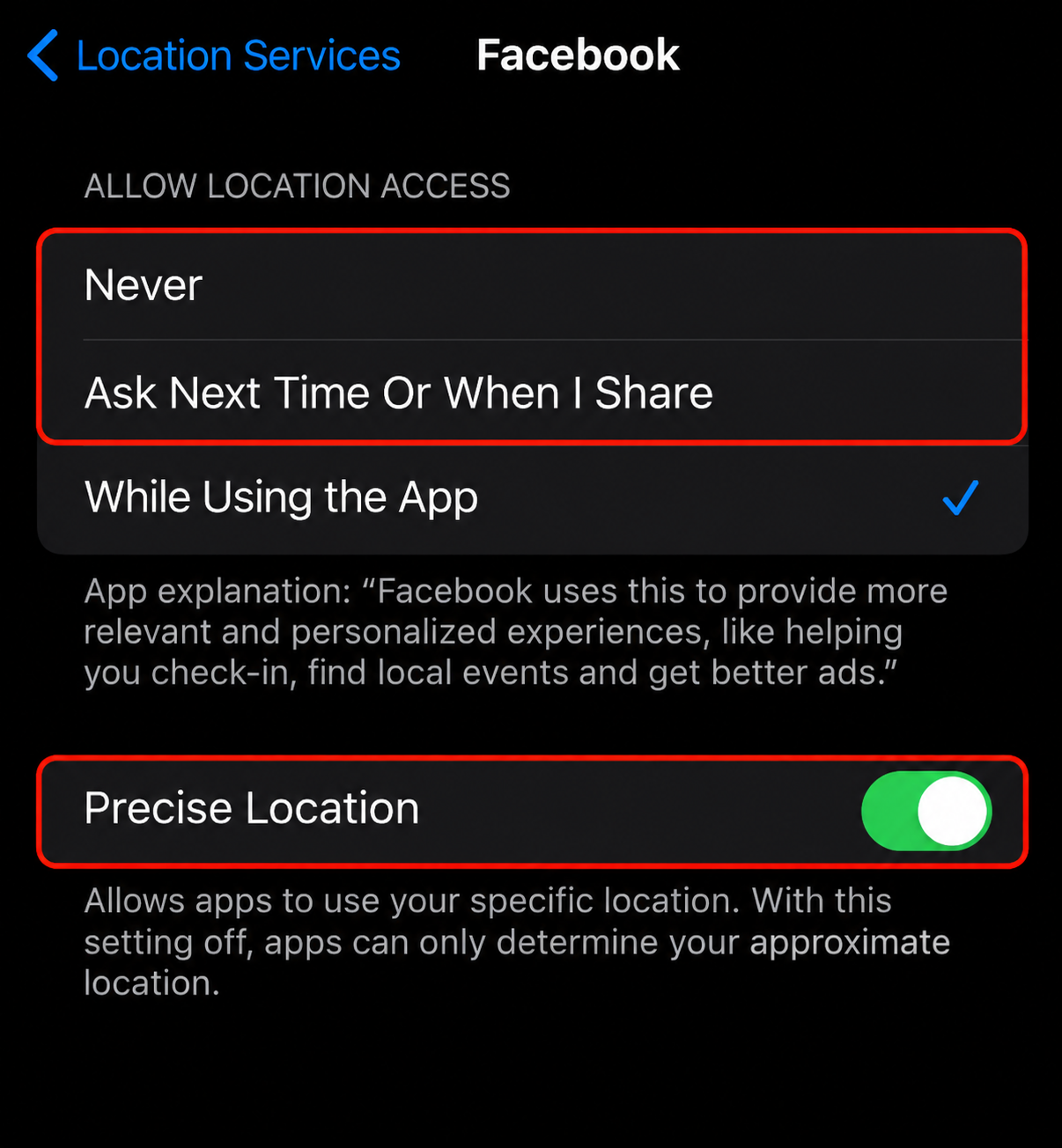
- iPhone or iPad: Settings, then Privacy & Security, then Location Services, then Facebook. Choose While Using the App, Ask Next Time or Never.
- Android: Settings, then Apps, then Facebook, then Permissions, then Location. Choose Allow only while using app, Ask every time or Don’t allow.
Recent iPhone and Android versions may also show a precise location option for each app; turning it off gives the app an approximate area instead. For more on per-app location on an iPhone, see how to turn Location Services on or off for one app.
Turning location off does not make Facebook blind to where you are. Meta says that when Location Services is off, it may still estimate your location using things like check-ins, events and information about your internet connection. Meta lists the uses of location information as more relevant and personalized experiences, protecting your account, and better ads.
If Check In or the Place Is Missing
- No nearby places: Facebook may not have location access. Search the place by name instead, or allow location only while using the app.
- Place not found: Try the exact business name plus the city, or a nearby landmark. Meta’s current check-in pages do not document a way to create a missing place, so a plain post without a location beats tagging the wrong one.
- Check in button not visible: Start from What’s on your mind? and look in the list of options for the post. Facebook moves composer buttons between versions; updating the app can help.
- Events: A Facebook event has its own location, set by the event host. That’s separate from checking in.
Habits That Keep a Check-In From Giving Too Much Away
- Post after you leave. A check-in from yesterday’s concert says much less about where you are now. Write the post, then share it once you’re home.
- Skip home, school and work. Repeated check-ins at the same places build a routine anyone on your audience list can read.
- Look at the photo, too. Tickets, street signs and house numbers can reveal location even with no check-in.
- Ask friends not to tag you live. A friend’s Public post can share your location regardless of your own settings.
- Review old posts. Scroll your profile for past check-ins and narrow their audience or remove the place. Finding them is easier with these tips to find old Facebook posts without scrolling.
For example, Jordan tags a stadium on a Saturday night. The post is set to Friends and tags two friends, so it reaches all three friend lists. Switching to Custom and unchecking Friends of those tagged would have kept it to Jordan’s own friends, and waiting until Sunday morning would have meant nobody knew Jordan’s apartment was empty that night.
Facebook Check-In Questions
Can I check in without anyone seeing it?
Set the audience to Only Me. The check-in appears on your profile but only you can see it, and Meta says tagging someone doesn’t expand that audience.
Does turning off Location Services stop Facebook knowing where I am?
Not completely. Meta says it may still estimate location from check-ins, events and your internet connection. Turning it off does stop the app using your phone’s GPS-based location.
Can I remove a check-in’s location without deleting the post?
Yes, on your own posts: Options, Edit post, click the location, click Remove, then Next and Save.
Does a check-in show my exact address?
It shows the place you picked. If that place is your home or a small business with a street address, people who see the post may see that address too, so choose a general place or skip the check-in.
Do business owners see my check-in?
Meta says people who manage a location’s Page can see Public posts you’re tagged in at that location. Choose any audience other than Public to keep it from them.
Before Your Next Check-In
Open the audience selector before you tap Share every time; Facebook may remember your last choice, and that may not be what you want at the next venue.

Matthew Burleigh is the founder, head writer, and editor of Solve Your Tech, which he launched in 2012. He has written technology tutorials since 2008 and worked in IT since 2003, including small-business support, IT management, and consulting. He holds Bachelor’s and Master’s degrees in Computer Science from Arizona State University.
Matthew writes practical guides for Windows, iPhone and iPad, Microsoft Office, Outlook, Google apps, and Android. Solve Your Tech’s guides are checked step by step against the device or app maker’s own documentation and tested on his own devices whenever he has the hardware or software, with clear steps, sources, and update dates.
Read more about Matthew and how Solve Your Tech writes and updates its guides, or report a correction.