File Explorer is the main Windows 11 tool for finding, opening, copying, moving, renaming, and organizing files and folders. Press Windows + E to open it quickly. From there, you can browse folders from the navigation pane, search for files, change how items are displayed, access drives under This PC, and work with local or cloud files.
If you are trying to get help with File Explorer because it is slow, frozen, crashing, or not finding a file, this guide also covers the most useful fixes.
How to Use File Explorer in Windows 11
The following steps cover the basic File Explorer workflow. Once you know these controls, most everyday file-management tasks become much easier.
Step 1: Open File Explorer
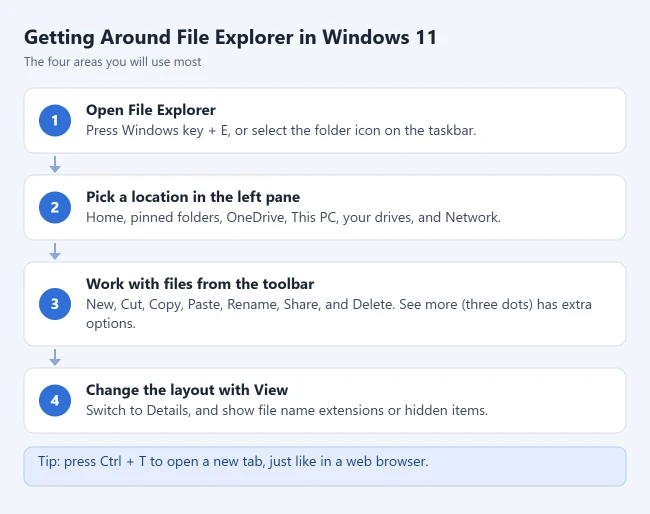
Press Windows + E on your keyboard. You can also select the File Explorer folder icon on the taskbar or search for File Explorer from the Start menu.
Step 2: Use the Navigation Pane
Look at the left side of the window. The navigation pane gives you quick access to Home, common folders, OneDrive when it is configured, This PC, drives, and other available locations.
Step 3: Open a Folder or Drive
Select a location in the navigation pane, or double-click a folder in the main part of the window. Use the Back, Forward, and Up buttons near the address bar to move through locations you recently visited.
Step 4: Find a File
Select the search box in the upper-right area of File Explorer and enter part or all of a file name. Starting your search inside a specific folder is usually faster when you know roughly where the file is stored.
Step 5: Work With the File
Select a file or folder to use commands such as Cut, Copy, Rename, Share, and Delete. You can also right-click an item for a context menu with common actions and select Show more options when you need commands from the traditional Windows context menu.
Understanding File Explorer Home and Quick Access
Current versions of Windows 11 use Home as the normal File Explorer starting page. It provides quick access to useful folders and files instead of making you browse through your drives every time.
Windows also places familiar folders such as Desktop, Documents, Downloads, Pictures, Music, and Videos in Quick access and the navigation pane. To keep another folder handy, right-click it and choose Pin to Quick access. You can remove it later by right-clicking it and choosing Unpin from Quick access.
How to Use File Explorer Tabs
Windows 11 File Explorer supports tabs, which let you keep several folders open in one window. Press Ctrl + T to open a new tab. Use Ctrl + Tab to move to the next tab, Ctrl + Shift + Tab to move to the previous tab, and Ctrl + W to close the active tab.
Tabs are useful when you are comparing folders or moving between locations without filling the desktop with separate File Explorer windows.
How to Make File Explorer Open to This PC
If you would rather see your drives when File Explorer opens, you can change its starting location.
- Open File Explorer.
- Select the See more button, which is represented by three dots.
- Select Options.
- Open the Open File Explorer to menu.
- Select This PC.
- Click Apply, then OK.
This PC is especially useful when you frequently work with internal drives, USB drives, or network locations. You can also use This PC to map a shared network folder as a drive for quicker access to a frequently used network location.
How to Change the File Explorer View
Select View on the File Explorer command bar to change how files and folders appear. You can switch among icon sizes, List, Details, and other layouts. Details view is useful when you want to compare information such as file size, type, or date modified.
If File Explorer feels too spread out, select View > Compact view to reduce the spacing between items.
How to Use the Preview Pane, Details Pane, and Item Check Boxes
Open View > Show to find several useful display tools. The Preview pane can show a preview of supported files without opening them, while the Details pane shows information about the selected item. You can also turn on Item check boxes if you prefer selecting files with visible check boxes.
Keep in mind that Windows security updates can prevent File Explorer from previewing some files downloaded from the Internet. If a particular downloaded file does not preview, that does not necessarily mean the Preview pane itself is broken.
How to Show File Name Extensions
File name extensions identify file types, such as .docx, .jpg, .pdf, and .xlsx. Windows can hide these extensions, but displaying them makes it easier to tell exactly what kind of file you are working with.
- Open File Explorer.
- Select View.
- Select Show.
- Turn on File name extensions.
Be careful when renaming an extension. Changing the letters after the period does not actually convert a file into a different format.
How to Show Hidden Files in Windows 11
If a file or folder has been marked as hidden, you can make hidden items visible from File Explorer.
- Open File Explorer.
- Select View.
- Select Show.
- Select Hidden items.
Hidden items usually appear slightly faded. Avoid changing unfamiliar system files simply because they become visible.
How to Search for Files in File Explorer
Where you begin a File Explorer search matters. If you know a missing file should be in Downloads, open Downloads first and search there. File Explorer searches that location and its folders.
If you do not know where the file is stored, try searching from Home for relevant local and cloud files or from This PC for a broader search of the computer’s available locations. A This PC search can take longer because Windows has more places to examine.
How to Copy, Move, Rename, and Delete Files
Most basic file-management commands are available from the command bar and the right-click menu.
- Copy: Select an item, choose Copy, open the destination folder, and choose Paste.
- Move: Select an item, choose Cut, open the destination, and choose Paste.
- Rename: Select the file or folder and choose Rename, then type the new name.
- Delete: Select the item and choose Delete. Files deleted from ordinary local folders normally go to the Recycle Bin unless you use a permanent-delete method.
- Share: Select a supported item and choose Share to see available Windows sharing options.
Keyboard shortcuts can make these jobs faster: Ctrl + C copies, Ctrl + X cuts, Ctrl + V pastes, and Ctrl + Z can undo many recent file operations.
Useful File Explorer Keyboard Shortcuts
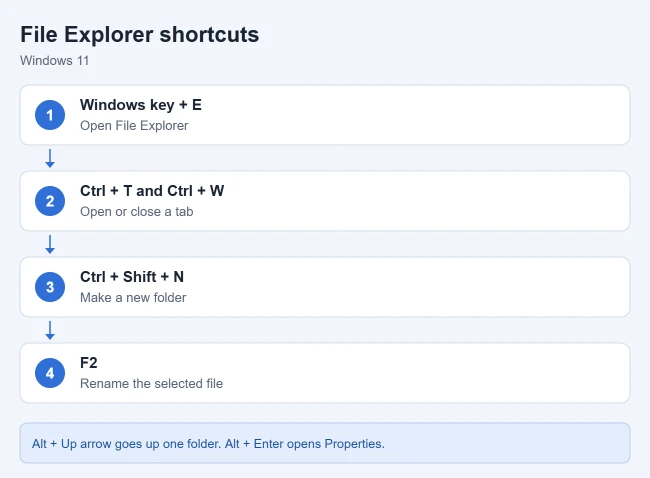
- Windows + E: Open File Explorer.
- Ctrl + Shift + N: Create a new folder.
- F2: Rename the selected item.
- Alt + Left Arrow: Go back.
- Alt + Right Arrow: Go forward.
- Alt + Up Arrow: Go up one folder level.
- Ctrl + L: Select the address bar.
- Ctrl + T: Open a new File Explorer tab.
- Ctrl + Tab: Move to the next tab.
- Ctrl + W: Close the active tab, or close the window when only one tab is open.
- Alt + P: Toggle the Preview pane.
How to Get Help With File Explorer in Windows 11
If you reached this page because File Explorer is not working correctly, start with the problem that most closely matches what you see. Many Explorer problems can be fixed without changing or deleting your personal files.
File Explorer Will Not Open
If File Explorer will not open at all, check Settings > Windows Update for available updates and restart the computer. Microsoft recommends these basic steps before moving to more disruptive Windows recovery options. If Explorer still will not start after ordinary troubleshooting, use Microsoft’s Windows recovery guidance rather than repeatedly forcing the process to restart.
File Explorer Is Frozen or Not Responding
Open Task Manager with Ctrl + Shift + Esc, locate Windows Explorer, and choose Restart task or Restart, depending on the version of Task Manager shown on your PC. Your taskbar and desktop may briefly disappear while Explorer restarts.
If Explorer repeatedly freezes, restart the computer as well. A recurring problem can be caused by a Windows issue, a third-party shell extension, a troublesome folder, or damaged system files, so repeated crashes deserve further troubleshooting rather than constant restarts.
File Explorer Is Slow
First determine whether File Explorer is slow everywhere or only in one location. A folder containing thousands of files, a disconnected network location, a cloud-sync problem, or a slow external drive can make one part of Explorer appear sluggish even when the application itself is working normally.
Try opening a simple local folder such as Documents. If that opens normally, focus your troubleshooting on the slow folder, drive, network share, or cloud location.
File Explorer Search Cannot Find a File
Check the location you are searching first. A search started in Documents is not the same as a broad search from This PC. If Windows Search repeatedly misses files that should be indexed, open Settings > Privacy & security > Searching Windows to review Windows search and indexing settings.
A Drive Is Missing From This PC
If a USB or external drive is missing, disconnect it and reconnect it, try another USB port when possible, and check whether Windows recognizes the device. For an internal or newly installed drive, Disk Management can help determine whether Windows detects the storage device even though it is not appearing normally in File Explorer.
OneDrive Is Missing or Not Syncing in File Explorer
OneDrive normally integrates with the File Explorer navigation pane after it is configured. If it is missing, make sure OneDrive is running and that you are signed in to the intended Microsoft account. A cloud file that appears in Explorer but will not open can also indicate a sync or Internet connection problem rather than a File Explorer problem.
The Navigation Pane Disappeared
You can restore the left navigation pane by opening File Explorer and selecting View > Show > Navigation pane.
A Right-Click Command Is Missing
Windows 11 uses a streamlined context menu. If you do not see the command you expect after right-clicking a file or folder, choose Show more options. Some commands and third-party application extensions still appear there instead of on the shorter Windows 11 menu.
When to Use the Get Help App
For a Windows problem that you cannot solve from File Explorer itself, open Start and search for Get Help. Microsoft’s Get Help experience can provide guided troubleshooting and routes to additional Microsoft support for Windows problems.
Before requesting support, write down what File Explorer is doing, when the problem started, whether it affects every folder, and any error message you see. Those details make it much easier to separate a File Explorer problem from a drive, account, network, or cloud-storage problem.
Frequently Asked Questions
What is the fastest way to open File Explorer in Windows 11?
Press Windows + E. This works from almost anywhere in Windows 11.
Where is This PC in Windows 11 File Explorer?
Open File Explorer and select This PC from the navigation pane. It shows drives and other computer locations. Windows 11 also lets you configure File Explorer to open to This PC instead of Home.
Why does File Explorer open to Home?
Home is the normal starting page in current Windows 11 versions. It provides quick access to useful folders and files. You can change the starting page to This PC from File Explorer Options.
How do I see hidden files?
Select View > Show > Hidden items in File Explorer.
How do I see file extensions?
Select View > Show > File name extensions.
Does restarting Windows Explorer delete my files?
No. Restarting the Windows Explorer process refreshes the Windows shell and File Explorer. It does not intentionally delete your documents, pictures, or other personal files.
Summary
- Press Windows + E to open File Explorer.
- Use Home and the navigation pane to reach common locations.
- Select This PC when you need drives and broader computer locations.
- Use the search box after choosing the most appropriate folder or location.
- Use View to change layouts and reveal hidden items or file extensions.
- Use the command bar or right-click menu to copy, move, rename, share, and delete files.
- If File Explorer freezes, restart Windows Explorer from Task Manager.
- If a problem persists, determine whether it affects File Explorer generally or only a particular folder, drive, network location, or cloud service.
Conclusion
File Explorer becomes much easier to use once you understand its main areas: Home, the navigation pane, the address bar, search, the command bar, and This PC. For everyday work, the most useful shortcut to remember is Windows + E.
When File Explorer is not behaving normally, avoid jumping immediately to drastic repairs. Start by identifying whether the problem involves Explorer itself or a specific file, folder, drive, search location, network connection, or cloud account. That usually points you toward the correct fix much faster.

Matthew Burleigh has been writing tech tutorials since 2008. His writing has appeared on dozens of different websites and been read over 50 million times.
After receiving his Bachelor’s and Master’s degrees in Computer Science he spent several years working in IT management for small businesses. However, he now works full time writing content online and creating websites.
His main writing topics include iPhones, Microsoft Office, Google Apps, Android, and Photoshop, but he has also written about many other tech topics as well.