To drag and drop in Windows 11, press and hold the left mouse button on a file, move the pointer to the folder, drive or app where it should go, and let go. Hold Shift while you drop to move it, Ctrl to copy it, or Alt to create a shortcut.
You need to move a folder of photos to an external drive or attach a file by dragging it into an app, and the drag either copies when you wanted to move or doesn’t work at all.
The Basic Drag and Drop
Open File Explorer with Windows key + E. If you’re new to its layout, using File Explorer in Windows 11 walks through the panes and toolbar.
- Select what you want to move. Click one file, Ctrl-click to add separate files, or click the first file and Shift-click the last to grab everything in between.
- Point at any of the selected items, press and hold the left mouse button, and start moving the mouse. The items follow the pointer as a small stack.
- Move over the destination: a folder in the same window, a folder or drive in the navigation pane on the left, the desktop, or another window.
- Watch the label next to the pointer. It usually reads something like Move to Pictures or Copy to USB Drive, telling you what will happen.

- Release the button to drop. To cancel, press Esc before you let go, or drag back to where you started.
Two File Explorer windows side by side make long drags much easier. Drag one window’s title bar to the left edge of the screen and the other to the right edge, and Windows snaps each to half the screen. Dragging a title bar moves the window itself; it doesn’t drop anything.
Why a Drag Sometimes Copies and Sometimes Moves
When you drag without holding any key, Windows picks the action based on the destination. In most cases a drag to another folder on the same drive moves the file, and a drag to a different drive, such as a USB stick or external disk, copies it and leaves the original where it was. That’s why a “move” to an external drive often leaves the photos behind on your PC.
Folders synced by OneDrive and network locations can behave differently, so don’t rely on the default when it matters. Read the label next to the pointer before you let go, or hold a key as described next. If you want the full set of ways to relocate files, see moving files instead of copying in Windows 11.
Choose Copy, Move or Shortcut on Purpose
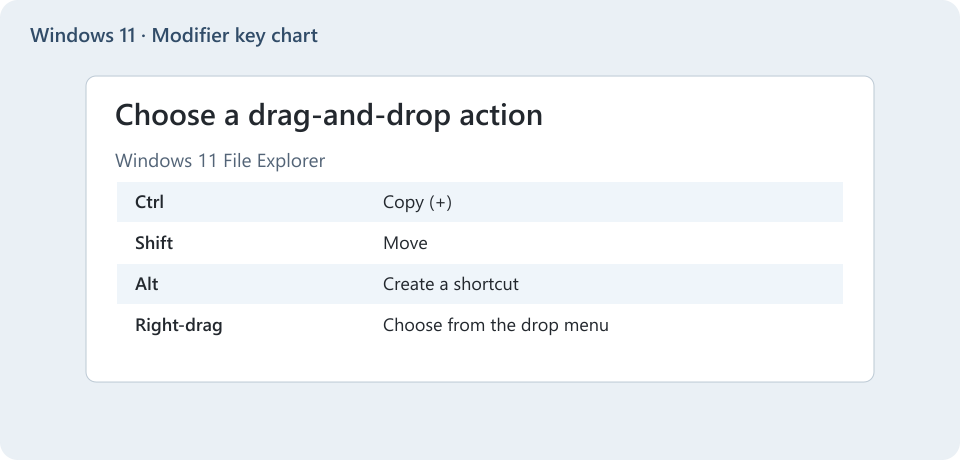
Microsoft’s keyboard shortcuts list for File Explorer documents three keys you can hold while dragging a file:
| Hold while you drop | Result |
|---|---|
| Shift | Moves the file to the new location |
| Ctrl | Creates a copy in the new location |
| Alt | Creates a shortcut to the original file |
Press the key after you start dragging and keep holding it until you’ve released the mouse button. The pointer label changes to match, which is a good check.
If you’d rather choose after the drop, drag with the right mouse button instead. When you let go, a small menu appears with options such as Copy here, Move here, Create shortcuts here and Cancel. This is the safest method when you’re not sure what the default will do. Alt-dragging an app or file onto the desktop is also a quick way to make a desktop shortcut in Windows 11.
Drag Onto the Taskbar and Into Other Apps
Dragging isn’t limited to File Explorer. You can drop a file into an email to attach it, into a browser’s upload box, or into a document to insert a picture, as long as the app accepts dropped files.
When the target app is hidden behind other windows, use the taskbar. Microsoft announced taskbar drag and drop for Windows 11 in a 2022 Insider build, and its Windows Insider announcement describes dropping files between app windows by hovering over apps on the taskbar. If your version of Windows 11 supports it, which recent updates should, it works like this:
- Start dragging the file and keep holding the button.
- Hover over the app’s button on the taskbar for a moment. Its window comes to the front.
- Move up into that window, to the message, upload area or folder, and release.
Dropping directly on the taskbar button doesn’t attach or open the file in most apps; the hover only brings the window forward. Text and images can be dragged too: select text in a document and drag it into another app or another spot in the same file.
Drag and Drop With a Touchpad or Touch Screen
On a laptop touchpad you can press and hold the physical button (or press down on a clickable pad) with one finger and slide with another. The easier option is the tap-and-drag gesture, which Microsoft lists in its touchpad gestures guide:
- Open Settings with Windows key + I and go to Bluetooth & devices > Touchpad.
- Expand Taps and make sure Tap twice and drag to multi-select is checked.
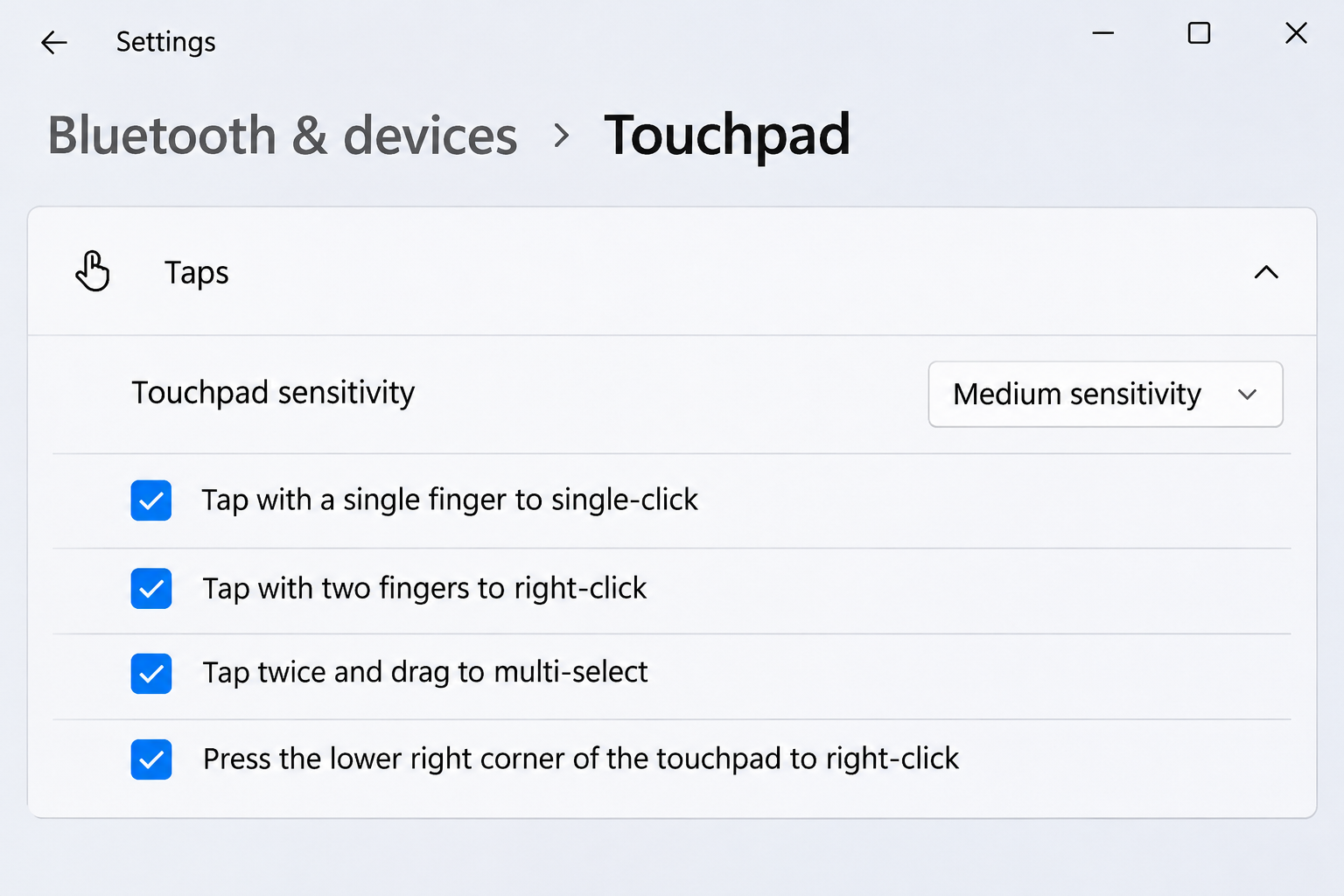
- In File Explorer, tap twice on a file, leaving your finger down on the second tap, then slide to the destination and lift your finger.
The same Taps section controls two-finger tap for right-click, which you need for the right-drag menu. If that gesture keeps opening menus by accident, see turning off two-finger right-click on a touchpad (written for Windows 10; in Windows 11, use the Taps setting above). On a touch screen, press and hold an item briefly, then slide your finger to the destination; on most PCs this works like a mouse drag.
Use the Keyboard When Dragging Is Awkward
Long drags across a big screen, crowded folders or a worn touchpad make dropping in the wrong place easy. Cut and paste gives the same results with no aiming: select the files, press Ctrl+X to move or Ctrl+C to copy, open the destination folder, and press Ctrl+V. The full set of methods is in copying and pasting on Windows 11.
If a drop lands in the wrong folder, press Ctrl+Z right away. In File Explorer that undoes the last move or copy, putting the files back.
When Drag and Drop Stops Working
Work through these in order, testing a drag after each one.
- Clear a stuck drag. A common quick fix is to click and hold any file, press Esc, then release. This can clear a drag that Windows thinks is still in progress.
- Restart Windows Explorer. Press Ctrl+Shift+Esc to open Task Manager, find Windows Explorer under Processes, right-click it and choose Restart (labeled Restart task in some versions). The taskbar disappears for a second and comes back. Other ways in are covered in opening Task Manager in Windows 11.
- Check the mouse or touchpad. Try a different mouse or USB port. If dragging works with another device, the button or driver is the problem.
- Check the target app. Some apps don’t accept drops at all, and dragging from a normal window into one that is running as administrator may be blocked. Test by dragging between two File Explorer folders.
- Restart the PC and install updates. Go to Settings > Windows Update and install anything waiting.
- Repair system files. Microsoft’s System File Checker instructions say to run DISM first. Open Terminal or Command Prompt as administrator, run
DISM.exe /Online /Cleanup-image /Restorehealth, thensfc /scannow, and leave the window open until verification reaches 100 percent.
Skip “fix” downloads and registry tweaks found on random sites. The steps above are the safe ones, and if copying with Ctrl+C and Ctrl+V also fails, the problem is wider than dragging; see fixing copy and paste in Windows 11.
Drag and Drop Questions
Can I Change What a Plain Drag Does?
Windows 11 doesn’t offer a setting for this in Settings that Microsoft documents. Use Shift, Ctrl or Alt, or the right-drag menu, each time you want something other than the default.
Why Did Windows Ask to Replace a File?
The destination already has a file with the same name. Windows typically lets you replace it, skip it, or compare the two and choose for each file.
Can I Drag Files to a Folder That Isn’t Open?
Yes. Drop them on the folder’s name in the navigation pane, or hover over a folder in the pane for a moment and it often expands so you can reach a subfolder.
For a big move to an external drive, select everything, Shift-drag it to the drive, and check that the originals are gone before you unplug. That one key is the difference between a move and a copy.

Matthew Burleigh is the founder, head writer, and editor of Solve Your Tech, which he launched in 2012. He has written technology tutorials since 2008 and worked in IT since 2003, including small-business support, IT management, and consulting. He holds Bachelor’s and Master’s degrees in Computer Science from Arizona State University.
Matthew writes practical guides for Windows, iPhone and iPad, Microsoft Office, Outlook, Google apps, and Android. Solve Your Tech’s guides are checked step by step against the device or app maker’s own documentation and tested on his own devices whenever he has the hardware or software, with clear steps, sources, and update dates.
Read more about Matthew and how Solve Your Tech writes and updates its guides, or report a correction.