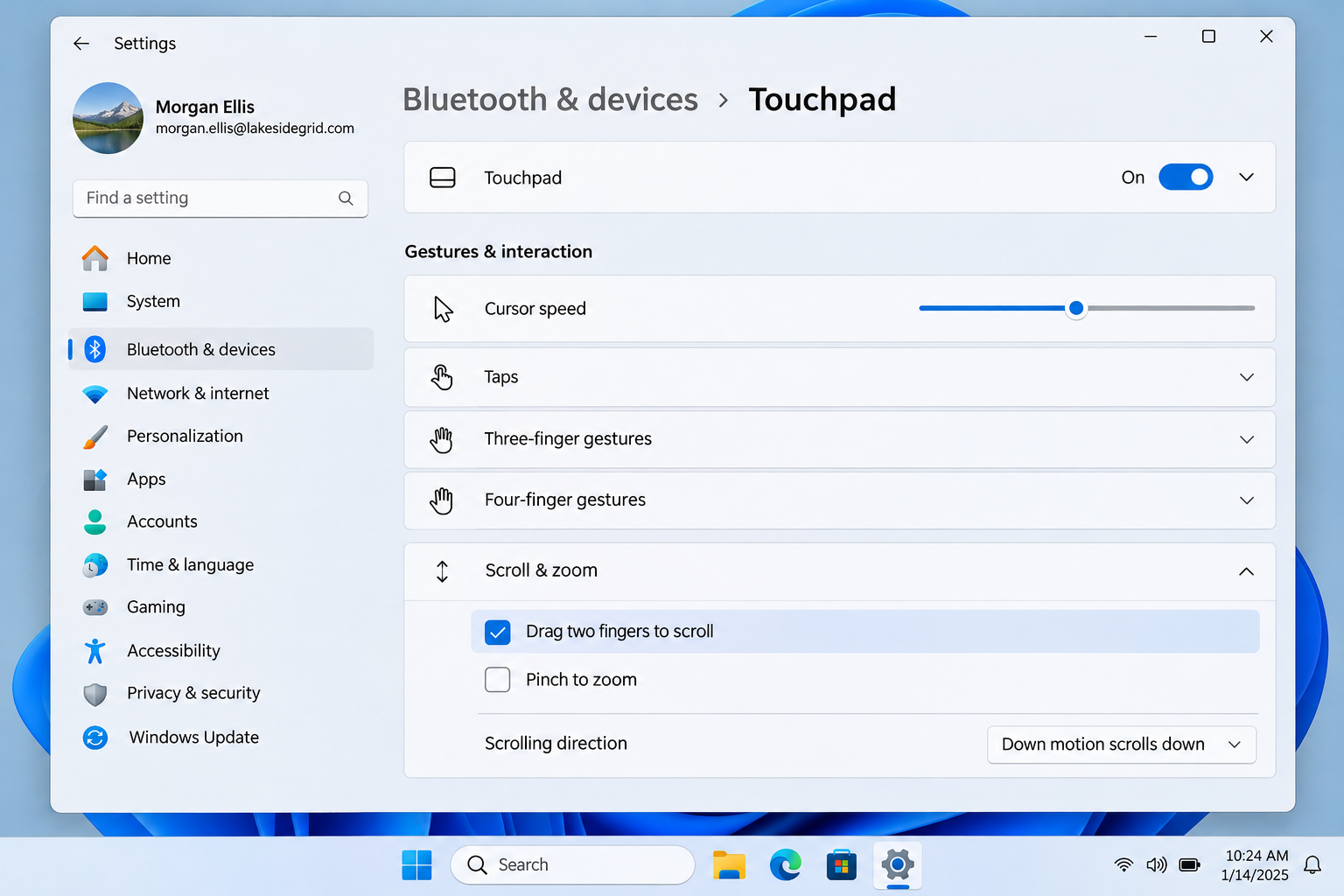
If dragging two fingers across your laptop’s touchpad doesn’t move the page, or moves it the wrong way, open Settings > Bluetooth & devices > Touchpad, expand Scroll & zoom, and tick Drag two fingers to scroll. The direction setting is in the same section.
This is for Windows 11 laptops and for touchpads Windows treats as precision touchpads. Wording on your PC may differ slightly.
Turn On Two-Finger Scrolling in Windows 11
Microsoft’s touch gestures page confirms the route to the Touchpad page. Microsoft doesn’t list the labels inside the Scroll & zoom section, so the names below come from recent third-party walkthroughs, and yours may differ slightly.
- Press Windows key + I to open Settings. You can also right-click Start and choose Settings, or search Start for “touchpad settings” to jump ahead.
- Select Bluetooth & devices, then Touchpad.
- Make sure the Touchpad switch at the top of the page is on. If it’s off, no gesture will work.
- Select Scroll & zoom to expand the section.
- Tick Drag two fingers to scroll.
- Open a long web page and slide two fingers up and down to test it.
The change should apply right away, so you usually don’t need to restart. Older instructions may send you to Settings > Devices > Touchpad, but that’s the Windows 10 path.
How to Scroll With Two Fingers
Microsoft describes the gesture simply: place two fingers on the touchpad and slide vertically or horizontally. Horizontal scrolling shows up in places like wide spreadsheets.
If it feels unreliable, a few practical habits can help, though these are general tips rather than Microsoft guidance. Touch down with both fingers at about the same time, keep them slightly apart, and keep your palm or thumb off the pad, since a third touch can cancel the gesture. A clean, dry pad helps too.
The checkbox next to it, usually labeled Pinch to zoom, controls a separate gesture: pinch in or stretch out to change the size of what’s on screen. Some older desktop apps ignore touchpad gestures, so test in a browser before you assume something’s wrong. In an app that won’t pinch, holding Ctrl while scrolling with two fingers may zoom instead.
Change the Scrolling Direction
Is the page going the wrong way? In the same Scroll & zoom section, look for a drop-down that’s usually named Scrolling direction. Microsoft’s pages don’t spell out these labels, so yours may be worded a little differently. Recent third-party walkthroughs show two choices:
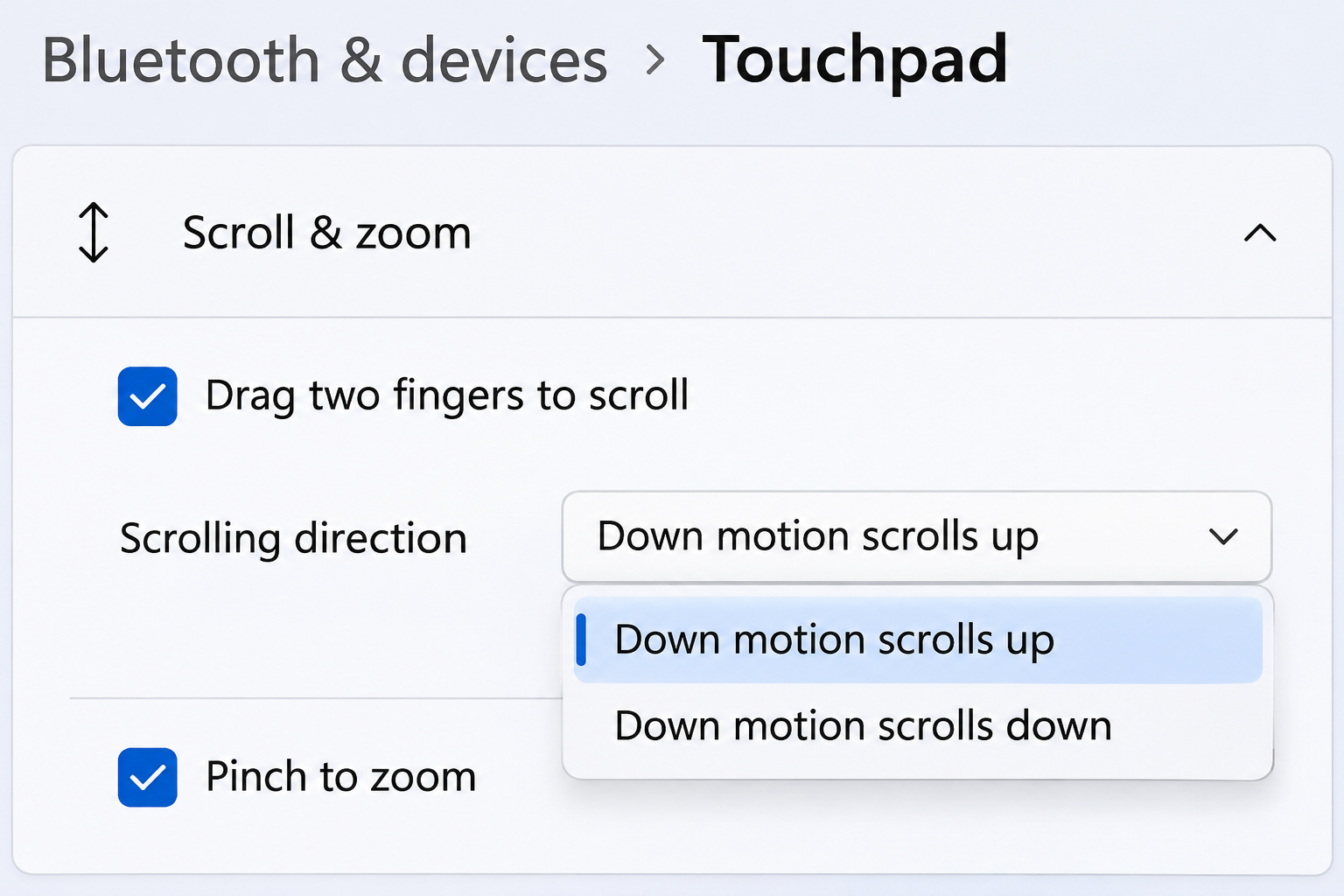
- Down motion scrolls down: slide your fingers down, and you move further down the page.
- Down motion scrolls up: slide your fingers down, and you move back up the page, as if you’re pushing paper around. This is how a phone feels.
Older articles call these options normal, natural or reverse, but don’t expect those words on the Touchpad page. Neither choice is more correct, so try each for a minute and keep the one your hand expects.
If Scroll & Zoom Is Missing
Microsoft notes that some touchpad gestures only work with precision touchpads. That’s a touchpad that uses gesture support built into Windows, rather than relying on the maker’s own software. If your Touchpad page shows few options and no Scroll & zoom section, you likely have an older driver or a touchpad without that support. Work through these in order:
- Run Windows Update. Microsoft recommends this route for touchpad drivers first, and an update alone sometimes brings the option back.
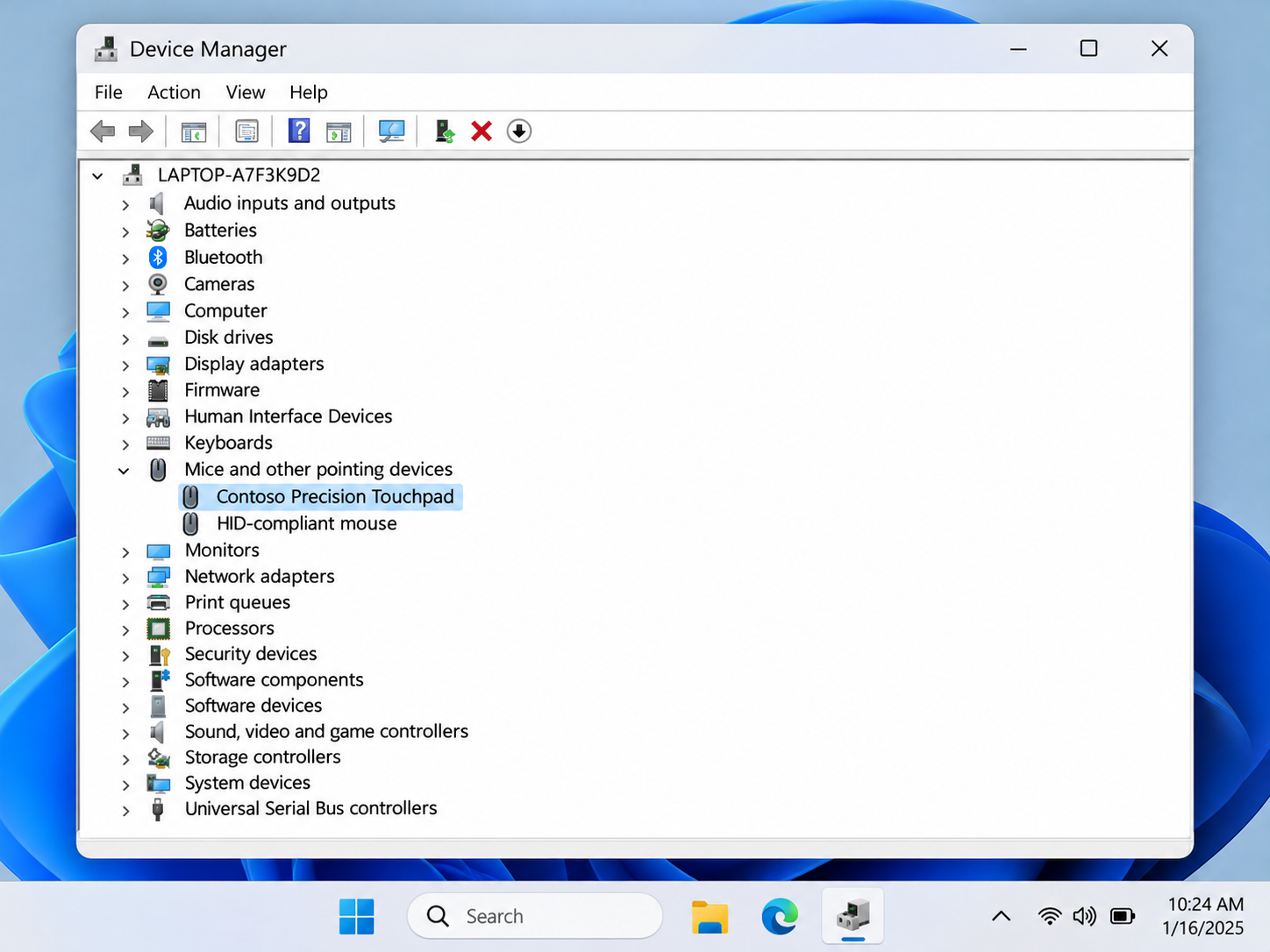
- Update the driver in Device Manager. Here’s how to open Device Manager in Windows 11. Expand Mice and other pointing devices or Human Interface Devices, right-click the touchpad and choose Update driver.
- Check the laptop maker’s support site for your exact model. Dell’s touchpad guide, for example, says some of its newer laptops use a precision touchpad driver built into Windows, and that Windows Update supplies the driver when Dell’s site lists none. This walkthrough on checking drivers on Windows 11 shows what you have now.
- Reinstall the driver. Plug in a USB mouse first, because the touchpad may stop responding until you restart. In Device Manager, right-click the touchpad, choose Uninstall device, then restart. Windows should set the touchpad up again on startup.
If none of this helps, contact the manufacturer. A touchpad that never had precision support won’t gain it from a settings change, and it may be controlled only by the maker’s software, described below.
If It Worked Before and Then Stopped
When a touchpad that used to scroll stops, the setting isn’t always the cause. Check these quick ones first:
- The touchpad got switched off. Many laptops have a key in the top row with a touchpad icon, or a spot on the pad itself, that turns it off. If the pointer has frozen as well, look for that key. Function-row behavior varies, and Fn key settings in Windows 11 can explain why the key seems to do nothing. If the pointer has vanished entirely, try these steps to bring back a missing cursor.
- A mouse is connected. Expand the Touchpad section at the top of the page and look for a checkbox usually named Leave touchpad on when a mouse is connected. When it’s cleared, plugging in a mouse disables the touchpad, which can look like a broken gesture.
- A recent update changed something. Driver installs sometimes reset touchpad options, so go back and recheck Scroll & zoom after a large update or driver install.
- It’s just one app. If scrolling works in your browser but not in one program, the issue is likely that program.
If Your Laptop Has Synaptics or ELAN Software
On some laptops the touchpad runs on its maker’s driver, and gesture controls move to that maker’s panel. These panels vary by maker and model, and the names below come from third-party how-tos, not Microsoft, so treat them as a rough map.
- Go to Settings > Bluetooth & devices > Mouse.
- Select Additional mouse settings to open the Mouse Properties window.
- Look for a tab with the touchpad maker’s name or something like Device Settings. Dell’s guide also reaches similar options through a More touchpad settings link on the Touchpad page.
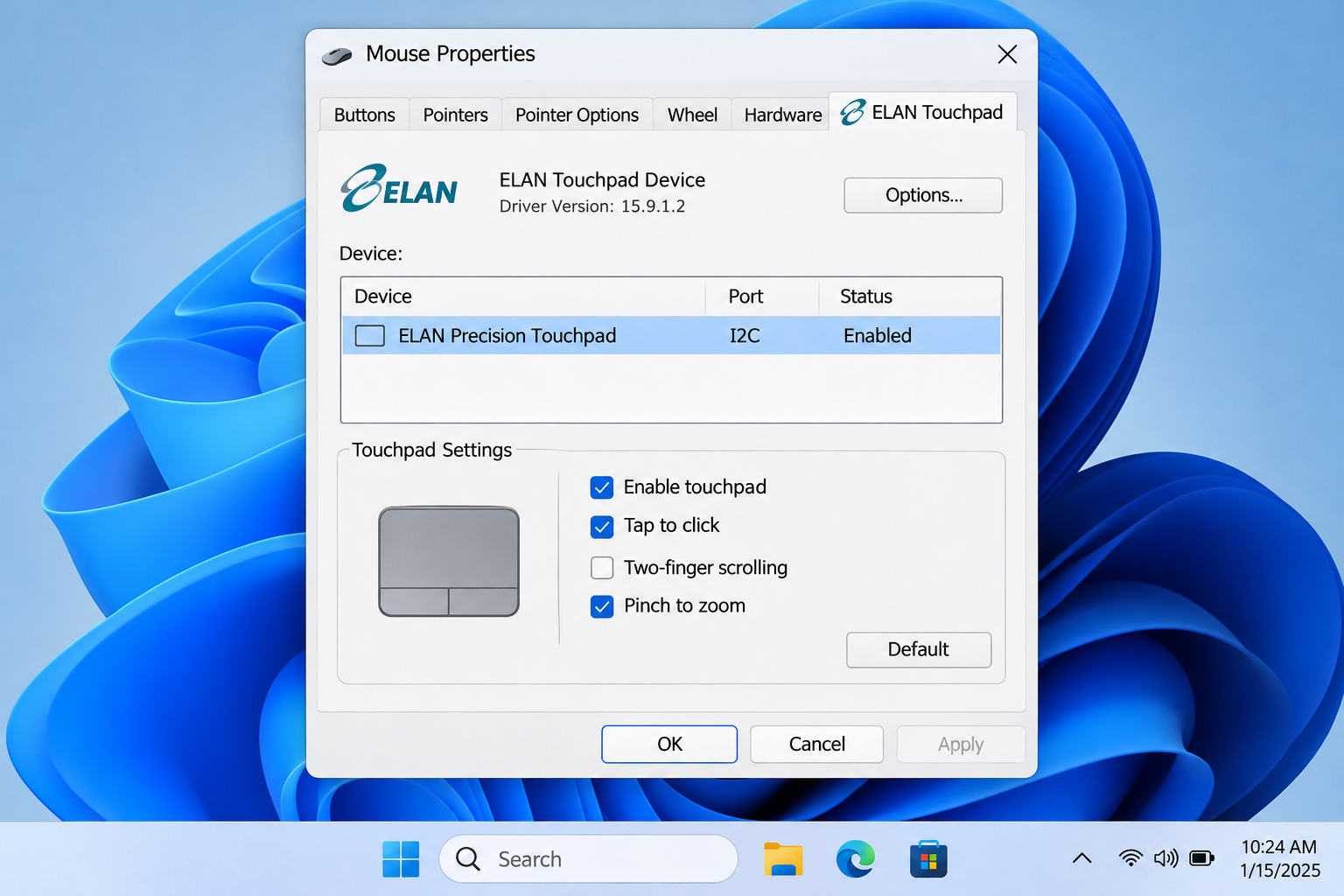
- Open that tab’s settings and look for a two-finger or multi-finger scroll option, then turn it on and select Apply.
If there’s no such tab, you aren’t using this software, and the Windows Touchpad page is the only control you need.
Other Touchpad Gestures
The same Touchpad page has Three-finger gestures and Four-finger gestures sections with drop-downs for what each swipe does. Note that Bluetooth & devices > Touch is a different page, for touch screens only. If a two-finger tap keeps opening menus instead, that’s a separate setting from scrolling, and you can turn off two-finger right-click without affecting it.
More Touchpad Scrolling Questions
Do I need to restart after turning it on?
Usually not. Restart if you reinstalled a driver, since that’s what prompts Windows to set the touchpad up again.
Does this work with an external touchpad or a mouse?
An external touchpad can use these settings if Windows sees it as a precision touchpad. Otherwise, its maker’s software controls it. A regular mouse uses its wheel and the separate Mouse settings page.
How do I turn two-finger scrolling off?
Go back to Scroll & zoom and clear Drag two fingers to scroll. Nothing else on the page changes.
Why can’t I find a Touchpad page at all?
A desktop PC without a touchpad won’t have this page, and a virtual machine often won’t either. On a laptop, suspect the driver and start with the driver steps above.
Once scrolling works, take a minute to set your direction, then try it in the program you use most.

Matthew Burleigh is the founder, head writer, and editor of Solve Your Tech, which he launched in 2012. He has written technology tutorials since 2008 and worked in IT since 2003, including small-business support, IT management, and consulting. He holds Bachelor’s and Master’s degrees in Computer Science from Arizona State University.
Matthew writes practical guides for Windows, iPhone and iPad, Microsoft Office, Outlook, Google apps, and Android. Solve Your Tech’s guides are checked step by step against the device or app maker’s own documentation and tested on his own devices whenever he has the hardware or software, with clear steps, sources, and update dates.
Read more about Matthew and how Solve Your Tech writes and updates its guides, or report a correction.