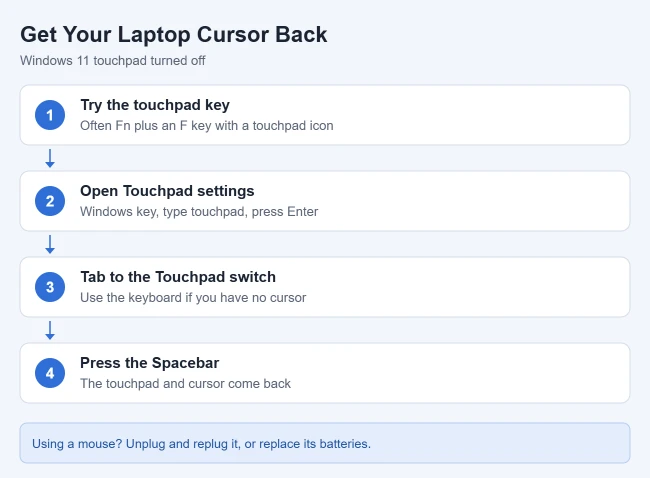
If the cursor disappeared on your Windows 11 laptop, the touchpad has most likely been turned off. Press your laptop’s touchpad key, often Fn plus one of the F keys with a touchpad icon, or turn Touchpad on in Settings > Bluetooth & devices > Touchpad. The steps below work with just the keyboard.
This guide starts with the fixes that solve most cases, then covers finding a pointer that’s there but hard to see, a cursor that vanishes after sleep, driver fixes, and external mice. Keyboard basics if you have no pointer at all: Tab moves between items, the arrow keys move within a list, Spacebar toggles a switch or checkbox, and Enter opens or confirms.
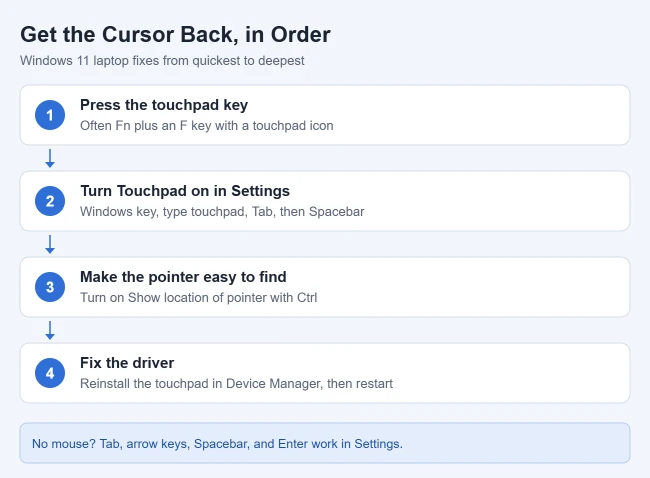
Step 1: Press the Touchpad Key
Look along the top row for a key with a touchpad icon (a rectangle, sometimes crossed out), often F5, F6, F7, or F9. Press it, or hold Fn and press it. Expected result: the cursor reappears right away, and some laptops show a “touchpad on” message. The key differs by brand, so check your laptop’s manual if you can’t find it.
Step 2: Turn the Touchpad Back On in Settings
- Press the Windows key, type touchpad, and press Enter to open Touchpad settings.
- Press Tab until the Touchpad switch is highlighted.
- Press the Spacebar to turn it on. Expected result: the switch shows On and the cursor responds to the touchpad.
- While you’re there, expand the Touchpad section and make sure Leave touchpad on when a mouse is connected is checked, if you sometimes use a mouse.
Step 3: Make a Hidden Pointer Easy to Find
Sometimes the pointer is there but hard to spot, or Windows hides it while you type. Check this setting:
- Open Settings > Bluetooth & devices > Mouse.
- Under Related settings, select Additional mouse settings, then the Pointer Options tab.
- Check Show location of pointer when I press the CTRL key, and uncheck Hide pointer while typing if the cursor keeps vanishing as you type.
- Select OK. Expected result: pressing Ctrl shows circles around the pointer.
To make the pointer bigger or a different color, see how to change your mouse cursor in Windows 11.
Step 4: Restart or Wake the Cursor
- Wake the cursor: press Ctrl + Alt + Delete, then Esc. Sometimes this makes a hidden cursor reappear.
- Toggle the touchpad: if the cursor disappears after sleep, a user on Microsoft Q&A reports that turning Touchpad off and back on in Settings brings it back.
- Restart: press Windows key + X, then U, then R. You can also press Ctrl + Alt + Delete and use the arrow keys to reach the power button in the corner.
Step 5: Update or Reinstall the Touchpad Driver
Microsoft says a missing or out-of-date driver is a common cause and recommends Windows Update first:
- Open Settings > Windows Update and install updates, including any optional driver updates under Advanced options > Optional updates.
- If that doesn’t help, open Device Manager (press Windows key + X, then M).
- Expand Human Interface Devices or Mice and other pointing devices and find the touchpad entry.
- Select it, press Shift + F10 to open the right-click menu, and choose Uninstall device. Confirm, then restart. Expected result: Microsoft says reinstalling forces the latest driver to download from Windows Update, and the touchpad works after the restart.
If the driver was updated recently and the problem started then, select Properties > Driver > Roll Back Driver instead, if it’s available. Microsoft suggests contacting the laptop maker if driver fixes don’t help, since the touchpad itself may be faulty.
Other Things That Hide the Cursor
The cursor moved to another screen
If a TV or second monitor is connected, or was recently, the pointer may be sitting on a screen you can’t see. Press Windows key + P, use the arrow keys to choose PC screen only, and press Enter. See how to set up multiple monitors to arrange the screens properly afterward.
It only disappears in Chrome or another app
Try toggling hardware acceleration when the pointer vanishes over one app. In Chrome, open Settings > System and switch Use graphics acceleration when available off or on, then relaunch Chrome.
It disappears after you use the touchscreen
On touchscreen laptops, Windows can hide the pointer while you use touch. Touch the touchpad or move the mouse to bring it back.
None of the fixes worked
Try repairing Windows system files: open Terminal (Admin) with Windows key + X, then A, type sfc /scannow, and press Enter. If the problem started recently, you can also go back to a restore point from before it began.
If Only a Mouse Is Missing
- USB mouse: unplug it, wait a few seconds, and plug it into a different port. Check the cable for damage.
- Wireless mouse: remove and reinsert the USB receiver, and replace the batteries.
- Bluetooth mouse: check that Bluetooth is on in Settings > Bluetooth & devices, then remove and pair the mouse again. See how to turn on Bluetooth in Windows 11.
- Test another mouse or try this one on another PC to rule out the mouse itself.
Frequently Asked Questions
Why did my touchpad turn off?
It’s easy to press the touchpad key by accident. Some laptops also turn off the touchpad when a mouse is connected.
How do I reset my cursor on Windows 11?
If the pointer is visible but looks wrong, go to Settings > Accessibility > Mouse pointer and touch and pick the white style at the smallest size. To change how fast it moves, see how to change mouse pointer speed.
The keyboard isn’t working either. What now?
Then the problem is broader than the touchpad. See how to fix a keyboard not working in Windows 11, or connect a USB mouse and keyboard to get around.
Does this work on a desktop PC?
Desktops don’t have a touchpad, so skip to the mouse section and check the mouse and its connection instead.
Touchpad opening menus when you tap? See how to change the right-click touchpad setting in Windows.

Matthew Burleigh is the founder, head writer, and editor of Solve Your Tech, which he launched in 2012. He has written technology tutorials since 2008 and worked in IT since 2003, including small-business support, IT management, and consulting. He holds Bachelor’s and Master’s degrees in Computer Science from Arizona State University.
Matthew writes practical guides for Windows, iPhone and iPad, Microsoft Office, Outlook, Google apps, and Android. Solve Your Tech’s guides are tested on current devices or checked against official product documentation, with clear steps, sources, and update dates.
Read more about Matthew and how Solve Your Tech writes and updates its guides, or report a correction.