Quick access in Windows 11 lives in File Explorer, as a section on the Home page and as a list of pinned folders at the top of the left pane. To add a folder, right-click it and select Pin to Quick access. To remove one, right-click it and select Unpin from Quick access.
These steps cover Windows 11 version 22H2 and later, where Microsoft renamed the old Quick access page to Home. A short note for Windows 10 is in the FAQ.
Quick access is a list of shortcuts, not a real folder. Pinning, unpinning, or resetting it never moves or deletes the files inside your folders.
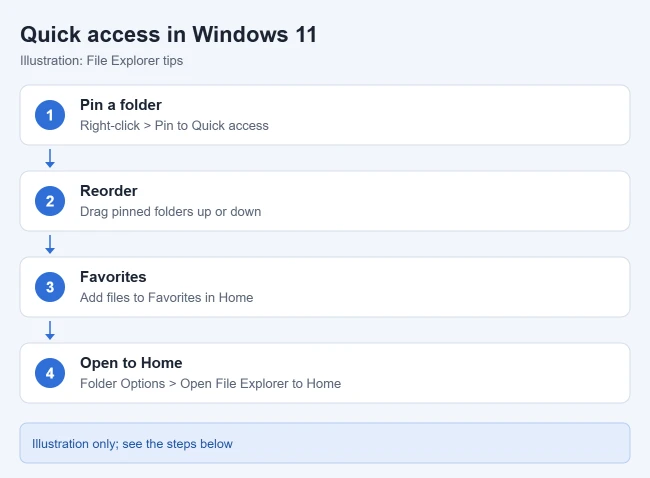
Where Is Quick Access in Windows 11?
Press Windows key + E to open File Explorer. Quick access shows up in two places:
- The Home page. Select Home at the top of the left pane. The Quick access section shows your pinned folders as large tiles, followed by Favorites and Recent files.
- The left pane. Your pinned folders are listed just below Home and Gallery, each with a small pin icon. These stay visible no matter which folder you’re in.
You can also type Home in the File Explorer address bar and press Enter to jump to the Home page.
Pin a Folder to Quick Access
- Press Windows key + E to open File Explorer and browse to the folder you want.
- Right-click the folder.
- Select Pin to Quick access.
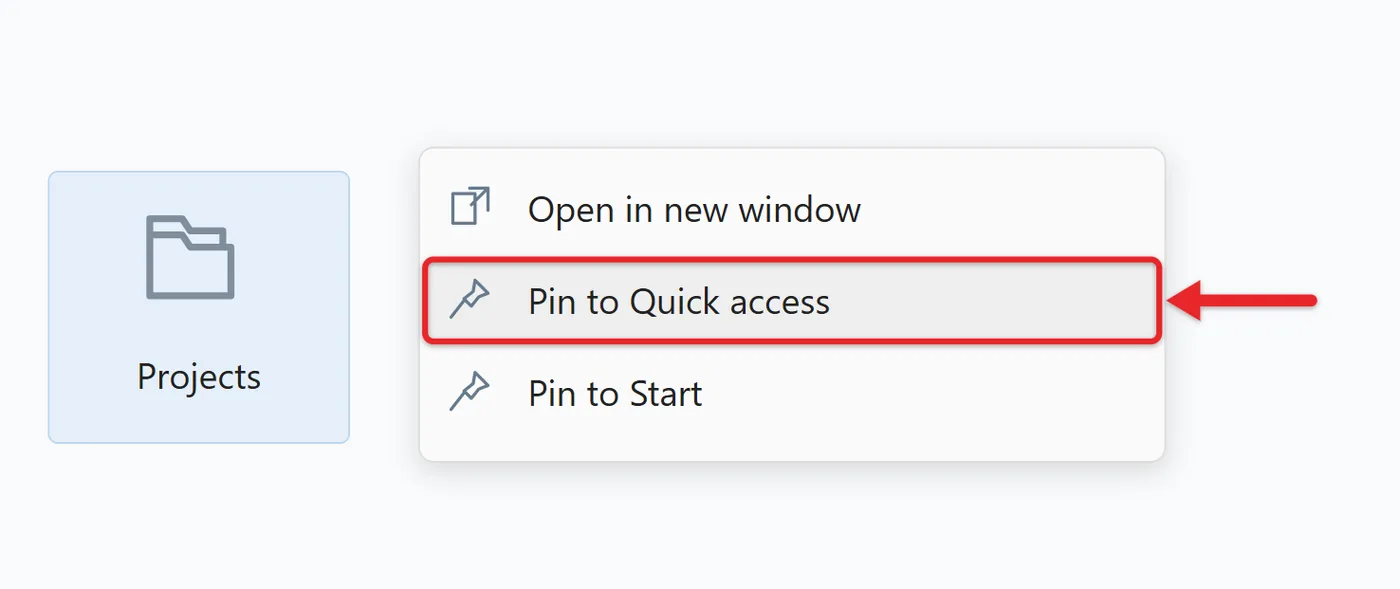
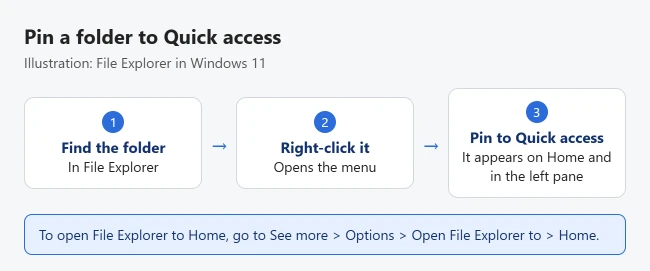
The folder now appears in the Quick access section of Home and near the top of the left pane. Here are two other ways to pin:
- Use the toolbar. Select the folder, select the three-dot See more button in the toolbar, and choose Pin to Quick access.
- Drag it. Drag the folder into the pinned list in the left pane and release it there.
You can pin drives, the Recycle Bin, network folders, and OneDrive folders the same way. Folders you pin to File Explorer’s jump list on the taskbar also show up in Quick access, since the two share one list.
A pinned folder is also a good place to start when you search for words inside files.
Unpin, Rearrange, or Remove Items
- Right-click a pinned folder in the left pane or on Home.
- Select Unpin from Quick access. The tile and the left-pane entry disappear. The folder itself stays where it was.
- To change the order, drag a pinned folder up or down in the left pane and drop it where you want it.
Folders that Windows added on its own (frequent folders) have no pin icon. If one keeps coming back, turn off Show frequently used folders, described below.
Add Files to Favorites
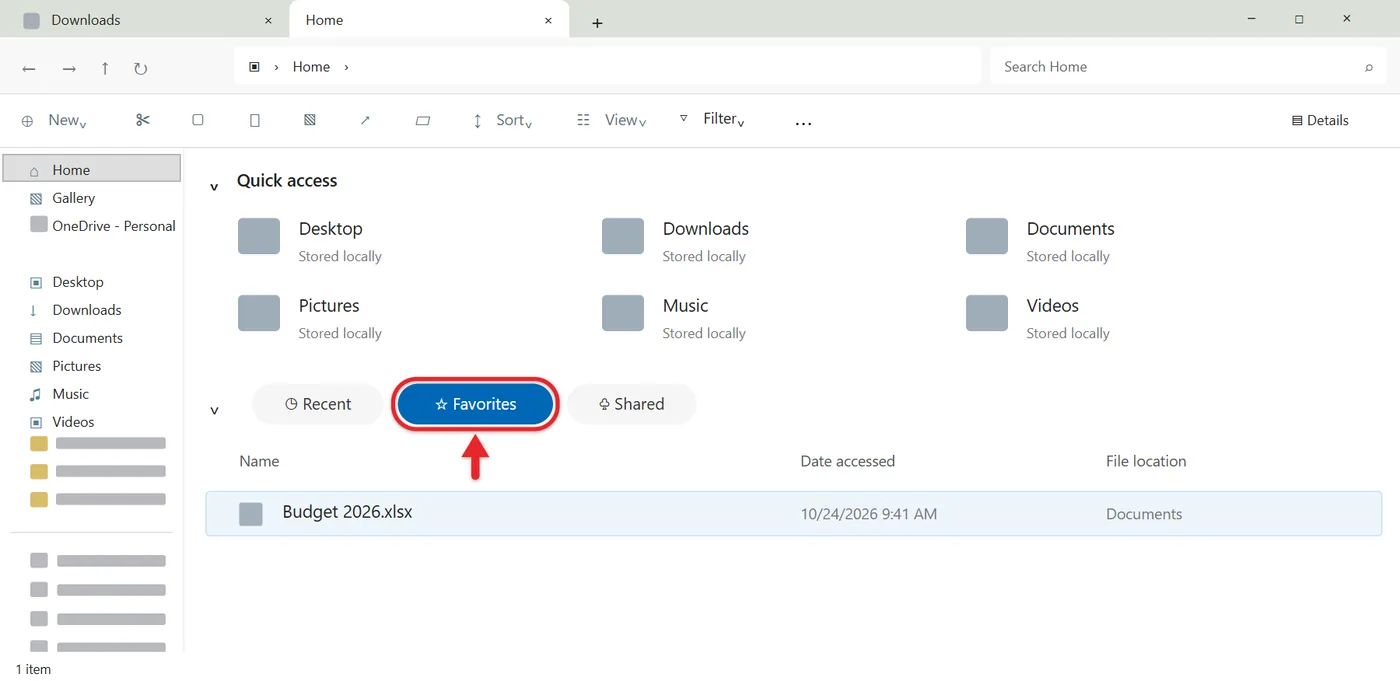
Quick access is for folders. For single files you open often, Home has a Favorites section.
- Right-click a file in File Explorer.
- Select Add to favorites.
- Open Home to find it under Favorites. To take it off, right-click it and select Remove from favorites.
If you sign in with a Microsoft account or a work or school account, files you favorite in Office apps or on Office.com can also show here.
Make File Explorer Open to Home or This PC
File Explorer opens to Home by default. If yours opens to This PC and you want Quick access first, change it here:
- Open File Explorer.
- Select the three-dot See more button in the toolbar, then Options. The Folder Options window opens.
- On the General tab, open the Open File Explorer to menu and choose Home.
- Select Apply, then OK.
- Close File Explorer and press Windows key + E. It should open on Home.
Older guides tell you to pick Quick access in this menu. That choice no longer exists in Windows 11 because Quick access became part of Home.
To start on your drives instead, choose This PC in the same menu. Quick access stays in the left pane either way. For more ways to reach it, read about showing This PC on the desktop.
Show or Hide Recent Files and Frequent Folders
The Privacy section of the same Folder Options window controls what Windows adds to Home on its own.
- Open See more > Options.
- Under Privacy, check or uncheck Show recently used files and Show frequently used folders.
- To wipe the current history, select Clear next to Clear File Explorer history.
- Select OK.
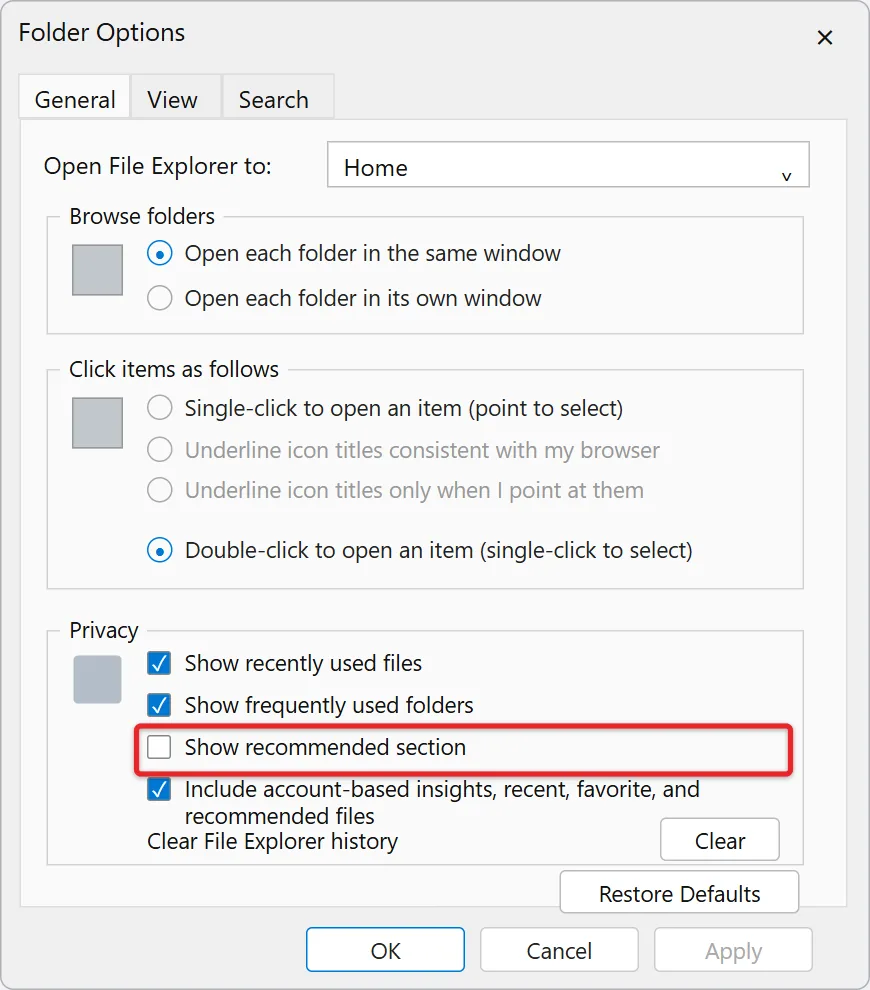
Depending on your Windows build and account, you may see more boxes here, such as one for Office.com files or Show recommended section. Turning everything off leaves Home showing only what you pinned and favorited, which is a good setup for a shared PC. Clearing history doesn’t touch your pins.
For other ways to empty the list, read about clearing recent files in Windows 11.
Restore Desktop, Documents, and Downloads
Since Windows 11 version 22H2, Desktop, Documents, Downloads, Pictures, Music, and Videos are pinned to Quick access by default, and they no longer appear under This PC. If you unpinned one, Microsoft’s File Explorer help gives this fix:
- Open File Explorer and select Home in the left pane.
- Select the Up arrow to the left of the address bar. All six folders appear.
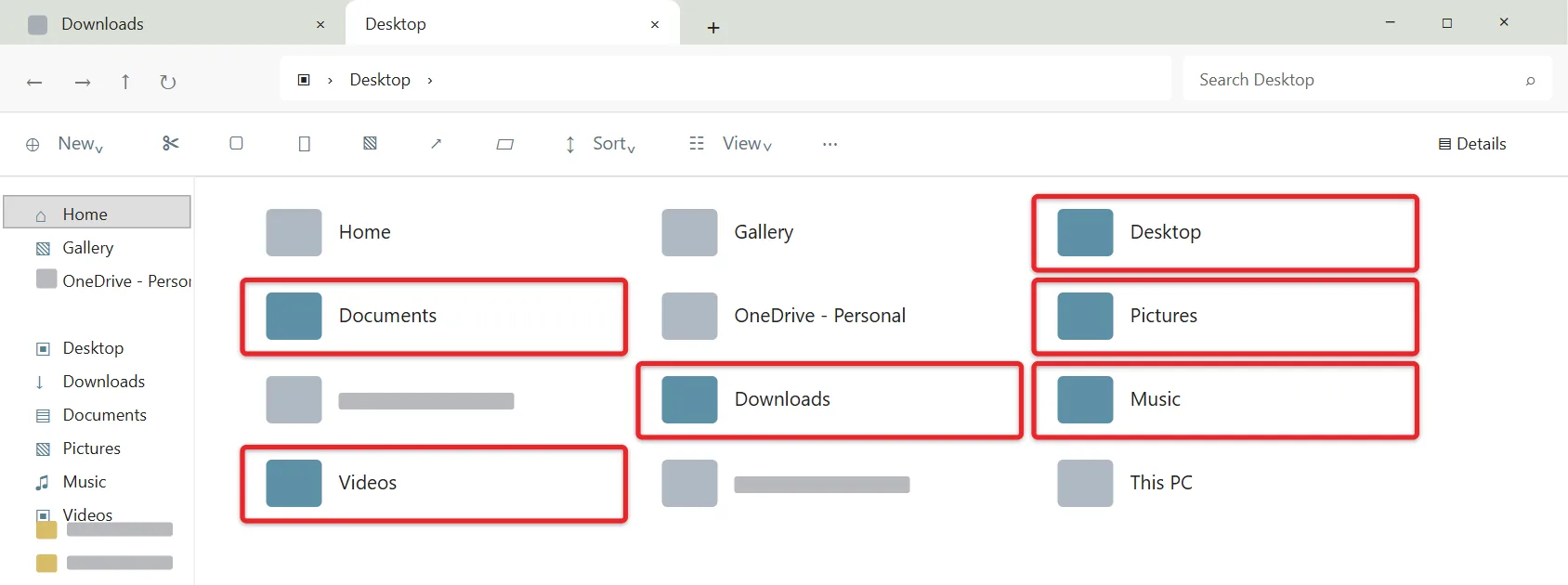
- Right-click the folder you want back and select Pin to Quick access.
Quick Access Is Missing: How to Get It Back
Work through these in order. Each one fixes a different cause.
| What you see | Fix |
|---|---|
| No left pane at all | Select View > Show > Navigation pane. |
| Left pane shows a long folder tree but no pinned folders | Right-click an empty area of the left pane and uncheck Show all folders. |
| Home shows Recommended where Quick access used to be | Open See more > Options and uncheck Show recommended section. If a box about account or cloud activity is there too, uncheck it, then select OK. |
| Pinned folders vanished after an update | Restore known folders with the Up arrow steps above, then re-pin the rest. |
Microsoft started adding a Recommended section to Home in 2025, and on some PCs it takes the space Quick access used. The fix in the table comes from Microsoft’s community forum and has worked for many users. Your pinned folders stay in the left pane either way.
Pin to Quick Access Is Missing or Won’t Work
- The menu says Unpin instead. The folder is already pinned.
- The option isn’t in the right-click menu. Select Show more options at the bottom of the menu, or use the three-dot See more button in the toolbar.
- You right-clicked a search result or library. Go to the folder’s real location and pin it from there.
- Pins stop updating or show old names. Restart File Explorer. Open Task Manager with Ctrl + Shift + Esc, right-click Windows Explorer, and select Restart.
- Home is slow to load. Unpin network folders or drives that aren’t connected. Windows waits for them before showing the page.
- A work PC won’t let you change these options. Your organization may control them with policy. Ask your IT department.
Reset Quick Access
If pins are stuck, duplicated, or won’t unpin, reset the list. This removes every pinned folder, so write down the ones you want or back up the file first.
- Close all File Explorer windows.
- Press Windows key + R, paste the path below, and press Enter.
%AppData%\Microsoft\Windows\Recent\AutomaticDestinations
- Find the file named f01b4d95cf55d32a.automaticDestinations-ms. To keep a backup, copy it to another folder first.
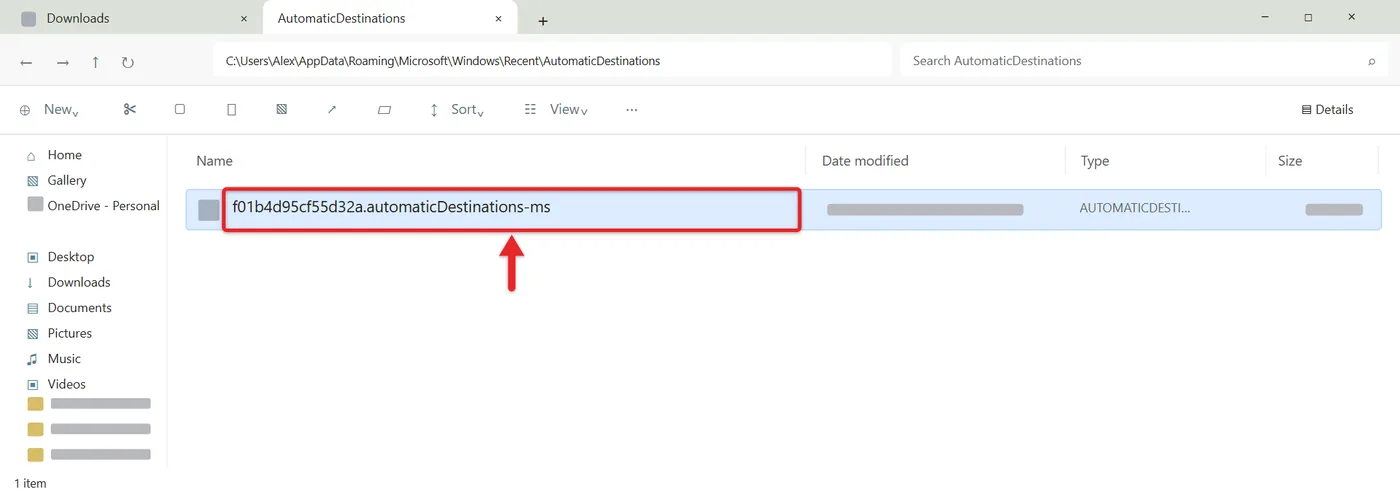
- Delete the file.
- Press Windows key + E. Windows rebuilds Quick access with the six default folders.
- Pin your own folders again.
To undo the reset, copy your backup file into the same folder while File Explorer is closed. The AppData folder is hidden by default, so here is how to access the AppData folder.
Quick Access Questions
Where did Quick access go in Windows 11?
It’s still there. Windows 11 version 22H2 moved it into the Home page of File Explorer, where it’s a section called Quick access. Pinned folders also appear near the top of the left pane.
Can I pin a drive or the Recycle Bin?
Yes. Right-click a drive in This PC, or the Recycle Bin, and select Pin to Quick access. If you need to locate your drives, here is how to find the C drive on Windows 11.
Does unpinning delete the folder?
No. It only removes the shortcut from Quick access. The folder and its files stay where they are.
Can I turn Quick access off completely?
Windows has no supported switch that removes it from the left pane. You can get close: set Open File Explorer to to This PC, uncheck the Privacy boxes, and unpin the folders you don’t want. Avoid registry tweaks that hide it, because Microsoft doesn’t document them and updates can undo them.
Is this the same as the Quick Access Toolbar?
No. The Quick Access Toolbar is the row of small command buttons in Word, Excel, and other Office apps. If those buttons are missing, here is how to restore a missing toolbar or ribbon in Word.
How does Quick access work in Windows 10?
Windows 10 opens File Explorer straight to a Quick access page, and Open File Explorer to offers Quick access instead of Home. Pinning and unpinning use the same right-click commands.
For more File Explorer tips, read about using File Explorer in Windows 11. To find files you opened lately, here is where to see recent files in Windows 11.

Matthew Burleigh is the founder, head writer, and editor of Solve Your Tech, which he launched in 2012. He has written technology tutorials since 2008 and worked in IT since 2003, including small-business support, IT management, and consulting. He holds Bachelor’s and Master’s degrees in Computer Science from Arizona State University.
Matthew writes practical guides for Windows, iPhone and iPad, Microsoft Office, Outlook, Google apps, and Android. Solve Your Tech’s guides are checked step by step against the device or app maker’s own documentation and tested on his own devices whenever he has the hardware or software, with clear steps, sources, and update dates.
Read more about Matthew and how Solve Your Tech writes and updates its guides, or report a correction.