To change your mouse cursor in Windows 11, open Settings > Accessibility > Mouse pointer and touch, choose a Mouse pointer style (white, black, inverted, or a custom color), and drag the Size slider. For a different pointer design, open Bluetooth & devices > Mouse > Additional mouse settings and pick a scheme on the Pointers tab.
The steps below follow Microsoft’s support articles on making your mouse and keyboard easier to use and changing mouse settings. They also cover the text cursor (the blinking line where you type), pointer trails, and pointer speed.
How to Change the Mouse Pointer Style, Color, and Size
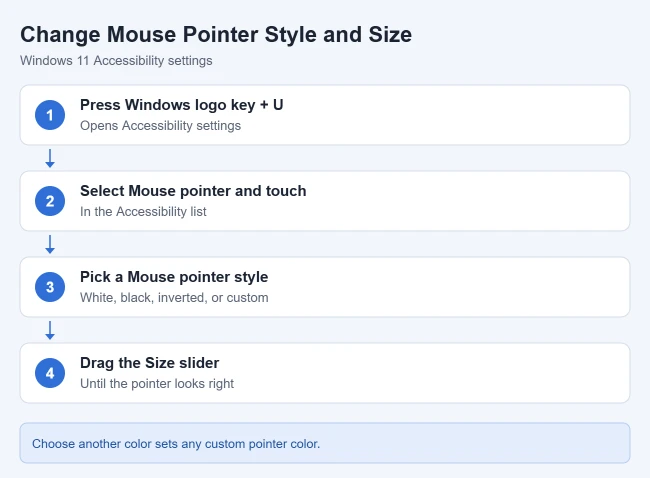
- Press the Windows logo key + U to open Accessibility settings, or select Start > Settings > Accessibility.
- Select Mouse pointer and touch.
- Under Mouse pointer style, choose white, black, inverted, or one of the bright recommended colors. To pick any color, select Choose another color.
- Under Mouse pointer, drag the Size slider until the pointer is the size you want.
Result: The pointer changes to the style, color, and size you picked.
How to Use a Different Pointer Scheme or Custom Cursor
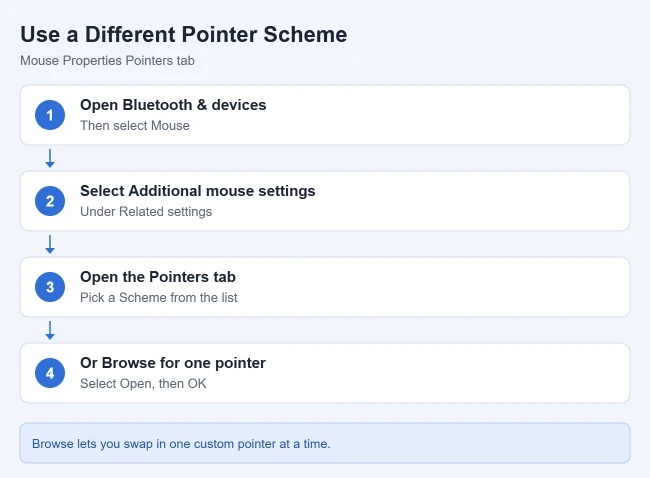
- Select Start > Settings > Bluetooth & devices > Mouse.
- Under Related settings, select Additional mouse settings.
- In the Mouse Properties window, select the Pointers tab.
- To change every pointer at once, open the list under Scheme and choose a new scheme.
- To change one pointer, select it under Customize, select Browse, choose the pointer file, then select Open.
- Select OK.
Result: The new scheme or custom pointer replaces the default cursor. Only use cursor files from sources you trust.
How to Make the Text Cursor Easier to See
The text cursor is the blinking line that shows where you’re typing. Microsoft lets you change it separately:
- Press Windows logo key + U and select Text cursor.
- Drag the Text cursor thickness slider until the preview looks right.
- To add a colorful marker, turn on Text cursor indicator, adjust its Size, and pick a color under Recommended colors or Choose another color.
Other Pointer Options
Microsoft’s mouse settings article covers a few more ways to change how the pointer behaves:
- Pointer speed: In Settings > Bluetooth & devices > Mouse, use the Mouse pointer speed slider. For more detail, see how to change mouse pointer speed in Windows.
- Precision: On the same page, turn on Enhance pointer precision to make the pointer more accurate when you move the mouse slowly.
- Pointer trails: Select Additional mouse settings, open the Pointer Options tab, and select Display pointer trails. Move the slider toward Short or Long.
- Hide while typing: On the Pointer Options tab, select Hide pointer while typing.
More Mouse Settings Worth Knowing
While you’re in the Mouse settings, Microsoft documents a few other changes that make the mouse more comfortable to use:
- Swap the buttons: In Settings > Bluetooth & devices > Mouse, use the Primary mouse button menu to choose Left or Right.
- Double-click speed: Select Additional mouse settings, stay on the Buttons tab, and move the Speed slider under Double-click speed.
- ClickLock: On the same Buttons tab, select Turn on ClickLock to highlight or drag without holding the button down.
- Snap To: On the Pointer Options tab, select Automatically move pointer to the default button in a dialog box. Microsoft notes some apps might not support it.
- Mouse keys: In Accessibility settings, select Mouse under Interaction and turn on Mouse keys to move the pointer with the numeric keypad.
Frequently Asked Questions
How do I go back to the default cursor?
In Mouse pointer and touch, choose the white style and drag Size back to the smallest setting. If you changed the scheme, open the Pointers tab and choose the Windows default scheme from the Scheme list.
Why did my cursor disappear?
That’s usually a different problem from changing its look. See how to get your cursor back on a Windows 11 laptop.
Does the pointer color work in dark mode?
Yes. Pointer style is set in Accessibility settings, separately from your Windows color mode, so you can pair a bright pointer with dark mode in Windows 11.
Related Guides

Matthew Burleigh is the founder, head writer, and editor of Solve Your Tech, which he launched in 2012. He has written technology tutorials since 2008 and worked in IT since 2003, including small-business support, IT management, and consulting. He holds Bachelor’s and Master’s degrees in Computer Science from Arizona State University.
Matthew writes practical guides for Windows, iPhone and iPad, Microsoft Office, Outlook, Google apps, and Android. Solve Your Tech’s guides are tested on current devices or checked against official product documentation, with clear steps, sources, and update dates.
Read more about Matthew and how Solve Your Tech writes and updates its guides, or report a correction.