To find all photos on a Windows 11 computer, open File Explorer, select This PC in the left pane, type kind:=picture in the search box, and press Enter. Windows searches every drive it can reach and lists your image files, wherever they’re saved.
These steps are for Windows 11 24H2 through 26H2, and File Explorer search works the same in Windows 10. File Explorer is the most complete option, since Photos and Gallery only show folders they know about. A full search can take minutes; the Enhanced indexing section speeds up later ones.
Where Windows Usually Keeps Photos
Before you search the whole PC, it helps to know the usual hiding places. Most pictures end up in one of these:
- Pictures (C:\Users\your name\Pictures), including its Camera Roll, Saved Pictures, and Screenshots subfolders. Screenshots taken with Windows key + Print Screen are saved in Pictures > Screenshots.
- Downloads, for images saved from websites, email, and chat apps.
- Desktop and Documents, for files someone saved in a hurry.
- OneDrive, if OneDrive backs up your Pictures folder. In that case the Pictures folder actually lives inside your OneDrive folder, and the Pictures shortcut in File Explorer’s left pane takes you there.
- External drives, SD cards, and phones, which only show up while they’re connected.
If you can’t find a photo in those places, search the whole PC.
Find All Photos With File Explorer
Where a search starts decides where it looks. Start from This PC when you don’t know where a picture is saved.
- Press Windows key + E to open File Explorer.
- Click This PC in the left pane. Your drives appear under Devices and drives. If you’re fairly sure the photo is in Pictures, Downloads, or on an external drive, click that location instead for a quicker search.
- Click the search box in the top-right corner of the window and type kind:=picture.
- Press Enter. A green progress bar moves across the address bar while Windows searches, and results fill in as they’re found. Wait for the bar to finish before deciding a photo isn’t there.
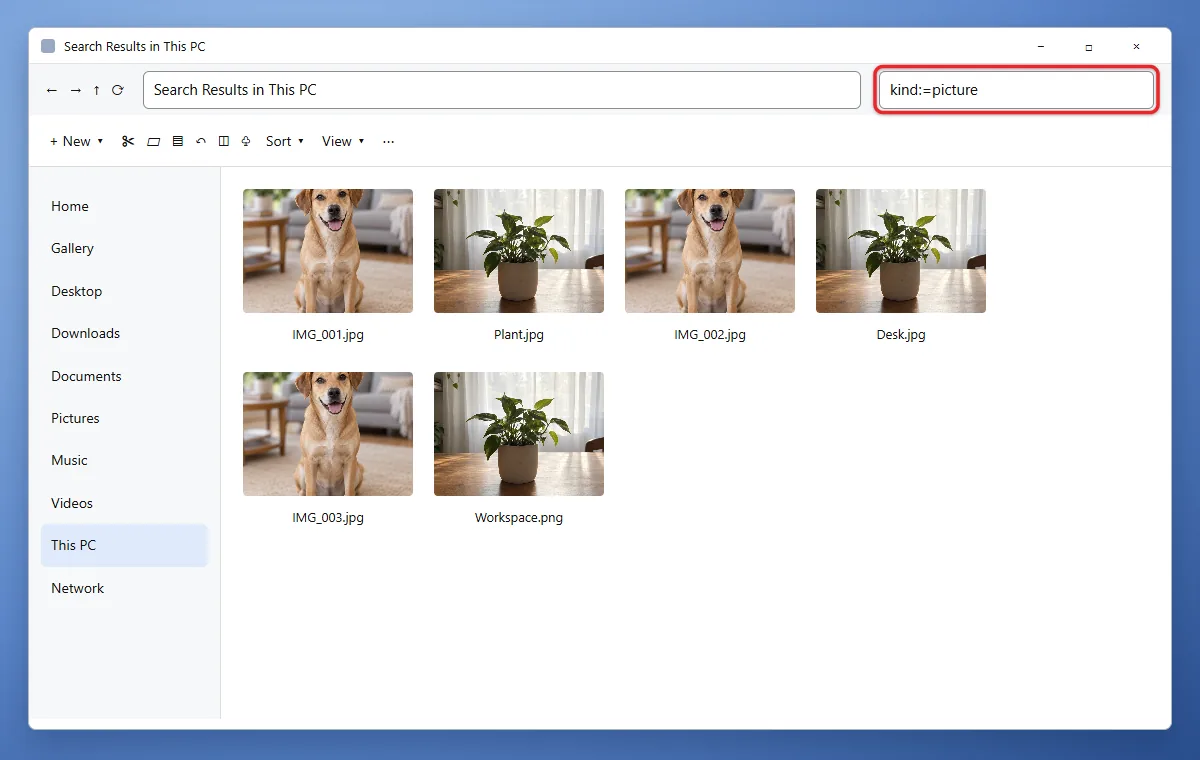
- Click View on the toolbar and choose Large icons so you see thumbnails instead of a list of file names.
- When you find the photo you want, right-click it and choose Open file location. File Explorer opens the folder that holds it, so you know where it lives.
The kind:=picture filter uses Windows Search’s query syntax, which Microsoft documents in its Advanced Query Syntax reference. The := part means “exactly equals,” so the search matches any file Windows classifies as a picture, including JPG, PNG, GIF, BMP, and HEIC files.
Search by File Extension Instead
If a photo you know exists still doesn’t show up, search for its file extension. Type one of these into the search box from This PC:
- *.jpg or *.jpeg for most camera and phone photos
- *.png for screenshots and graphics
- *.heic for photos copied from an iPhone
- *.gif or *.webp for images saved from websites
To search for several types at once, join them with OR in capital letters, such as *.jpg OR *.png OR *.heic. An extension search can catch files that Windows doesn’t classify as pictures, such as a format it doesn’t recognize without an extra codec.
Narrow the Results
A search of the whole PC can return thousands of images, including tiny icons that belong to apps. Add one or more filters after kind:=picture, separated by spaces:
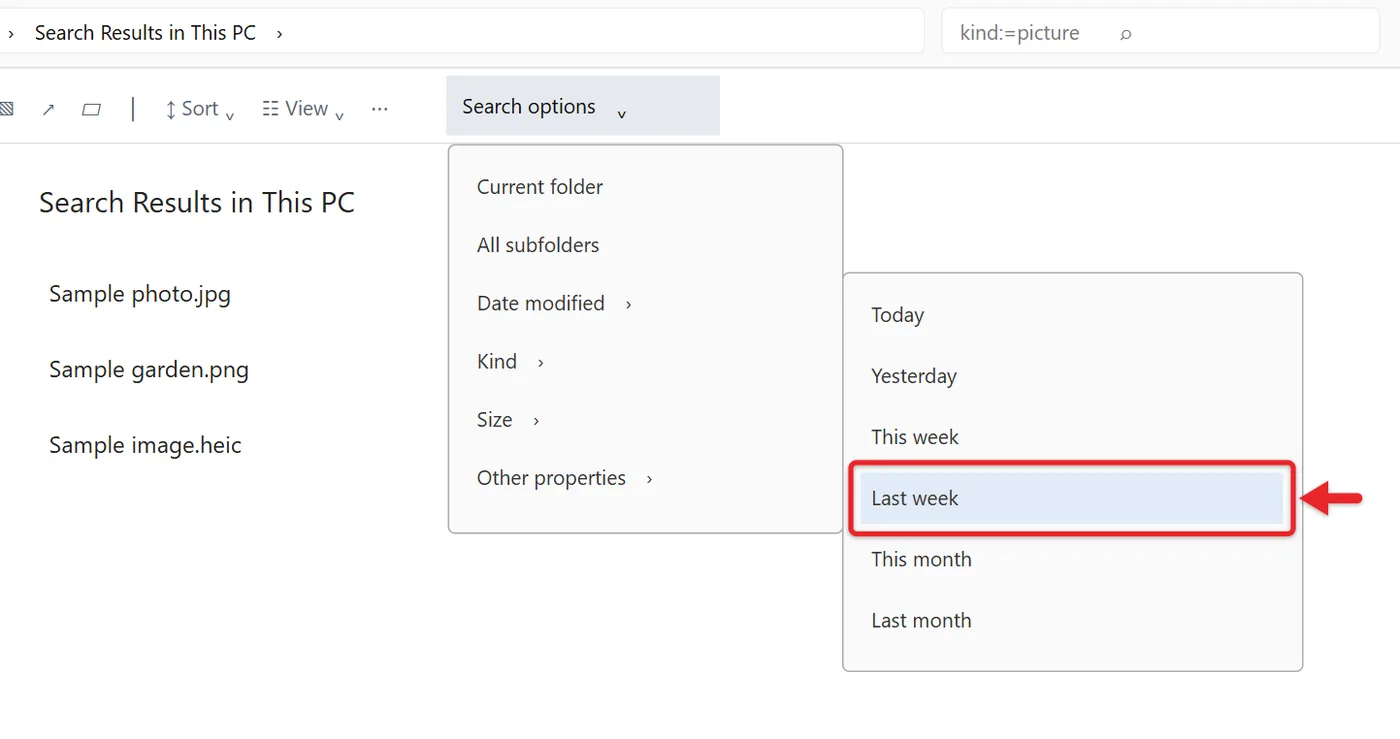
- ext:.jpg or ext:.png shows only one file type. For iPhone photos, try ext:.heic.
- datemodified:this year or datemodified:last week limits results by date.
- size:>1MB hides small icons and thumbnails, which leaves mostly real photos.
- Part of a file name, such as IMG_ (common on phones) or DSC (common on cameras), finds photos that kept their original names.
For example, kind:=picture size:>1MB IMG_ finds full-size phone photos and skips the clutter. If you’d rather not type filters, click Search options on the toolbar after a search starts and pick Date modified, Kind, or Size from the menus. To reorder what you find, click Sort on the toolbar and choose Date modified, Name, Type, or Size.
In Details view, you can also add a Date taken column in File Explorer to sort photos by when they were shot. Date modified changes when a file is copied or edited, so Date taken is usually closer to the day the picture was actually taken.
Make Searches Faster With Enhanced Indexing
By default, Windows uses Classic indexing, which only covers your Documents, Pictures, and Music folders plus the desktop. When you search everywhere else, Windows has to read the files one by one, which is why a This PC search is slow. Enhanced mode indexes your entire PC so later searches return results much faster.
- Press Windows key + I to open Settings.
- Click Privacy & security in the left pane.
- Click Search.
- Under Find my files, select Enhanced.
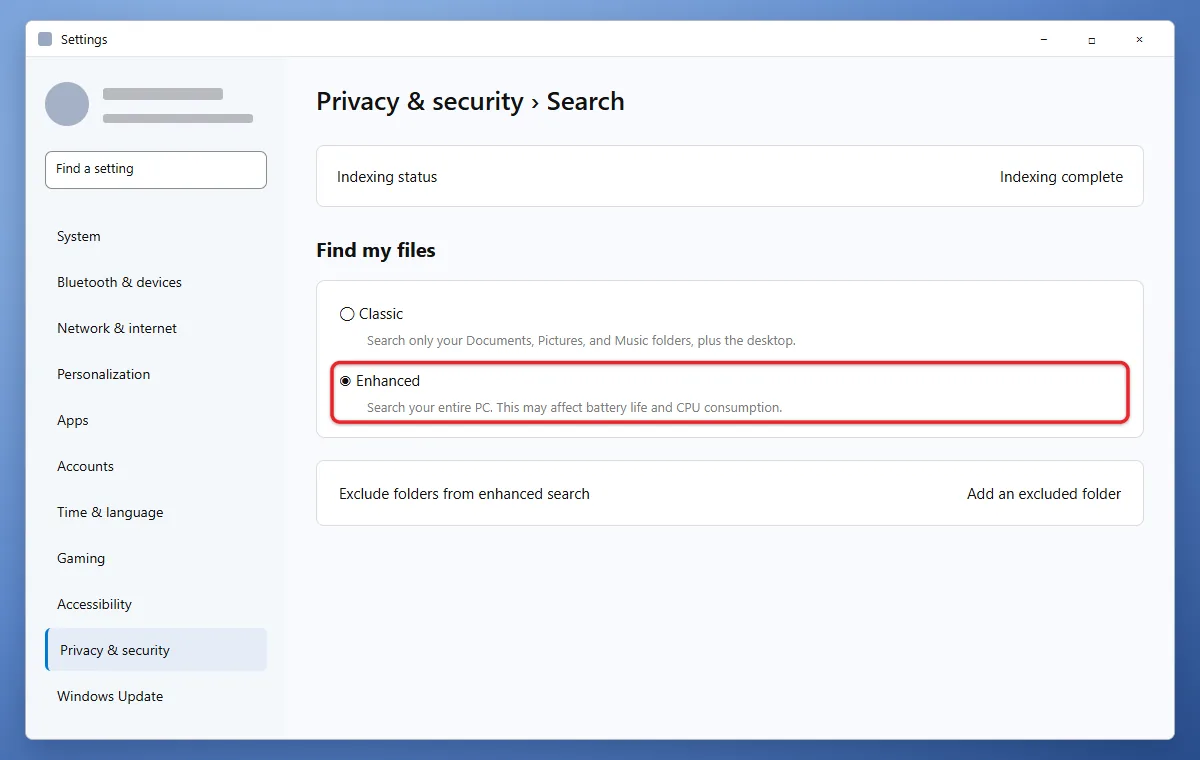
Microsoft’s search indexing help says the first indexing run can take up to a couple of hours and that Enhanced mode may use more system resources. On a laptop, keep it plugged in while that first run finishes. You can switch back to Classic at the same place at any time. If you’d rather keep Classic, click Customize search locations on the same page to add only the folders where you keep photos.
Show All Your Photos in the Photos App
Once you know where your pictures are, the Photos app is a nicer way to browse them in date order. Its Gallery shows your Pictures folder automatically, so add any other folders you found.
- Open the Photos app from the Start menu.
- Click This PC in the left pane.
- Click Add a folder.
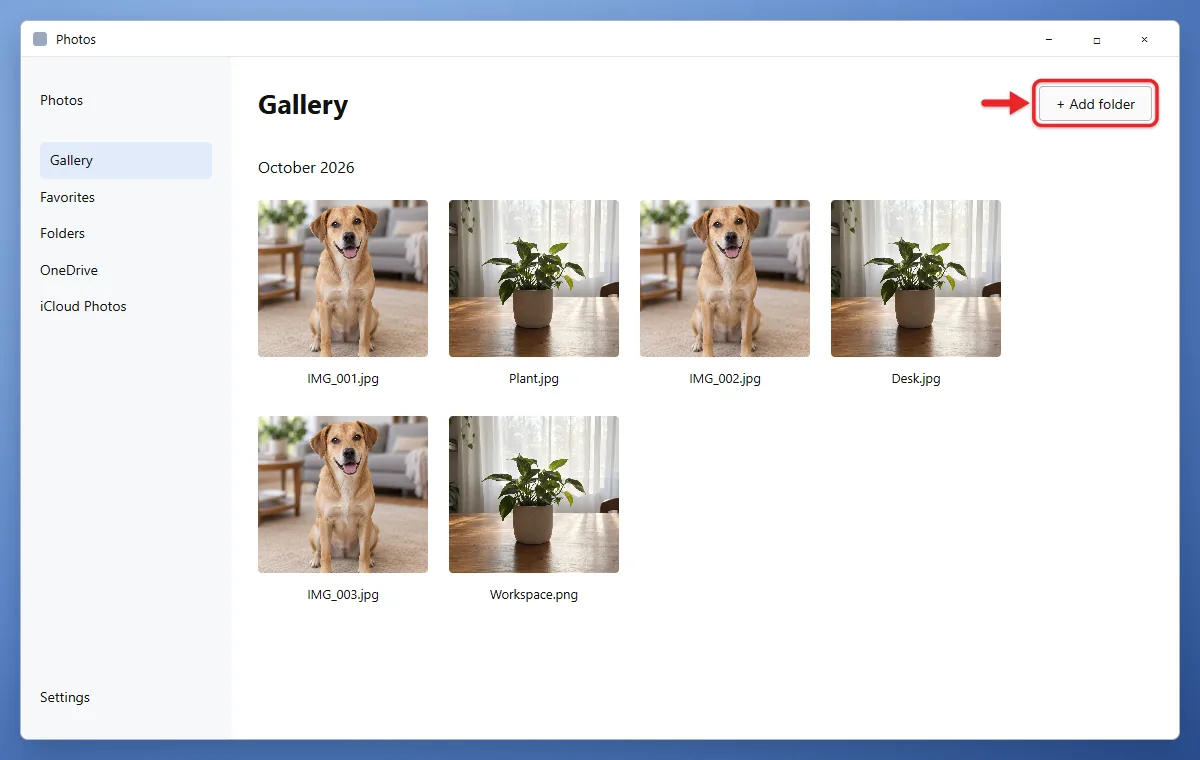
- Choose the folder, such as Downloads or a folder on another drive, and confirm. Its pictures appear in Gallery after Photos finishes scanning it.
These steps follow Microsoft’s guide to browsing photos on Windows, which also notes that adding a folder this way doesn’t upload anything to OneDrive. In Gallery, the Options button controls whether you see All OneDrive folders or Only the Pictures folder, and the Hide screenshots and GIFs switch clears out clutter. The search box at the top matches names, dates, file types, and locations.
File Explorer’s Gallery view in the left pane works in a similar way: click Gallery, then use the Collection menu at the top to add folders to it.
To keep your best shots easy to get back to, mark them and view your favorite photos on Windows 11.
List Every Photo With Command Prompt
If you want a plain list of every image path, for example to check a backup, Windows’ built-in dir command can do it.
- Click Start, type cmd, and open Command Prompt.
- Type cd /d C:\ and press Enter to start at the top of the C: drive. Use another letter, such as D:, for a second drive.
- Type dir /s /b *.jpg *.jpeg *.png *.heic *.gif and press Enter. The /s switch searches every subfolder, and /b shows only the file paths.
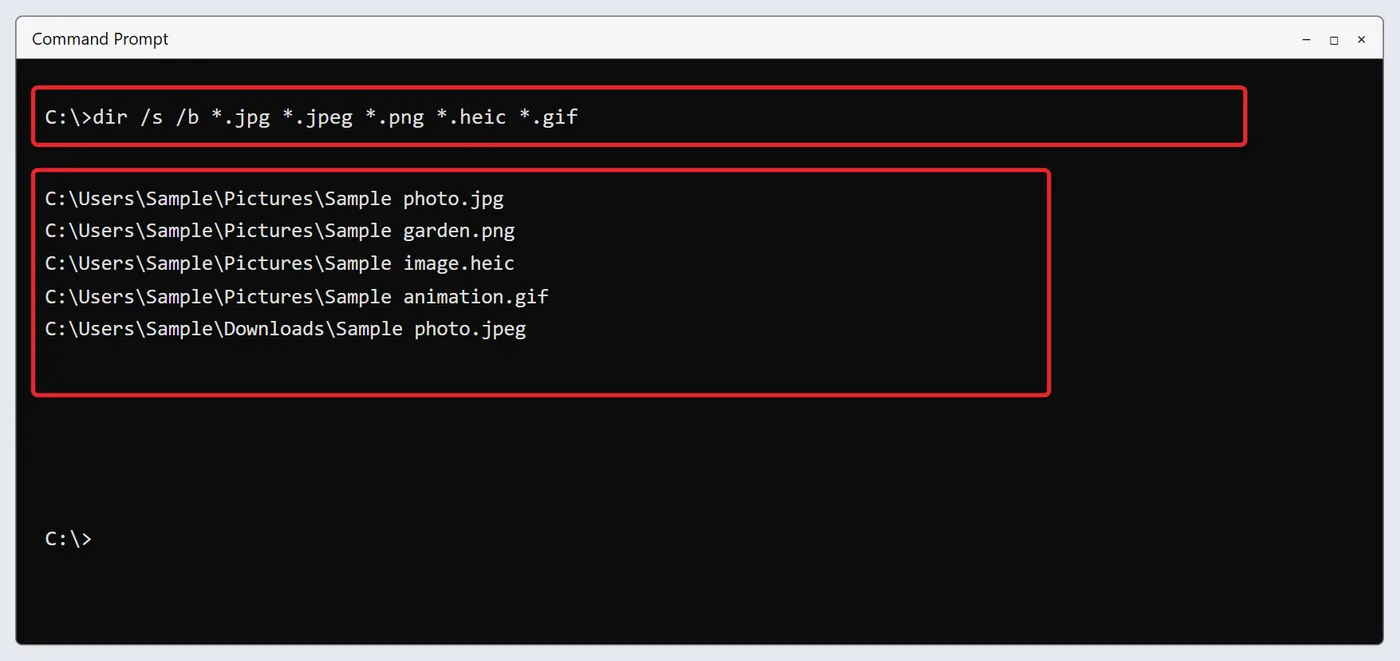
- To save the list instead of scrolling through it, add > %USERPROFILE%\Desktop\photos.txt to the end of the command. A text file with every path appears on your desktop.
Microsoft’s dir command reference lists the other switches. Folders you don’t have permission to open are skipped.
Example: What Gallery Included on One Laptop
On an Alienware m16 R2 running Windows 11 Home 25H2 (OS build 26200.9711), I opened Gallery in the File Explorer left pane. It grouped pictures by date, newest first, with a year scrubber on the right edge and an Add phone photos button in the toolbar.
Opening the Collection menu showed only three entries: Show all, Pictures (OneDrive – Personal) and Manage collection. So Gallery was showing just the OneDrive Pictures folder. Downloads, where many screenshots and saved images end up, wasn’t part of it. That’s why a File Explorer search of This PC can turn up photos Gallery never shows. Use Manage collection to add those folders if you want Gallery to show them too.
Check Your Phone, OneDrive, and Other Cloud Libraries
Photos you took on a phone may only exist on the phone or in the cloud. If OneDrive backs up your Pictures folder, open File Explorer and look in OneDrive > Pictures. Files with a cloud icon are online-only and download when you open them. File Explorer’s search does include them, but only if OneDrive is signed in and syncing.
To see pictures that are still on a phone, follow Microsoft’s phone photo transfer steps:
- Connect the phone with a USB cable that can transfer data. Some cables only charge.
- Unlock the phone. Windows can’t read a locked phone.
- On an iPhone, tap Trust or Allow when asked. On an Android phone, change the USB setting to transfer files or photos if nothing shows up.
- Open Photos on the PC, select Import, and pick your phone to copy the pictures to your computer.
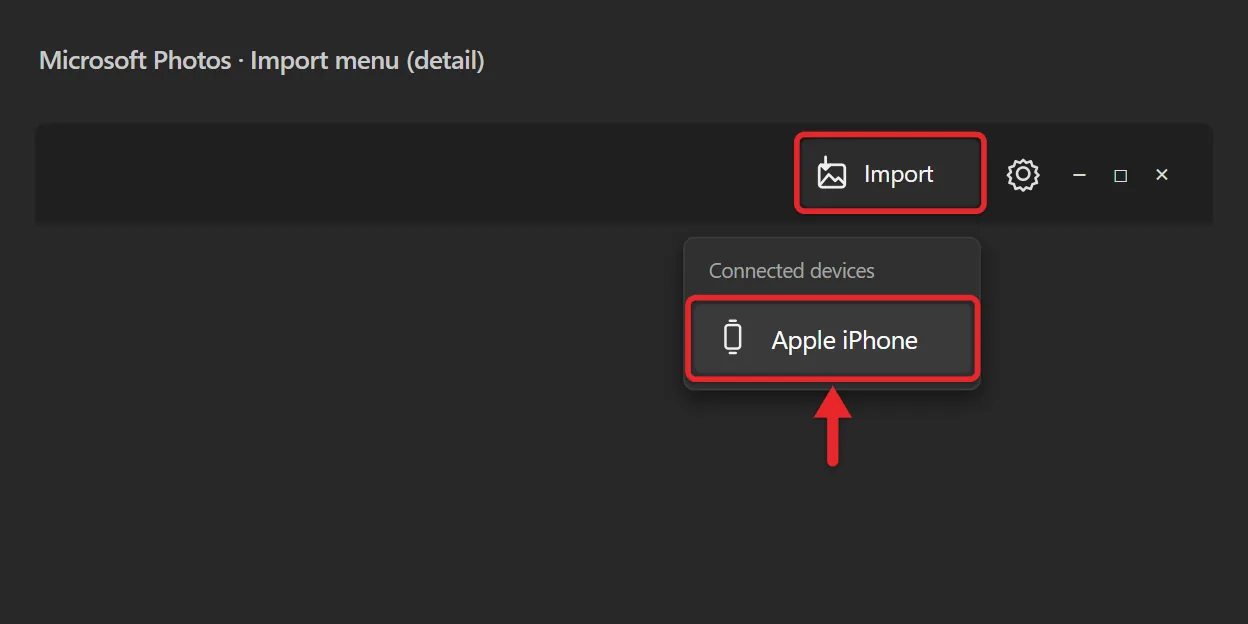
There are more ways to transfer iPhone photos to a PC as well. Pictures still on a digital camera or its memory card need copying first; here’s how to transfer photos from a camera to Windows 11.
If you’d rather keep a local copy of cloud photos, you can move files from OneDrive to your PC. Google Photos pictures stay online unless you download them from photos.google.com.
If a Photo Doesn’t Show Up
- The search started in the wrong place. Click This PC before searching, or pick the exact drive the photo should be on.
- The drive isn’t connected. Plug in the external drive, SD card, or phone and search again. Windows can’t search a drive that isn’t attached.
- The file is in a hidden folder. Click View > Show > Hidden items, then repeat the search.
- The search hasn’t finished. Wait for the green progress bar to reach the end, especially on a large hard drive.
- Search results seem stuck or incomplete. Under Settings > Privacy & security > Search, open Advanced indexing options, click Advanced, and then click Rebuild. Rebuilding can take a while, and searches are slower until it’s done.
- The photo is only in the cloud. Check OneDrive, iCloud Photos, Google Photos, or wherever your phone backs up.
- The photo was deleted. Open the Recycle Bin on the desktop, click Sort > Date deleted to put recent files at the top, right-click the photo, and choose Restore to put it back in its original folder. Files deleted with Shift + Delete, or from a USB drive or memory card, skip the Recycle Bin, so also check the cloud service’s recently deleted area. Finding deleted files on Windows 11 covers more recovery options.
Finding Photos on Windows Questions
Does the Photos app show every photo on my computer?
No. It shows your Pictures folder plus any folders and cloud accounts you’ve added to it. To see everything, search from This PC in File Explorer, then add the folders you find to Photos.
Why is searching This PC so slow?
Classic indexing doesn’t cover most of your drive, so Windows reads every file during the search. Turn on Enhanced under Settings > Privacy & security > Search to index the whole PC and speed up future searches.
How do I find only the photos I took with my phone or camera?
Search kind:=picture size:>1MB to skip icons, or search for IMG_ or DSC, which most phones and cameras use at the start of file names. iPhone photos may also use the .heic extension.
Do I need a separate program to find all my photos?
No. File Explorer search, the Photos app, and the dir command are all built into Windows and find every photo on drives that are connected. The only extra step is waiting for the first full search or the first Enhanced indexing run to finish.
Can I copy all the search results into one folder?
Yes. Press Ctrl + A in the results to select everything, then hold Ctrl while you drag the files into a new folder. Holding Ctrl copies them instead of moving them, so the originals stay where they were. There’s plenty more you can do with File Explorer in Windows 11.
If you collect animated images, you can make a GIF folder and copy every .gif result into it.

Matthew Burleigh is the founder, head writer, and editor of Solve Your Tech, which he launched in 2012. He has written technology tutorials since 2008 and worked in IT since 2003, including small-business support, IT management, and consulting. He holds Bachelor’s and Master’s degrees in Computer Science from Arizona State University.
Matthew writes practical guides for Windows, iPhone and iPad, Microsoft Office, Outlook, Google apps, and Android. Solve Your Tech’s guides are checked step by step against the device or app maker’s own documentation and tested on his own devices whenever he has the hardware or software, with clear steps, sources, and update dates.
Read more about Matthew and how Solve Your Tech writes and updates its guides, or report a correction.