No. AirDrop only sends to a nearby iPhone, iPad or Mac, so a Windows 11 PC never shows up in the AirDrop list. The closest built-in substitute is Microsoft’s Phone Link, which can add a Link to Windows button to the iPhone share sheet. A USB cable, iCloud for Windows, OneDrive or email also work, depending on what you’re moving.
These steps cover iPhones on iOS 16 or later (including iOS 27) and Windows 11 PCs. Phone Link file sharing also works on Windows 10. The Phone Link steps follow Microsoft’s announcement of iPhone file sharing and its Phone Link setup page.
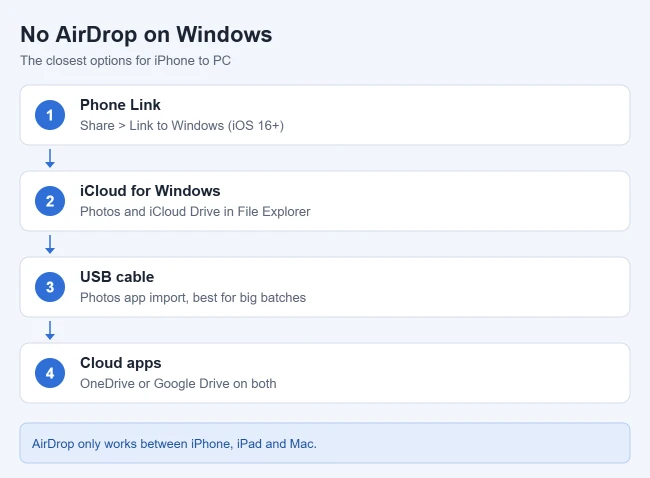
Why AirDrop Doesn’t Work With Windows
AirDrop is Apple’s own wireless sharing system. Apple’s AirDrop guide for iPhone describes it as a way to send photos, videos and documents to a nearby iPhone, iPad or Mac. Apple doesn’t make AirDrop for Windows, so turning on Bluetooth and Wi-Fi on the PC won’t make it appear.
On your Apple devices, you control who can send to you; for example, you can turn off AirDrop receiving on an iPad.
Two Windows features sound similar but don’t help here:
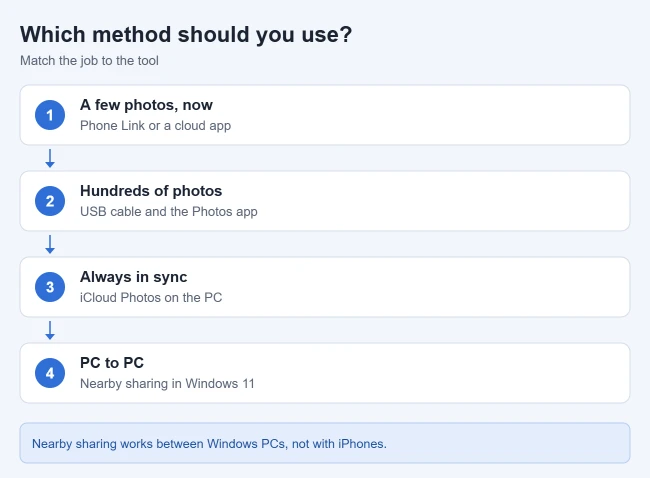
- Nearby sharing in Windows 11 sends files between Windows PCs. Microsoft’s nearby sharing troubleshooting page describes it only for PCs, and an iPhone can’t see it.
- Bluetooth on an iPhone is for accessories such as headphones and keyboards. The iPhone share sheet has no option to send a file to a PC over Bluetooth.
Which Method Should You Use?
| What you want to do | Best option |
|---|---|
| Send one photo or file now, wirelessly | Phone Link (Link to Windows) |
| Copy hundreds of photos and videos | USB cable and the Photos app |
| Have every new photo show up on the PC | iCloud for Windows |
| Move documents you already keep in the cloud | iCloud Drive or OneDrive |
| Send a few small photos to any computer |
Option 1: Phone Link (Closest to AirDrop)
Phone Link is Microsoft’s app for connecting a phone to a Windows PC. With an iPhone, it handles texts, calls and notifications, and Microsoft added file sharing through the Link to Windows app. Microsoft began rolling file sharing out to Windows Insiders in December 2024 and said it would reach more users over time, so whether you see it depends on your app versions.
What You Need
- An iPhone running iOS 16 or later.
- A Windows 11 PC (or Windows 10) with Bluetooth turned on.
- The latest Phone Link app on the PC. Microsoft’s announcement lists Phone Link version 1.24112.89.0 or later.
- The free Link to Windows app from the App Store, version 1.24112.73 or later.
Send a File From the iPhone to the PC
- On the PC, open Phone Link from the Start menu and select iPhone. A QR code appears. For the full pairing process, follow the steps to link your iPhone to Windows 11 with Phone Link.
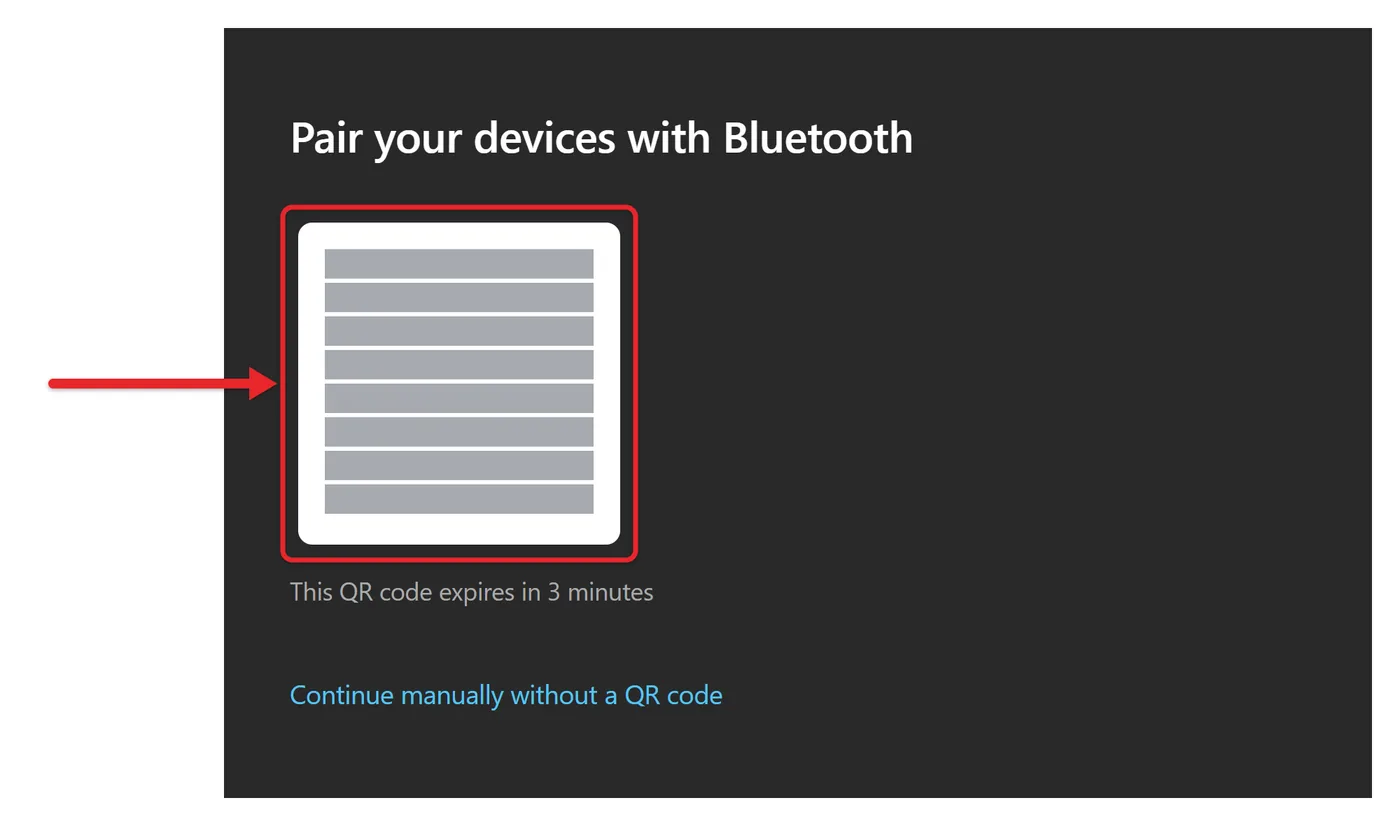
- Scan the code with the iPhone’s Camera app and follow the prompts to pair. If Phone Link offers file sharing during setup, turn it on.
- On the iPhone, open the photo, video or file you want to send.
- Tap the Share button. The share sheet opens.
- Tap Link to Windows. A list of your linked PCs appears.
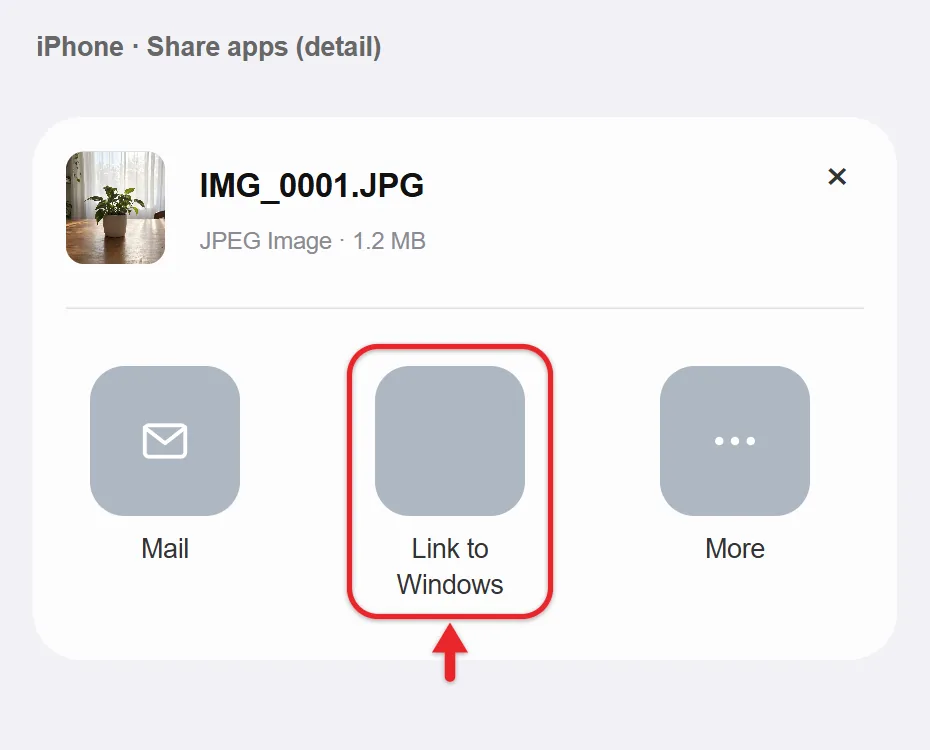
- Tap your PC. The file transfers, and Windows shows a notification when it arrives.
If you paired your iPhone before file sharing was available, go to aka.ms/addAccount on your PC to turn it on.
Send a File From the PC to the iPhone
- In File Explorer, select the file or files. They must be saved on the PC, not cloud-only files.
- Right-click and select Share.
- Select My Phone. If you don’t see it, select Phone Link.

If Link to Windows Doesn’t Appear
- Update Phone Link in the Microsoft Store (Library > Get updates) and update Link to Windows in the App Store.
- In the share sheet, swipe left on the app row and tap More to find Link to Windows.
- Make sure Bluetooth is on for both devices and the iPhone is unlocked and nearby.
- If it still isn’t there, the feature may not have reached your PC yet. Use one of the options below.
Option 2: USB Cable (Best for Lots of Photos)
A cable is the fastest way to move a large photo library, and it doesn’t use your internet connection or cloud storage. Apple’s steps for transferring photos to a Windows PC start with the Apple Devices app.
- Install Apple Devices from the Microsoft Store. It provides the connection Windows uses to see the iPhone.
- Connect the iPhone to the PC with a USB cable that supports data, not just charging.
- Unlock the iPhone. When it asks whether to trust the computer, tap Trust or Allow and enter your passcode.
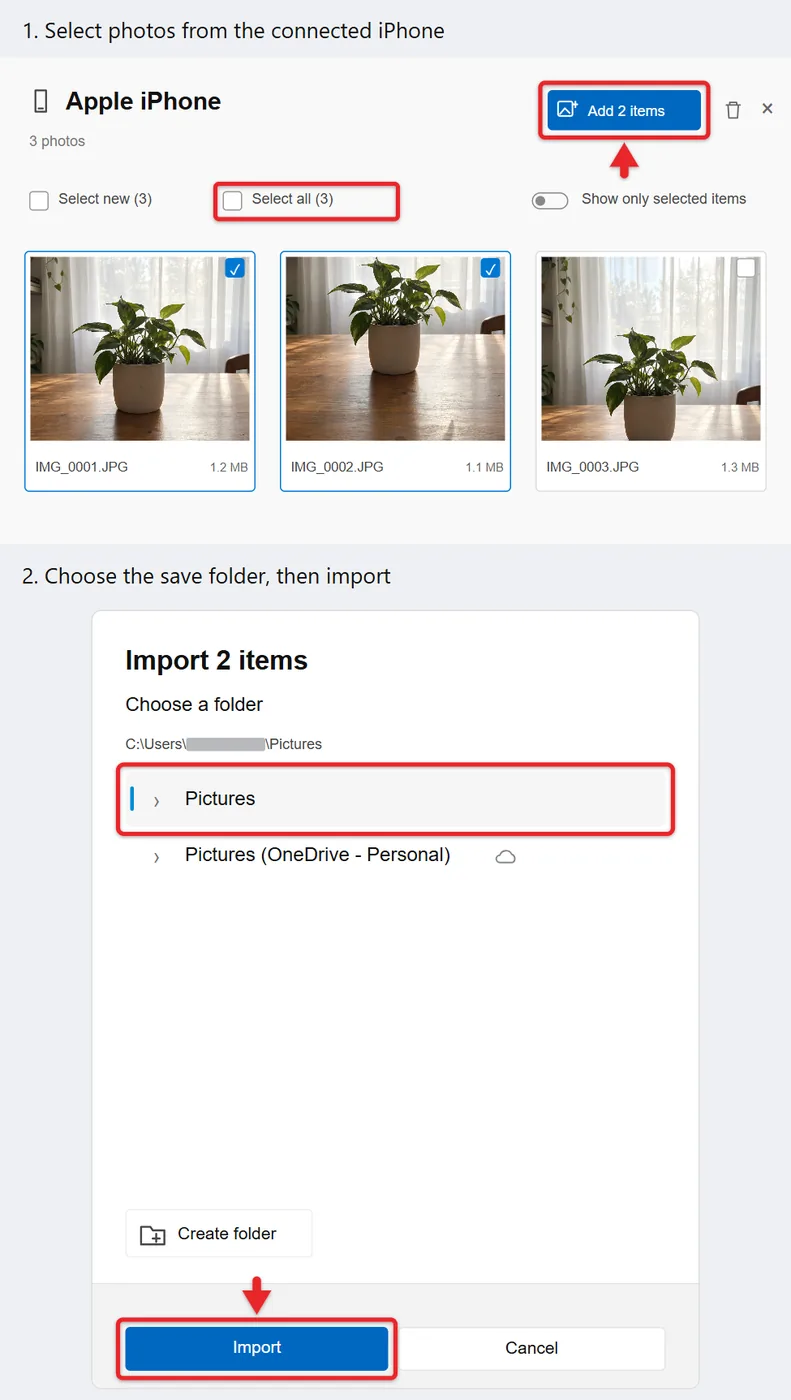
- Open the Photos app on the PC and select Import.
- Choose your iPhone, select the photos you want, and start the import. Keep the iPhone unlocked and connected until it finishes.
If you use iCloud Photos with Optimize iPhone Storage, some full-size originals may only be in iCloud. Download the originals to the iPhone before importing. Two other walkthroughs go further: transferring iPhone photos to a PC and uploading photos from iPhone to a computer.
iPhone photos are saved as HEIC files by default. If the PC can’t open them, there are free ways to open HEIC files on Windows 11, or you can switch the camera to Most Compatible in Settings > Camera > Formats so new photos save as JPEG.
Option 3: iCloud for Windows (Automatic Photo Sync)
iCloud for Windows keeps your iCloud Photos and iCloud Drive files on the PC without any cable. Apple’s iCloud for Windows setup guide and Photos setup page list these steps.
- On the iPhone, make sure iCloud Photos is on in Settings > your name > iCloud > Photos.
- On the PC, install iCloud for Windows from the Microsoft Store and open it.
- Sign in with the same Apple Account you use on the iPhone and enter the verification code if asked.
- Next to iCloud Photos, click the arrow, turn on iCloud Photos, and click Done.
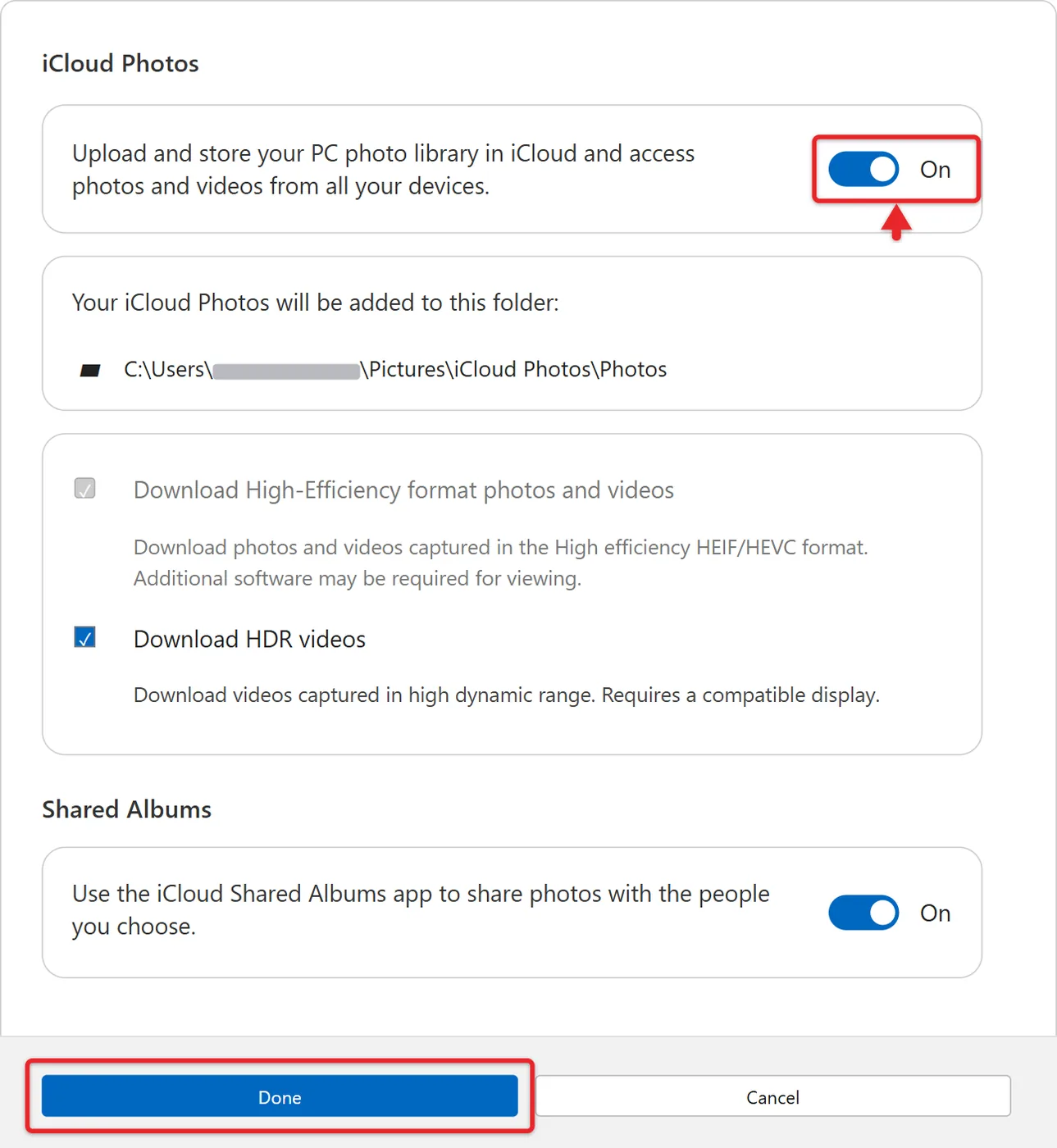
- Turn on iCloud Drive the same way if you want your files too.
Synced photos are stored in the Pictures > iCloud Photos > Photos folder on the PC. Photos you take later appear there after they upload to iCloud. The catch: everything counts against your iCloud storage, and the free plan is 5 GB.
On a PC you don’t own, skip the app. Go to icloud.com in a browser, sign in, and download photos or iCloud Drive files there instead.
Option 4: OneDrive or Email
OneDrive works well if you already use Microsoft 365. Install the OneDrive app on the iPhone, sign in with your Microsoft account, tap the + button, and upload the photos or files. On the PC, they show up in the OneDrive folder in File Explorer once they sync. Long videos may need the tips for uploading large files to OneDrive.
Email is fine for a few small photos. Attach them on the iPhone, send the message to yourself, and download the attachments on the PC. Most email services cap a message at 20 to 25 MB, so it isn’t practical for videos. For the size limits and what to do when a photo is too big, read about sending a photo by email.
Send Files From the PC to Your iPhone
- Phone Link: right-click a local file, select Share, then My Phone, if file sharing is set up.
- iCloud Drive or OneDrive: save the file in the synced folder on the PC, then open it in the iPhone’s Files app (here’s where to find iCloud Drive on iPhone).
- Cable: the Apple Devices app can copy files into iPhone apps that support file sharing. For the cable method, follow the steps to transfer files from iPhone to PC.
About Third-Party “AirDrop for Windows” Apps
Many search results recommend browser-based or downloadable apps that copy the AirDrop experience. Apple and Microsoft don’t make them, and they work by running their own software on both devices, sometimes through outside servers. If you want to try one, download it only from the App Store and the Microsoft Store, read its privacy policy, and avoid using it on public Wi-Fi. For most people, the built-in options above do the job without another account or app.
How to Confirm the Transfer Worked
- Phone Link: check the Windows notification, or look in your Downloads folder.
- USB import: the Photos app shows the imported items, and they’re saved in the destination folder you chose.
- iCloud or OneDrive: open File Explorer and check the iCloud Photos or OneDrive folder. A green check on a file means it’s stored on the PC.
Open a few photos and play a video on the PC before you delete anything from the iPhone. If you use iCloud Photos, deleting a photo on one device deletes it everywhere.
Frequently Asked Questions
Is there an AirDrop app for Windows?
No. Apple doesn’t make one. Microsoft’s Phone Link, with the Link to Windows button on the iPhone, is the closest built-in option.
Can I AirDrop from a Mac to a Windows PC?
No. AirDrop only sends to Apple devices. From a Mac, use iCloud Drive, OneDrive, a USB drive, or a shared network folder.
Does Phone Link work on Windows 10?
Yes. iPhone file sharing works on Windows 10 and Windows 11, as long as the PC has Bluetooth and the latest Phone Link app.
What’s the fastest way to move lots of photos?
A USB cable with the Photos app. It handles large batches without upload time or cloud storage limits.
Will the photos keep their full quality?
Yes, with a cable, iCloud or OneDrive. Email and some messaging apps can shrink photos, so avoid them when you need full-size originals.
Next step: if you plan to use Phone Link regularly, finish pairing your iPhone with Phone Link so file sharing is ready when you need it.

Matthew Burleigh is the founder, head writer, and editor of Solve Your Tech, which he launched in 2012. He has written technology tutorials since 2008 and worked in IT since 2003, including small-business support, IT management, and consulting. He holds Bachelor’s and Master’s degrees in Computer Science from Arizona State University.
Matthew writes practical guides for Windows, iPhone and iPad, Microsoft Office, Outlook, Google apps, and Android. Solve Your Tech’s guides are checked step by step against the device or app maker’s own documentation and tested on his own devices whenever he has the hardware or software, with clear steps, sources, and update dates.
Read more about Matthew and how Solve Your Tech writes and updates its guides, or report a correction.