To resize your desktop background in Windows 11, go to Settings > Personalization > Background, make sure Picture or Slideshow is selected, and change Choose a fit for your desktop image. Fill covers the whole screen, Fit shows the whole picture, and Stretch, Tile, Center and Span give other layouts.
These steps are for Windows 11 Home and Pro. Windows 10 uses the same Settings > Personalization > Background page with the same six fit options, so the steps also work there.
How to Change How Your Wallpaper Fits the Screen
- Right-click an empty part of the desktop and select Personalize, or open Settings > Personalization. The Personalization page opens.
- Select Background.
- Next to Personalize your background, choose Picture or Slideshow. The fit list doesn’t appear for Windows spotlight or Solid color. Spotlight also adds a desktop icon, and removing “Learn about this picture” takes it away.
- Open the Choose a fit for your desktop image list and pick an option. The desktop changes right away, with no restart, so you can try each one and keep the one that looks best.
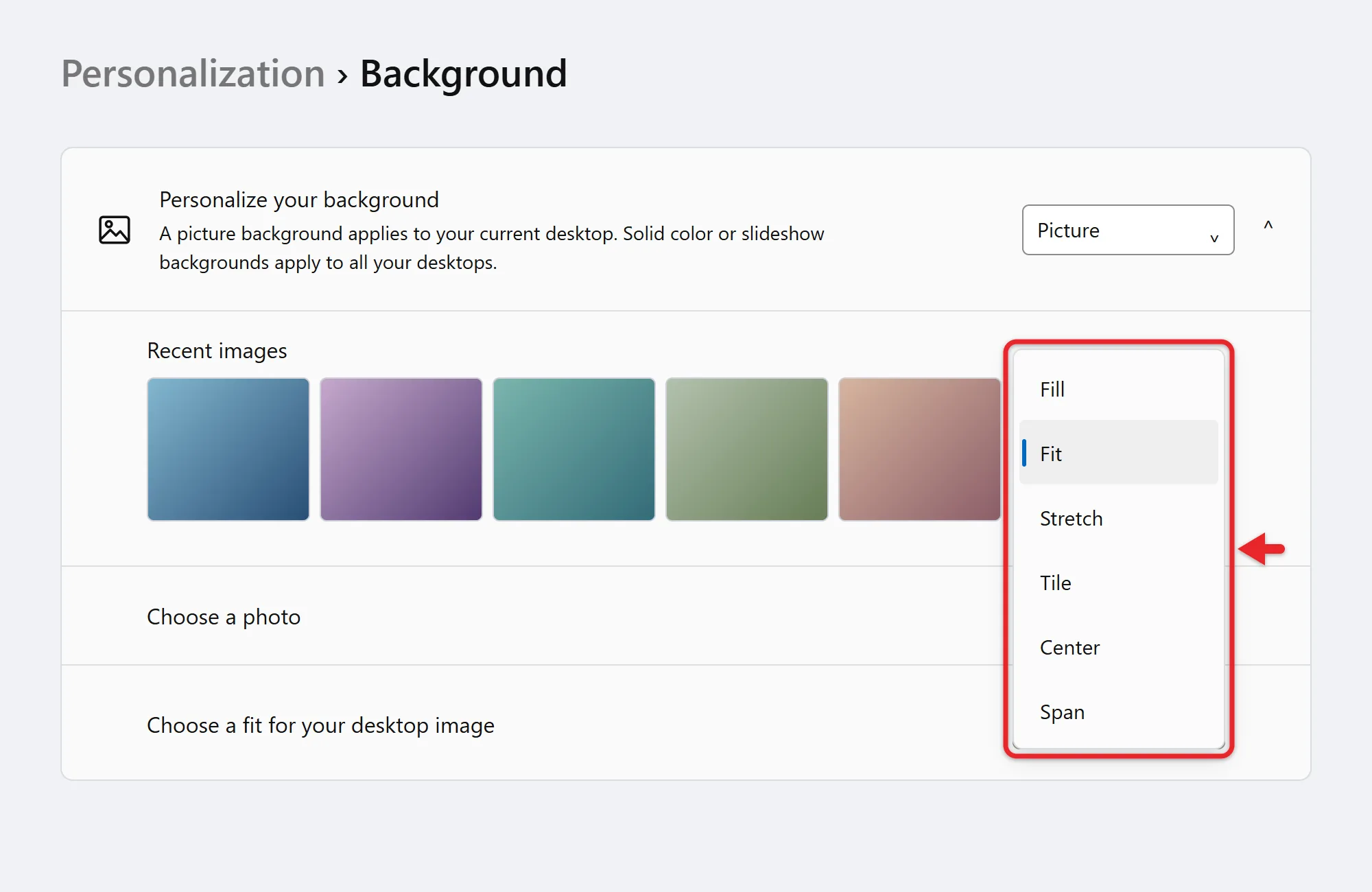
To undo a change, open the same list and pick the option you had before.
What Each Fit Option Does
According to Microsoft’s guide to changing the desktop background:
| Option | What it does | Best for |
|---|---|---|
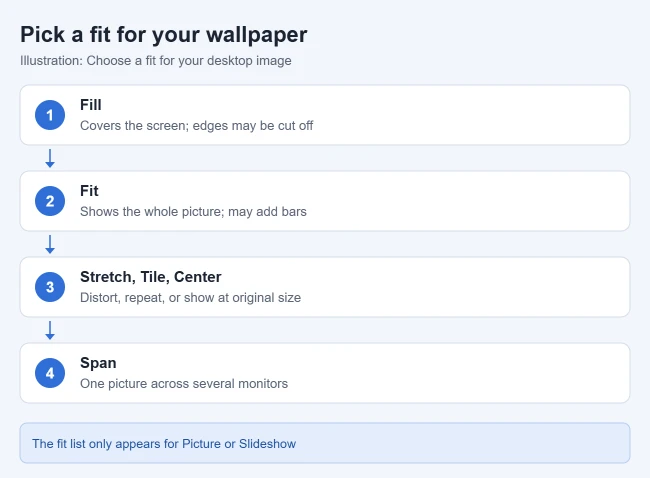
| Fill | Enlarges the picture to cover the screen. Some edges may be cut off. | Most photos |
| Fit | Shows the whole picture without distortion. Bars may appear on the sides or top and bottom. | Group photos, text, logos |
| Stretch | Stretches the picture to cover the screen, which can distort it. | Pictures already shaped like your screen |
| Tile | Repeats the picture across the screen. | Small patterns and textures |
| Center | Puts the picture in the middle at its original size. A smaller picture leaves a border. | Small logos or artwork |
| Span | Spreads one picture across multiple monitors. | A wide picture on two or more screens |
Which fit should you pick?
The choice comes down to the picture’s shape compared with your screen’s shape (its aspect ratio, such as 16:9 for most monitors and laptops). When the two match, Fill, Fit and Stretch all look the same. When they don’t:
- Pick Fill if you’d rather lose a little of the edges than see bars. Keep faces and other important parts near the middle of the picture, because Fill trims the edges.
- Pick Fit if every part of the picture matters. The empty space around the picture shows as a solid color.
- Avoid Stretch for photos of people unless the picture is already close to your screen’s shape, because faces look wider or taller than they should.
- With Center, a picture larger than your screen shows only its middle, and a small picture can look tiny on a high-resolution display.
With the wallpaper set, you can also add This PC and other desktop icons on top of it.
Multiple Monitors and Virtual Desktops
- One picture across all screens: choose a wide picture and set the fit to Span. For the best result, use a picture about as wide as all your screens combined, and arrange the screens in Settings > System > Display to match your desk so the picture lines up.
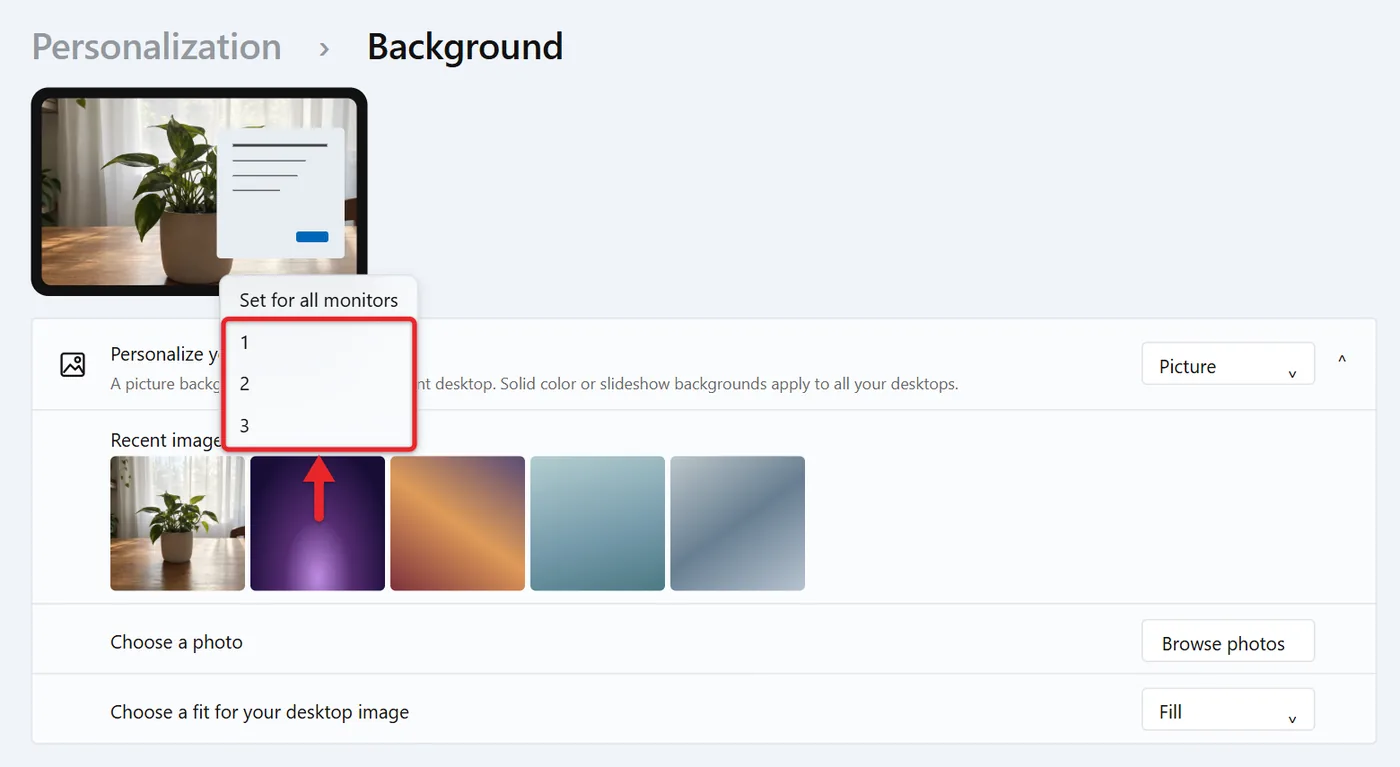
- A different picture on each monitor: with Picture selected, right-click an image under Recent images and choose the monitor to set it for. Microsoft notes this isn’t available if you use multiple desktops. A separate article looks at setting a different background for each monitor in more depth.
- Slideshow: each screen shows a different picture from the folder you chose.
- Virtual desktops: right-click an image under Recent images and choose which desktop to use it on, or Set for all desktops. Per-monitor pictures and slideshows aren’t supported for virtual desktop backgrounds.
If the Wallpaper Looks Blurry, Cut Off or Won’t Change
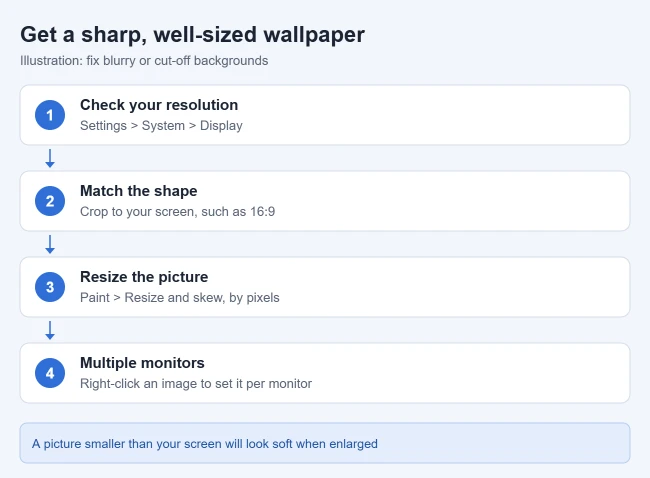
- Blurry picture: use a picture at least as large as your screen resolution. Check your resolution in Settings > System > Display under Display resolution. A 1280 x 720 picture on a 2560 x 1440 screen looks soft when Fill enlarges it.
- Important parts cut off: switch from Fill to Fit, or crop the picture to your screen’s shape first. The Photos app’s crop tool has preset aspect ratios, so you can pick the one that matches your screen before you set it as the background.
- Wrong size on an external monitor: According to Microsoft, the wallpaper can look too small or cut off on the right and bottom when a laptop screen and an external monitor have different resolutions. Its workaround is to open Settings > System > Display, select the external display, pick a different Display resolution, and then select Revert. Details are in Microsoft’s note on wallpaper not fitting after connecting an external display. When the whole screen, not only the wallpaper, looks too big or small, adjust the screen size on the second monitor instead.
- Settings grayed out: if the Background page won’t let you change anything, check Settings > System > Activation, since personalization settings can be locked until Windows is activated. On a work or school PC, a message that some settings are managed by your organization means an administrator controls the wallpaper.
- The picture looks squashed: check whether Stretch is selected and switch to Fill or Fit.
Resize the Picture Itself in Paint
If none of the fit options look right, change the picture’s size to match your screen before setting it as the background. Paint is included with Windows.
- Right-click the picture, select Open with, and choose Paint.
- Select Resize and skew in the Image group at the top (or press Ctrl + W).
- Choose Pixels, keep the link button between Horizontal and Vertical turned on (older versions of Paint call it Maintain aspect ratio), and enter your screen width, such as 1920. The height changes to match.
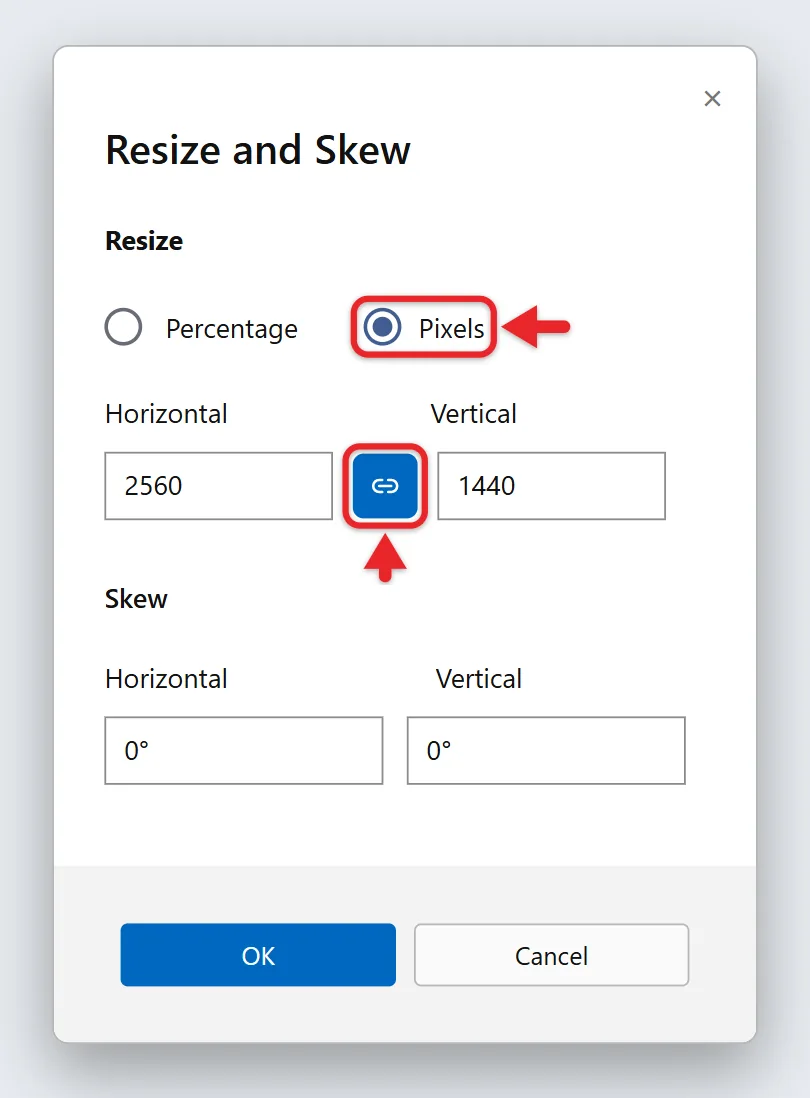
- Select OK, then File > Save as to save a copy so the original stays untouched.
- Right-click the new copy and choose Set as desktop background. It becomes your wallpaper.
If the new height is taller than your screen, Fill trims the top and bottom. To control exactly what gets trimmed, crop the picture to your screen’s shape before or after resizing.
Making a small picture larger in Paint won’t add detail, so start with the largest version you have.
The article on resizing an image in Microsoft Paint explains Percentage versus Pixels and saving in different file formats.
If you’ve hearted pictures in the Photos app, viewing your favorite photos on Windows 11 is a quick way to pick a wallpaper candidate.
Resize a batch of wallpapers
If you have a folder of pictures for a slideshow, Microsoft’s free PowerToys includes Image Resizer. After you install PowerToys, select the pictures in File Explorer, right-click, and choose Resize with Image Resizer. Its Fill, Fit and Stretch settings work like the wallpaper options, and it saves resized copies as new files.
Other Ways to Set a Picture as Your Background
- File Explorer: right-click a picture and select Set as desktop background.
- Photos app: open the picture, select the ••• menu, then Set as > Background, per Microsoft.
- Slideshow: on the Background page, choose Slideshow, select Browse to pick a folder, and set Change picture every, Shuffle the picture order and whether it runs on battery power. The fit list appears here too. To skip ahead, right-click the desktop and select Next desktop background. On an older PC, you can view pictures as a full-screen slideshow in Windows 10 instead.
Frequently Asked Questions
How do I set a different wallpaper on each monitor?
Select Picture on the Background page, right-click an image under Recent images, and choose the monitor. For the full steps, read about setting a different background for each monitor in Windows 11.
Why is the fit option missing?
It only appears when Picture or Slideshow is selected. Windows spotlight and solid colors don’t use it.
What size should my wallpaper be?
Match your display resolution, shown in Settings > System > Display. For two side-by-side monitors with Span, use a picture as wide as both screens combined, such as 3840 x 1080 for two 1920 x 1080 screens.
Which fit option does Windows use by default?
Fill is the usual setting. You can change it any time from the same list.
Does changing the fit change my picture file?
No. The fit option only changes how Windows displays the picture. Your original file stays the same unless you edit and save it in an app like Paint.
Want a different picture, color or slideshow altogether? You can change the desktop background in Windows 11.

Matthew Burleigh is the founder, head writer, and editor of Solve Your Tech, which he launched in 2012. He has written technology tutorials since 2008 and worked in IT since 2003, including small-business support, IT management, and consulting. He holds Bachelor’s and Master’s degrees in Computer Science from Arizona State University.
Matthew writes practical guides for Windows, iPhone and iPad, Microsoft Office, Outlook, Google apps, and Android. Solve Your Tech’s guides are checked step by step against the device or app maker’s own documentation and tested on his own devices whenever he has the hardware or software, with clear steps, sources, and update dates.
Read more about Matthew and how Solve Your Tech writes and updates its guides, or report a correction.