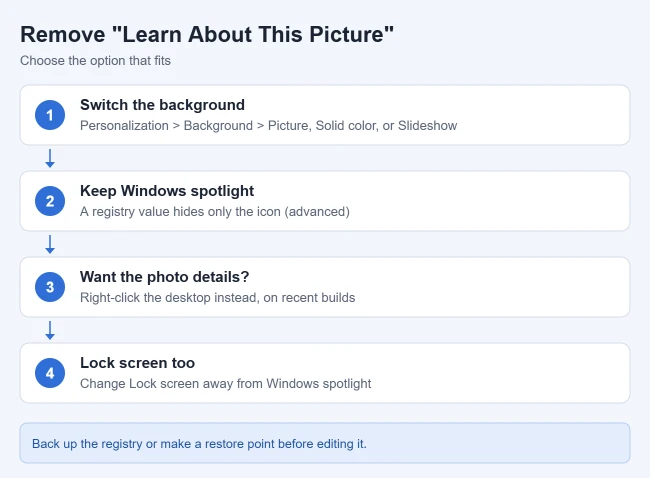
The “Learn about this picture” icon appears on the desktop when your background is set to Windows spotlight. To remove it, open Settings > Personalization > Background and change Personalize your background from Windows spotlight to Picture, Solid color, or Slideshow.
This works on Windows 11 Home and Pro. If you want to keep the daily Spotlight wallpapers and lose only the icon, use the registry method further down instead.
Why the Icon Is There
Windows spotlight puts a new photo from Microsoft on your desktop each day. The “Learn about this picture” icon (some builds call it “Learn more about this picture”) opens a Bing page about the current photo, and right-clicking it gives options to switch to the next picture or say whether you like the current one.

The icon only appears while Spotlight is your desktop background. It’s a system item, not a normal shortcut, so you can’t delete it or drag it to the Recycle Bin, and it isn’t listed in Desktop icon settings with This PC and the Recycle Bin. An accepted answer from a Microsoft staff member on Microsoft Q&A confirms the two ways to remove it that this guide covers: change the background, or hide the icon with a registry value.
Which Method Should You Use?
| You want to | Use | Spotlight wallpapers |
|---|---|---|
| Remove the icon the simple, supported way | Change the background | Stop |
| Keep new photos every day without the icon | Registry value | Keep coming |
| Remove photo details from the lock screen | Lock screen settings | Stop on the lock screen |
Remove the Icon by Changing the Background
- Right-click an empty spot on the desktop and select Personalize. You can also press Windows key + I and select Personalization.
- Select Background.
- Open the drop-down menu next to Personalize your background and change it from Windows spotlight to Picture, Solid color, or Slideshow. The icon disappears from the desktop right away.
- If you chose Picture, pick a recent image or select Browse photos to use your own. For Slideshow, choose a folder of pictures and how often they change. For Solid color, pick a color.
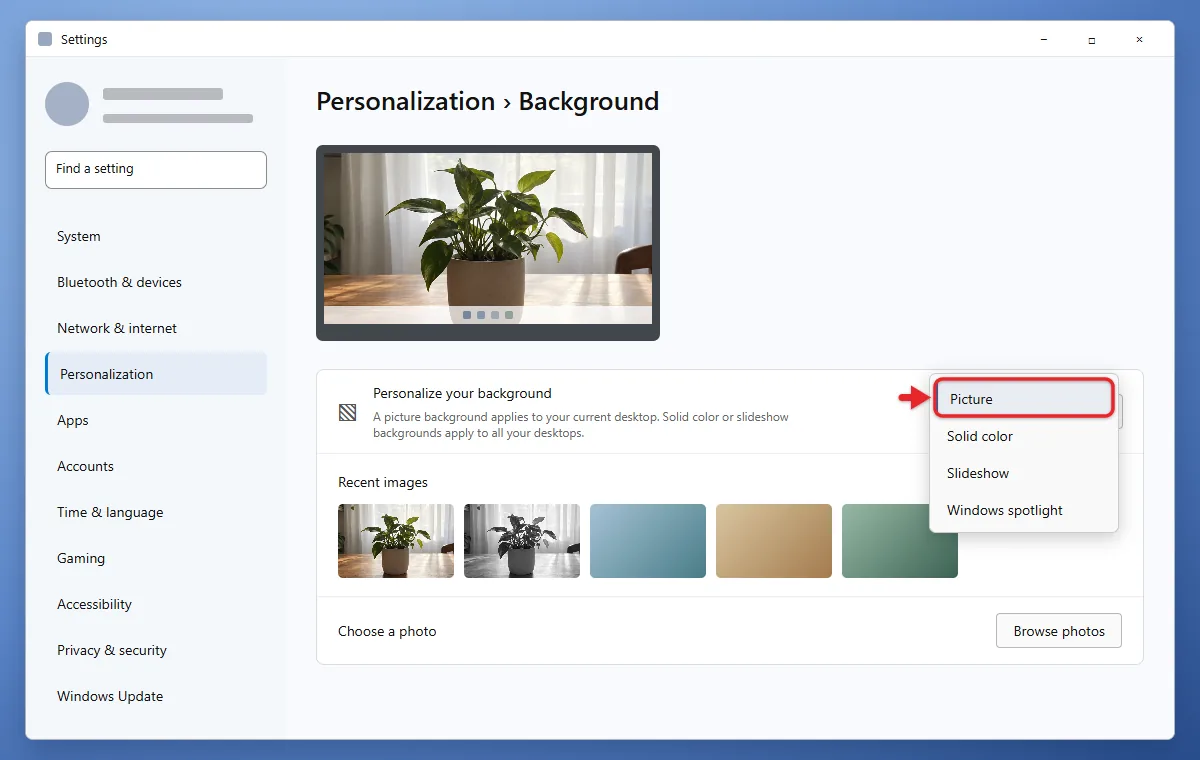
- Under Choose a fit for your desktop image, pick Fill to cover the screen. To fine-tune it, resize your desktop background in Windows 11.
These options match Microsoft’s desktop background guide. Slideshow is the closest match to Spotlight if you like a changing wallpaper: point it at a folder of photos and it rotates them on a schedule you set. For more on each option, read how to change the desktop background in Windows 11.
If your new picture is dark, you can match it by switching Windows to dark colors; here’s how to turn on dark mode in Windows 11.
To undo it, go back to Settings > Personalization > Background and choose Windows spotlight again. The icon returns with the next photo.
Keep Spotlight but Hide the Icon (Advanced)
Windows 11 has no on/off switch for the icon, but a registry value hides it while Spotlight keeps changing your wallpaper. It’s the method in the accepted Microsoft Q&A answer above. Editing the wrong part of the registry can cause problems, so create a restore point first. The value only affects your own user account.
For a fuller safety net than a restore point, you can also back up Windows 11 to an external hard drive.
- Press Windows key + R, type
regedit, press Enter, and select Yes when Windows asks for permission. Opening Registry Editor in Windows 11 covers other ways to open it and how to back up a key. - Paste this path into the address bar at the top of Registry Editor and press Enter:
HKEY_CURRENT_USER\Software\Microsoft\Windows\CurrentVersion\Explorer\HideDesktopIcons\NewStartPanel - If Windows says it can’t find the path, the HideDesktopIcons or NewStartPanel key doesn’t exist yet. Go to the last key that does exist (usually Explorer), right-click it, choose New > Key, and type the missing name. Repeat for the next key.
- With NewStartPanel selected, right-click an empty area of the right pane and select New > DWORD (32-bit) Value.
- Name it
{2cc5ca98-6485-489a-920e-b3e88a6ccce3}. The curly braces are part of the name, and leaving them out is the most common reason this doesn’t work. - Double-click the new value, set Value data to 1, and select OK.
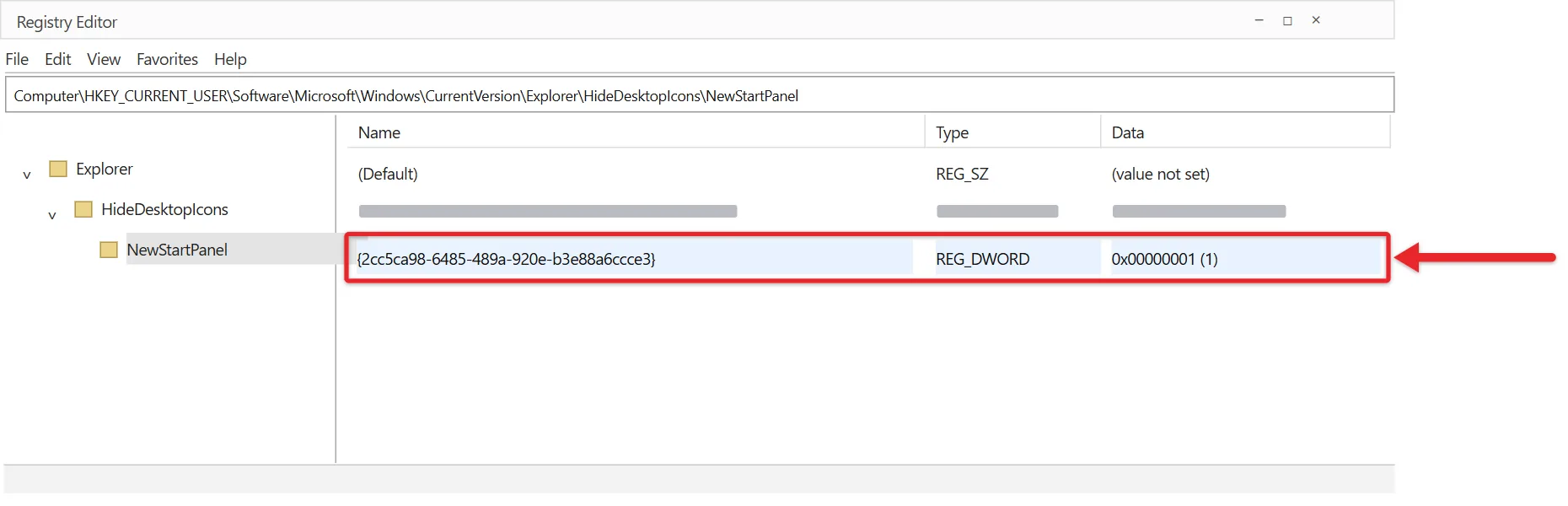
- Go to the desktop and press F5, or right-click and select Refresh. If the icon is still there, sign out and back in. Spotlight keeps changing your wallpaper, but the icon is gone.
A value of 1 hides the icon and 0 shows it. Some instructions online have these reversed, so if your icon is still visible, check that the data is 1.
Do the Same Thing With One Command
If you’re comfortable with Command Prompt, this single command creates the keys and the value for you. Open Command Prompt (no admin rights needed, since it changes your own account), paste it, and press Enter:
reg add HKCU\Software\Microsoft\Windows\CurrentVersion\Explorer\HideDesktopIcons\NewStartPanel /v {2cc5ca98-6485-489a-920e-b3e88a6ccce3} /t REG_DWORD /d 1 /f
Then press F5 on the desktop. Microsoft documents the switches in its reg add command reference.
To bring the icon back, delete the {2cc5ca98-6485-489a-920e-b3e88a6ccce3} value or set it to 0, then refresh the desktop. Because this isn’t an official setting, a future Windows update could change how it works.
Remove Photo Details From the Lock Screen
The lock screen shows its own photo details when it uses Windows spotlight, and that setting is separate from the desktop. Changing your desktop background doesn’t affect it.
- Open Settings > Personalization > Lock screen.
- Change Personalize your lock screen from Windows spotlight to Picture or Slideshow.
- Turn off Get fun facts, tips, tricks, and more on your lock screen if you don’t want Microsoft’s extra content there.
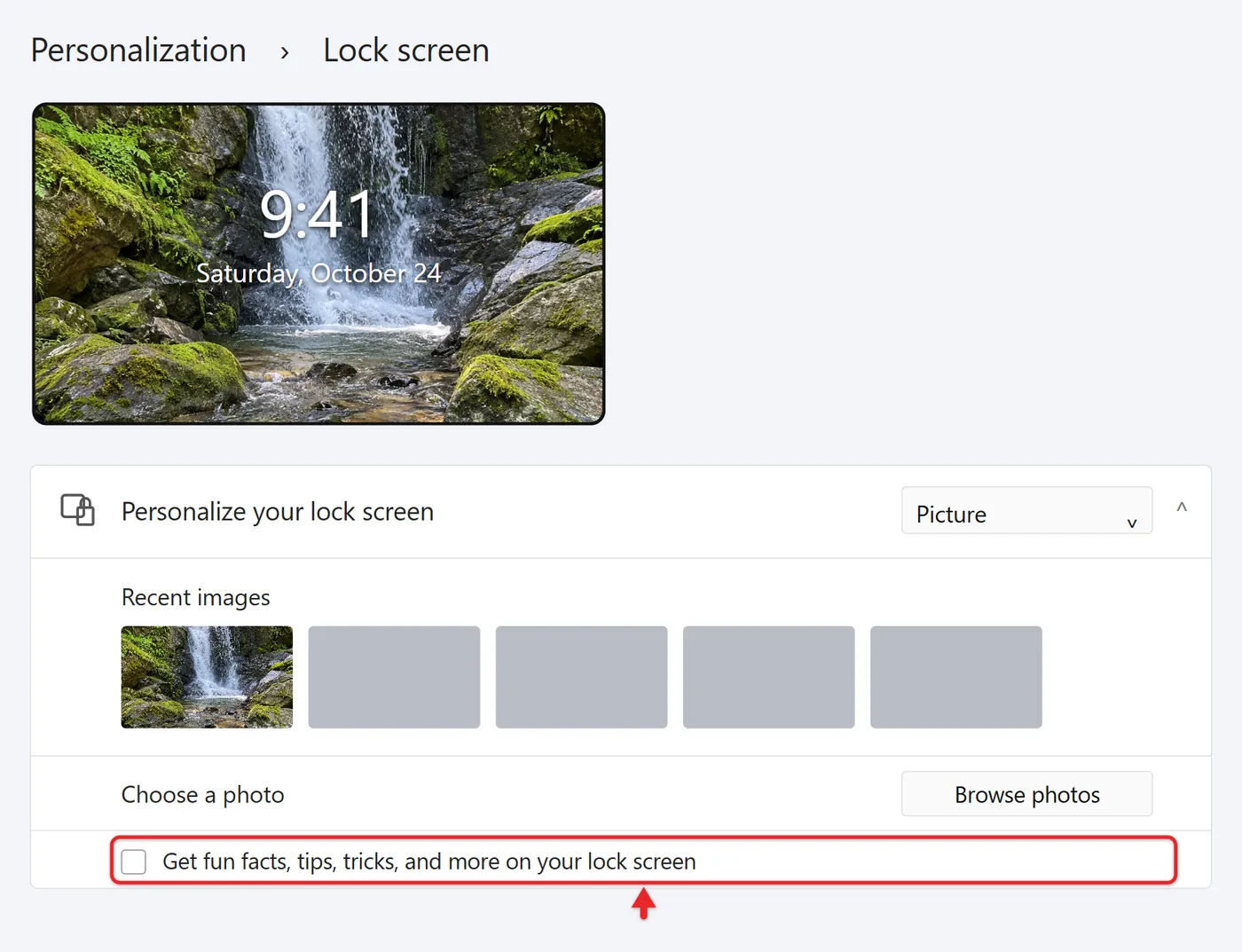
Microsoft’s lock screen guide lists the same options. Setting the lock screen on Windows 11 covers more lock screen settings.
If the Icon Won’t Go Away
- Spotlight is still selected. Check Settings > Personalization > Background again. If it says Windows spotlight, the icon stays.
- The desktop hasn’t refreshed. Press F5 on the desktop, sign out and back in, or restart the PC.
- The registry value has the wrong name or data. It must include the curly braces, be a DWORD (32-bit) value, and be set to 1. It must sit inside NewStartPanel, not HideDesktopIcons.
- The background options are grayed out. Windows needs to be activated before you can change personalization settings. On a work or school PC, your organization may control the background, so ask your IT department.
- The icon came back after an update. Some users have reported Windows updates switching the background back to Spotlight. Check the background setting, and if you used the registry method, confirm the value still exists and is set to 1.
Frequently Asked Questions
Can I save a Spotlight picture I like?
Select the “Learn about this picture” icon to open the Bing page for the current photo, where you can see what it shows and search for it. Right-clicking the icon also lets you like the picture or skip to the next one.
Will I lose my current wallpaper?
Yes. Spotlight photos change each day, and the current one won’t stay once you switch to Picture or Solid color. If you like it, open the icon’s Bing page to note what it shows before you switch, or pick one of your own photos instead.
Does removing the icon turn off Spotlight?
Changing the background turns Spotlight off for the desktop. The registry method hides only the icon and leaves Spotlight running.
Can each monitor have a different background?
Yes. With Picture backgrounds, you can set a different background for each monitor. Spotlight, Slideshow and Solid color don’t offer per-monitor choices.
Can I hide every icon on the desktop instead?
Yes. Right-click the desktop, select View, and uncheck Show desktop icons. That hides all icons, including your files and shortcuts, without deleting them. To hide only a few system icons, follow the steps to remove the Recycle Bin from the desktop in Windows 11.

Matthew Burleigh is the founder, head writer, and editor of Solve Your Tech, which he launched in 2012. He has written technology tutorials since 2008 and worked in IT since 2003, including small-business support, IT management, and consulting. He holds Bachelor’s and Master’s degrees in Computer Science from Arizona State University.
Matthew writes practical guides for Windows, iPhone and iPad, Microsoft Office, Outlook, Google apps, and Android. Solve Your Tech’s guides are checked step by step against the device or app maker’s own documentation and tested on his own devices whenever he has the hardware or software, with clear steps, sources, and update dates.
Read more about Matthew and how Solve Your Tech writes and updates its guides, or report a correction.