This post contains affiliate links. As an Amazon Associate, solveyourtech.com earns from qualifying purchases, at no extra cost to you.
To cast your laptop to a TV in Windows 11, press Windows key + K, then select your TV from the list. The TV must support Miracast, or have a Miracast adapter plugged in, and the laptop needs Wi-Fi turned on. For a Chromecast, Google TV Streamer, or TV with Google Cast, use Chrome’s Cast option instead. Google Cast and Miracast are different systems, so a TV supporting one does not automatically support the other.
Cast to a Miracast TV
Many smart TVs support Miracast, sometimes called screen mirroring. Check your TV’s manual or input menu for a screen mirroring option.
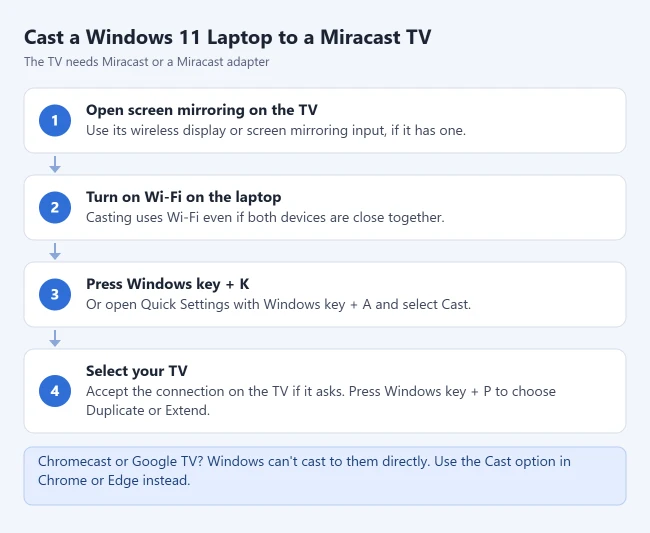
- Turn on the TV and open its screen mirroring or wireless display input, if it has one.
- Make sure Wi-Fi is turned on on your laptop.
- Press Windows key + K to open the Cast list. You can also open Quick Settings with Windows key + A and select Cast.
- Select your TV from the list of devices.
- Accept the connection on the TV if it asks.
To stop casting, press Windows key + K again and select Disconnect. Microsoft covers these steps in its screen mirroring guide.
If Cast Is Missing From Quick Settings
You do not need to add a Quick Settings tile to connect. Press Windows key + K to open Cast directly. This avoids differences in the Quick Settings layout between Windows 11 versions.
You can also connect from Settings > System > Display > Multiple displays and select Connect next to Connect to a wireless display.
Choose What Shows on the TV
Press Windows key + P while connected to pick a mode:
- Duplicate: the TV shows the same thing as your laptop.
- Extend: the TV acts as a second screen, so you can drag windows onto it.
- Second screen only: the laptop screen turns off and only the TV shows your desktop.
Cast to a Chromecast or Google TV
Windows doesn’t cast to Chromecast directly, but your browser can.
- Open Chrome and select the three-dot More menu.
- Select Cast, save, and share, then Cast.
- For the whole desktop, select Sources > Cast screen before choosing the receiver. Leave the source as Cast tab to share only the current tab.
- Select your Chromecast, Google TV Streamer, or TV with Google Cast. If asked which screen to share, select it and confirm.
Your laptop and the receiver must be on the same Wi-Fi network. To stop, select Chrome’s Cast button next to the address bar, then Stop casting. Google’s Chrome casting guide explains both sources. When casting your entire screen, audio may stay on the computer; casting a tab is the better choice when you want that tab’s sound on the TV.
Google no longer sells the Chromecast. Its replacement is the Google TV Streamer, which you can cast to the same way. See what replaced the Chromecast.
Cast to a Samsung, LG, Roku, or Fire TV
Support depends on the exact TV or streaming-device model. A smart TV label alone does not confirm Miracast support. Look for Screen Mirroring, Smart View, or a similar input, open it on the TV, then press Windows key + K on the laptop. Samsung has its own guide to projecting a Windows PC to a Samsung TV. On a supported Roku or Fire TV model, enable screen mirroring in its settings first. Check Roku’s model compatibility guide if unsure. On Fire TV, look for Settings > Display & Sounds > Enable Display Mirroring; Amazon says that a missing option means that Fire TV does not support this feature.
If Your TV Doesn’t Show Up
- Check that your laptop supports Miracast. Press Windows key + K. If Windows says to connect a display with a cable, your laptop can’t cast wirelessly, so use HDMI or a Chromecast.
- Check the TV. Make sure it supports Miracast and its screen mirroring input is open. If it doesn’t, a Miracast adapter plugged into an HDMI port adds support.
- Turn on Wi-Fi on the laptop, and move it closer to the TV.
- Update drivers. Install updates in Settings > Windows Update, including optional driver updates, and update the TV or adapter firmware.
- Restart both the laptop and the TV.
- Remove and reconnect the TV. Go to Settings > Bluetooth & devices > Devices, select the TV under Wireless displays & docks, select Remove device, then cast again.
These checks come from Microsoft’s wireless display troubleshooting page. Note that the Wireless Display optional feature in Settings is only needed on a PC that receives a cast, not on the laptop sending it.
Casting over Wi-Fi can lag. For a steady picture, use a cable: a standard HDMI cable, plus a USB-C to HDMI adapter if your laptop has no HDMI port and its USB-C port supports video output. Check the laptop specifications before buying an adapter. See how to use HDMI on a Windows 11 laptop.
Frequently Asked Questions
Does casting play sound through the TV?
Usually, yes. If sound still comes from the laptop, select the speaker icon on the taskbar and choose the TV as the output device.
Can I cast to a Roku or Fire TV?
Yes, if your particular model supports screen mirroring. Enable that feature on the receiver, then use Windows key + K. If the model lacks it, use a compatible receiver or a wired connection instead.
Why is casting laggy?
Wireless casting depends on your Wi-Fi. It works well for videos and slides, but an HDMI cable is better for games.
To use another Windows laptop as the second screen, see how to wirelessly connect to another display in Windows.
Can I cast just a video instead of my whole screen?
Yes. Google Cast-enabled sites can show a Cast button in the video player. Select it and choose a compatible Google Cast receiver. The button depends on the site and browser; its absence does not mean Windows key + K will connect to a Chromecast.
Can I cast my phone or iPad instead?
See how to screen mirror Android to a TV or how to screen mirror an iPad to a TV.

Matthew Burleigh has been writing tech tutorials since 2008. His writing has appeared on dozens of different websites and been read hundreds of millions of times.
After receiving his Bachelor’s and Master’s degrees in Computer Science he spent several years working in IT management for small businesses. However, he now works full time writing content online and creating websites.
His main writing topics include iPhones, Microsoft Office, Google Apps, Android, and Photoshop, but he has also written about many other tech topics as well.