To limit ad tracking on an iPhone, open Settings > Privacy & Security > Tracking and turn off Allow Apps to Request to Track, then open Settings > Privacy & Security > Apple Advertising and turn off Personalized Ads. There is no Reset Advertising Identifier button anymore; blocking tracking cuts apps off from the identifier instead.
These steps apply to iOS 27 and earlier versions back to iOS 14.5, the release that added tracking permission prompts, on any iPhone that runs them. The same switches are on iPad. Steps for older iOS versions, such as iOS 10 on an iPhone 7, are near the end.
The steps follow Apple’s app tracking and Apple Advertising guides, Apple’s support article If an app asks to track your activity, and Apple’s Apple Advertising and privacy notice.
What the Advertising Identifier Is
The advertising identifier, or IDFA (Identifier for Advertisers), is a random ID that iOS gives your device. It doesn’t contain your name or email address. Ad companies use it to recognize the same phone across different apps, so they can measure which ads you saw, build an interest profile, and show you related ads in other apps.
Apple defines tracking as linking information about you or your device from one app with information collected by other companies’ apps, websites or locations, for targeted ads or ad measurement. Sharing that information with data brokers also counts.
There are two separate kinds of ads to think about on an iPhone:
| Who shows the ads | Where | Setting that controls it |
|---|---|---|
| Other companies’ apps and ad networks | Games, social apps, news apps and other third-party apps | Tracking |
| Apple | App Store, Apple News and Stocks | Apple Advertising |
Turning off one doesn’t change the other, so set both.
Stop Apps From Tracking You
- Open the Settings app.
- Tap Privacy & Security.
- Tap Tracking.
- Turn off Allow Apps to Request to Track. If apps already have permission, iPhone asks whether to tell all of them to stop tracking or let them keep their permission. Choose the option to ask them all to stop.
Apps stop showing tracking prompts. Any app that asks while this switch is off is treated as if you tapped Ask App Not to Track, and it can’t access the advertising identifier. An app told not to track also isn’t allowed to track you with other information that identifies you or your device, like your email address.
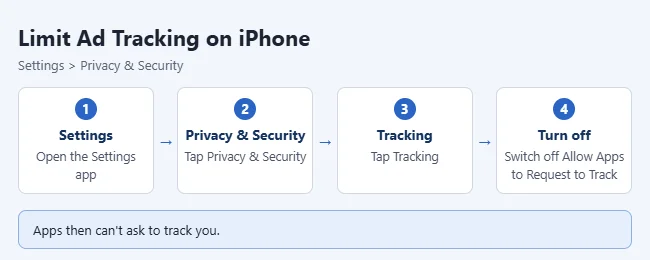
To confirm it worked, go back to Settings > Privacy & Security > Tracking. The main switch is off, and any app listed below it shows its switch off.
Answer the Tracking Prompt in an App
If you leave the main switch on, each app that wants to track you shows a prompt the first time it asks. It names the app and asks whether to allow it to track your activity across other companies’ apps and websites. The developer can add a short line explaining why it wants permission.
- Tap Ask App Not to Track to deny it. The app can’t read your advertising identifier.
- Tap Allow only for apps you trust with your activity data.
You can use the full features of an app either way. Before you install an app, you can also scroll to App Privacy on its App Store page to see what data the developer says it collects and whether that data is used to track you.
Manage Tracking for Individual Apps
The list under Allow Apps to Request to Track shows apps that have already asked. Tap the switch next to any app to turn its permission on or off. The change applies right away.
If the list is empty, no app has asked yet, or the main switch was off before you installed your apps. That’s normal. When the main switch is off, no app needs to be on the list.
Use this method if one app, such as a shopping app, gives you a reason to allow tracking and you want to block everything else. Leave the main switch on, allow that one app, and tap Ask App Not to Track for the rest.
Turn Off Personalized Ads From Apple
Apple’s own ad platform shows ads in the App Store, Apple News and Stocks. Apple doesn’t share your personal data with third parties for these ads. To stop Apple from personalizing them:
- Open Settings.
- Tap Privacy & Security.
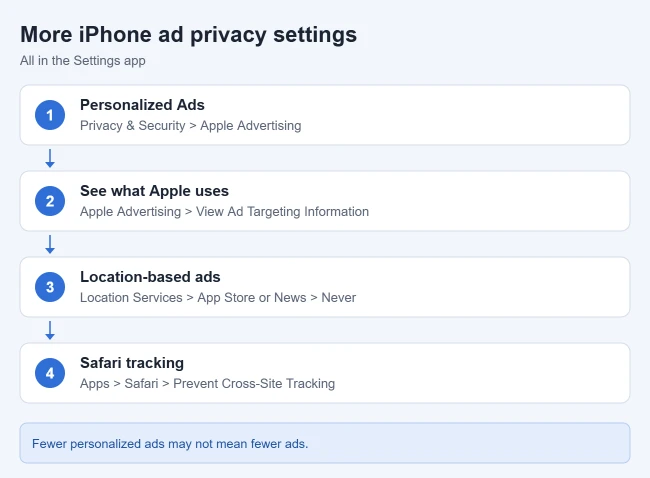
- Scroll to the bottom and tap Apple Advertising.
- Turn off Personalized Ads.
Apple stops using information such as your downloads, purchases and the stories you read in News to target its ads. This may not reduce how many ads you see. The ads are just less relevant. Apple can still show contextual ads, which are picked from things like your search term in the App Store or the story you’re reading, not from your profile.
To see what Apple uses, tap View Ad Targeting Information on the same screen. It shows the groups, called segments, that you’re placed in, built from details like your account information, App Store activity, News and Stocks activity, and how you’ve interacted with Apple’s ads.
The Personalized Ads option may be missing if you’re a minor, use a managed account, or live in a region where Apple doesn’t deliver ads.
Block Location-Based Ads
If you let the App Store or Apple News use your location, Apple’s ad platform might use your current location for geographically targeted ads. To stop that:
- Go to Settings > Privacy & Security > Location Services.
- Tap App Store, then choose Never under Allow Location Access.
- Go back, tap News, and choose Never.
Apple’s ads in those apps no longer use your current location. You can also turn off Location Services at the top of the screen, but that affects every app, including Maps and Weather, so choosing Never for App Store and News is usually the better choice. For the other options, read about turning off Location Services on an iPhone.
To control which publications appear in Apple News itself, you can also block a channel in Apple News.
Limit Tracking in Safari
The tracking settings above cover apps. Websites you visit in Safari are handled by Safari’s own settings. Go to Settings > Apps > Safari (on iOS 17 or earlier, Settings > Safari) and check these:
- Prevent Cross-Site Tracking: keep it on. Safari then limits third-party cookies and data, and regularly deletes tracking data unless you visit the tracker’s site directly. See Apple’s Safari privacy guide.
- Hide IP Address: choose Trackers Only to hide your IP address from known trackers. That option is free. Trackers and Websites routes all Safari traffic through iCloud Private Relay and requires an iCloud+ subscription.
- Block All Cookies: under Advanced. It’s stricter, but it signs you out of sites and breaks shopping carts. Most people should leave it off, and if a site complains you can allow cookies in Safari on iPhone again.
Email can report back to senders too. To control remote content in Mail, you can stop loading email pictures on the iPhone.
What These Settings Don’t Stop
Blocking tracking is a big step, but it has limits worth knowing:
- Tracking inside one company’s own apps. Apple’s rules cover tracking across other companies’ apps and websites. A company can still use what you do in its own apps, such as one social network using your activity across the apps it owns, to choose ads.
- Ad-supported apps. Free apps still show ads. They’re just not built from a cross-app profile.
- In-app privacy choices. Many apps have their own ad settings, often under Settings, Privacy or Ad Preferences inside the app. Check them in apps you use often.
- Your other devices. Each phone, tablet and TV has its own settings. On Apple TV, the path is Settings > General > Privacy & Security > Tracking. On a Mac, go to Apple menu > System Settings > Privacy & Security > Apple Advertising and deselect Personalized Ads.
Why the Reset Option Went Away
Older versions of iOS let you reset the advertising identifier so ad companies would see you as a new user. The old profile tied to the previous ID stayed on their servers, and apps could start building a new one right away. Starting with iOS 14.5, Apple requires apps to ask permission before tracking you across other companies’ apps and websites. If you say no, or turn off the request switch, the app gets a blank identifier instead of your real one. That does more than a reset did, so there’s nothing to reset on current iOS.
Older iPhones (iOS 13 and Earlier)
On older versions of iOS, such as iOS 10 on an iPhone 7, the settings are in one place:
- Open Settings and tap Privacy.
- Scroll down and tap Advertising.
- Turn on Limit Ad Tracking.
- Tap Reset Advertising Identifier, then confirm to get a new identifier.
Limiting tracking doesn’t remove ads. It tells apps not to target ads with your identifier. Since iOS 10, apps see a blank identifier when Limit Ad Tracking is on.
When Tracking Requests Are Grayed Out
- Allow Apps to Request to Track is grayed out: this happens with a child account or a user under 18 by birth year, an Apple Account managed by a school or business, a device profile that limits tracking, or an Apple Account created in the last 3 days. In most of these cases the switch is locked off, which already blocks tracking. If your account is new, check again after 3 days.
- You can’t change a privacy setting at all: check Settings > Screen Time > Content & Privacy Restrictions. Restrictions set by a parent can lock privacy settings. Ask the person who manages Screen Time to allow changes.
- There is no Tracking option: update your iPhone in Settings > General > Software Update. Tracking appears in iOS 14.5 and later.
- Personalized Ads is missing: you may be signed in with a minor’s or managed account, or you’re in a region where Apple doesn’t show ads.
Ad Tracking Questions
Will I see fewer ads?
Not necessarily. These settings limit tracking and personalization. Turning off personalized ads may not reduce the number of ads you receive. To hide ads on web pages, use a content blocker; blocking ads in Microsoft Edge on an iPhone is one example. If you also stream on an Amazon device, you can turn off interest-based ads on a Fire TV Stick as well.
Can I delete my advertising identifier?
No. iOS doesn’t offer a delete or reset button. When you deny tracking, the app can’t read the identifier, which has the same practical effect for that app.
Is the advertising identifier the same as my Apple Account?
No. The advertising identifier belongs to the device, not your Apple Account, and it isn’t your name, email address or phone number.
Why can’t I turn on Allow Apps to Request to Track?
It can be locked off for child accounts, users under 18, managed school or work accounts, devices with a restricting profile, and Apple Accounts created in the last 3 days.
Next step: open Settings > Privacy & Security and look through the other permissions apps have. Related: how to change local network access and how to see which apps can access your photos.

Matthew Burleigh is the founder, head writer, and editor of Solve Your Tech, which he launched in 2012. He has written technology tutorials since 2008 and worked in IT since 2003, including small-business support, IT management, and consulting. He holds Bachelor’s and Master’s degrees in Computer Science from Arizona State University.
Matthew writes practical guides for Windows, iPhone and iPad, Microsoft Office, Outlook, Google apps, and Android. Solve Your Tech’s guides are checked step by step against the device or app maker’s own documentation and tested on his own devices whenever he has the hardware or software, with clear steps, sources, and update dates.
Read more about Matthew and how Solve Your Tech writes and updates its guides, or report a correction.