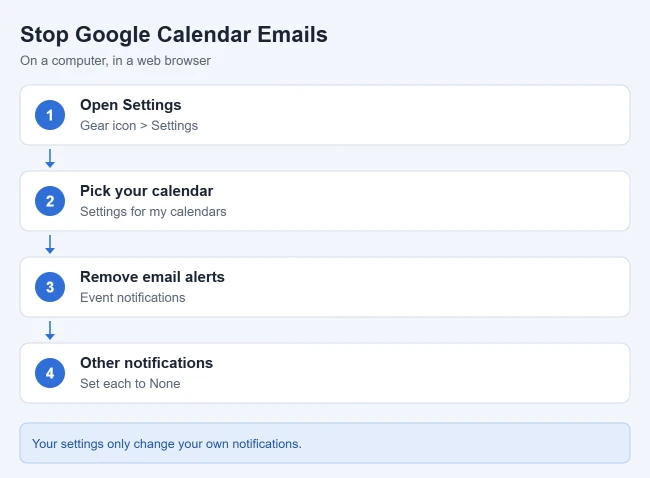
To stop email notifications from Google Calendar, open Calendar on a computer, go to Settings, click your calendar under Settings for my calendars, and remove each email notification under Event notifications and All-day event notifications. Then click Other notifications and set the email categories, such as changed events and event responses, to None.
These steps cover Google Calendar in a web browser and the Google Calendar apps for Android, iPhone, and iPad, as described in Google Calendar Help’s Change Google Calendar notifications page and its Android version. Google says your notification settings are personal: they only change what you receive, not what people you share a calendar with receive.
The Two Kinds of Calendar Email
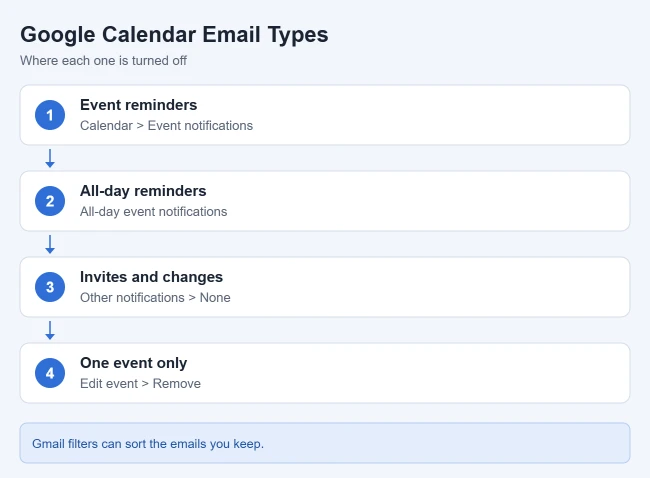
Google Calendar sends two different kinds of email, and each one is turned off in a different place:
| Email type | Example | Where to turn it off |
|---|---|---|
| Event reminders | “Reminder: Dentist at 3pm” | Event notifications and All-day event notifications for each calendar, or inside one event |
| Updates about events | New invites, changed or canceled events, guest replies, daily agenda | Other notifications for each calendar |
If you only fix one of these, the other kind keeps arriving.
How to Turn Off Event Reminder Emails
Event reminder emails are set for each calendar you own. You need to use Calendar in a web browser, like Chrome or Safari, to change these settings on a computer.
- Open Google Calendar in a web browser on your computer.
- Click the Settings (gear) icon at the top right, then click Settings.
- On the left, under Settings for my calendars, click the calendar. Its settings sections appear below its name.
- Find Event notifications and All-day event notifications.
- Click Remove notification (the X or trash icon) next to any email notification, or change it from Email to Notification.
New events on that calendar no longer send reminder emails. Calendar-level settings decide your notifications for new events unless you customize a specific event. If you have more than one calendar, repeat these steps for each one.
How to Turn Off Emails About Invites and Changes
These are under a separate setting for each calendar, called Other notifications.
- Open Google Calendar in a web browser on your computer.
- Click the Settings (gear) icon at the top right, then click Settings.
- Under Settings for my calendars, click the calendar name.
- Click Other notifications.
- Next to each category, open the drop-down menu and choose None.
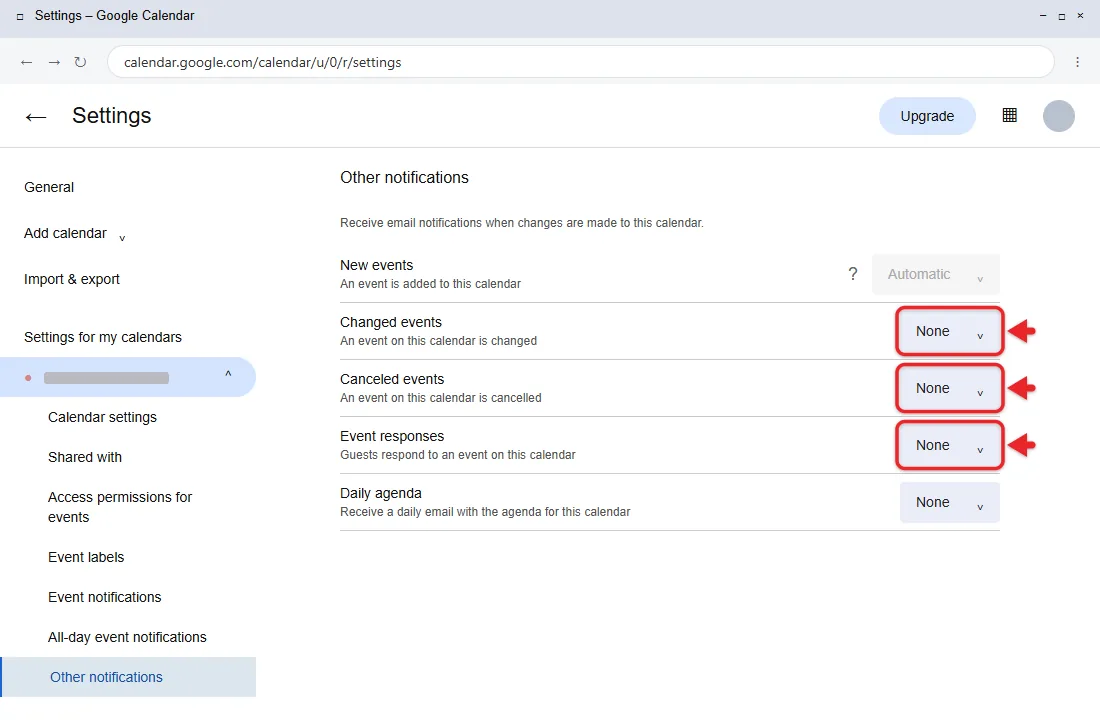
You stop getting emails for those categories. Choose Email again for any category you want back. Google’s Calendar developer documentation describes what each type covers:
- New events: someone adds an event to your calendar, such as an invite.
- Changed events: the organizer changes an event you’re invited to.
- Canceled events: an event you’re invited to is canceled.
- Event responses: a guest changes their reply to an event you created.
- Daily agenda: a list of your day’s events, sent each morning.
If New events shows Automatic and can’t be changed, it follows the invitation setting under General in Settings, as the screenshot above shows.
How to Stop Emails for One Event
- Open Google Calendar on your computer.
- Click the event, then click Edit event (the pencil icon).
- Next to Notifications, click Remove (the trash icon) on the email notification.
- Click Save at the top.
Only that event changes. Your other events keep their calendar-level settings.
Account-Wide Notification Settings
Google also has general notification settings for all your events. They control pop-up style alerts, not email, so changing them won’t stop reminder emails on their own.
- Open Google Calendar on your computer.
- Click the Settings (gear) icon at the top right, then click Settings.
- On the left, under General, click Notification settings.
- Use the Notifications drop-down to choose how alerts appear, or check Notify me only if I have responded Yes or Maybe.
The “Yes or Maybe” box is useful if you get many invites you never accept. It limits notifications to events you’ve responded to that way.
How to Turn Off Email Reminders in the Android App
Google’s Android instructions say you can also remove reminders from the Google Calendar app, and the change syncs to your other devices.
- Open the Google Calendar app on your Android phone or tablet.
- Tap Menu at the top left, then tap Settings at the bottom.
- Select one of your calendars.
- Tap a notification and select No notification. Do the same for each email notification.
Those reminders stop on all your devices, since notification changes on your phone sync with your computer. Repeat for each account or calendar.
How to Turn Off Reminders in the iPhone or iPad App
- Open the Google Calendar app and tap Menu at the top left.
- Tap Settings at the bottom.
- Select one of your calendars.
- Swipe left on a notification and tap Delete. Repeat for each notification.
The Other notifications emails for invites and changes aren’t in the phone apps, so change those on a computer, as shown above.
If the problem is pop-up alerts from the Calendar app on your phone rather than emails, you can silence notifications on your iPhone for that app.
Still Getting Calendar Emails?
- Check every calendar. Notification settings are per calendar, so a second calendar, or a calendar in another Google account, can still send emails.
- Check customized events. Calendar settings apply to new events unless you customize a specific event, so an event with its own email notification keeps it. Edit that event and remove the email.
- Check your other calendar apps. An app synced to your Google account, such as Apple Calendar on a Mac, can add its own alerts on top of Google’s. Look in that app’s alert settings too.
- Invites still arrive. If you don’t use Calendar, you get emails when someone creates, updates, or deletes an event you’re invited to.
- Work or school account. An administrator can change events on your calendar without you getting a notification. Ask your administrator if settings look different from these steps.
Filter Calendar Emails Instead of Turning Them Off
If you still want some calendar emails but not in your inbox, Google’s answer is a Gmail filter. Its guide to filtering Calendar notification emails gives search terms like header:X-Google-Calendar-Notification:rsvpDeclined for declined replies. Search Gmail with a term like that, open the search options, click Create filter, and choose to label, archive, or delete the matching emails.
If calendar emails arrive in an Outlook mailbox you still want them in, you can create an Outlook rule to file them in a folder instead.
If an old filter is hiding calendar emails you want to see, learn how to delete a filter in Gmail.
Frequently Asked Questions
Will turning off my email notifications affect other people?
No. Your notification settings apply only to your account, and they don’t change notifications for anyone else who has access to the calendar.
Can I keep pop-up reminders but stop emails?
Yes. In Event notifications, change each email notification to a regular notification instead of removing it. Notifications can come by email, as desktop notifications, or as alerts inside Calendar.
Do guests still get emails when I change an event?
Your settings don’t decide that. Event guests get notifications based on their own settings, so each guest has to change their own account if they want fewer emails.
More Google Guides
- How to stop Google Calendar from adding Gmail events
- How to hide the Meet section in Gmail
- How to change iPhone Calendar alerts and settings
- How to view a Google Calendar file in Excel

Matthew Burleigh is the founder, head writer, and editor of Solve Your Tech, which he launched in 2012. He has written technology tutorials since 2008 and worked in IT since 2003, including small-business support, IT management, and consulting. He holds Bachelor’s and Master’s degrees in Computer Science from Arizona State University.
Matthew writes practical guides for Windows, iPhone and iPad, Microsoft Office, Outlook, Google apps, and Android. Solve Your Tech’s guides are checked step by step against the device or app maker’s own documentation and tested on his own devices whenever he has the hardware or software, with clear steps, sources, and update dates.
Read more about Matthew and how Solve Your Tech writes and updates its guides, or report a correction.