To make Windows 11 prefer one connection, give that adapter a lower interface metric: in Network Connections (ncpa.cpl), open its TCP/IPv4 properties, select Advanced, clear Automatic metric, and enter a smaller number than the other adapter. To change which saved Wi-Fi network joins first, use netsh wlan set profileorder.
Your laptop is plugged into Ethernet at the desk, yet Windows keeps sending traffic over a weaker Wi-Fi network, or it keeps joining the wrong Wi-Fi first. Each problem has its own setting.
What Network Priority Means in Windows 11
“Network priority” can mean three separate things, and each one is controlled in a different place:
- Which adapter carries your traffic when two are connected at once, such as Ethernet and Wi-Fi. This is set by the interface metric.
- Which saved Wi-Fi network Windows tries first when several known networks are in range. This is the Wi-Fi profile order.
- Whether Windows joins a network on its own at all. This is the automatic connection option for each saved network.
The interface metric is a number attached to each network adapter. When Windows picks a route for outgoing traffic, it adds the route metric and the interface metric together, and the lowest total wins. A lower interface metric therefore means a higher priority.
By default, every adapter uses an automatic metric that Windows calculates from the link speed: the fastest interface gets the lowest number. Microsoft’s automatic metric table for IPv4 routes shows how this works. A wired link at 1 Gbps gets a metric of 25, while a Wi-Fi link between 200 and 500 Mbps gets 35. Microsoft counts a wireless link at half its advertised speed for this table, so a Wi-Fi connection showing 866 Mbps lands in the 35 band. That is why Ethernet usually wins without any changes. Wi-Fi can still come out ahead when it reports a faster link than a slow wired port, or when a VPN or virtual adapter has its own low metric.
Changing the metric decides which connection is used. It does not make either connection faster. If the Wi-Fi itself is slow, the tips for getting better Wi-Fi speed on a Windows 11 laptop are a better place to start.
Check Your Current Interface Metrics
Write down the current values before you change anything, so you know which adapter is winning and can compare after the change.
- Right-click the Start button and choose Terminal (or search for PowerShell).
- Type
Get-NetIPInterface -AddressFamily IPv4and press Enter. - In the table that appears, look for the ifIndex, InterfaceAlias and InterfaceMetric columns (column order can vary). The alias is the adapter name, such as “Ethernet” or “Wi-Fi”. The ifIndex number is what you use in PowerShell later.
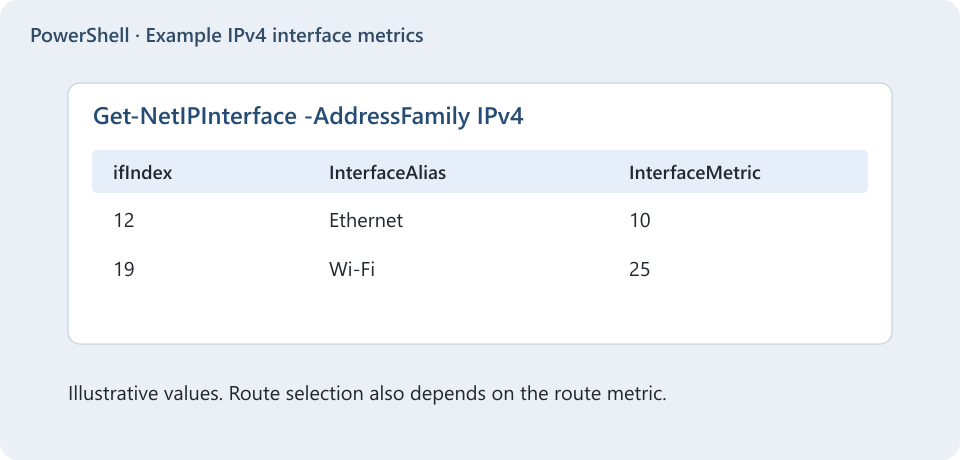
Ignore entries such as “Loopback Pseudo-Interface 1”; those are internal to Windows. If a VPN or virtualization program is installed, you may also see extra adapters with their own metrics, which matters later in troubleshooting.
Set an Adapter Priority in Network Connections
This is the classic dialog, and it is the same one Microsoft documents for setting a manual metric. You’ll likely need an administrator account, since Windows may ask for permission before it saves adapter changes.
- Press Windows key + R, type
ncpa.cpl, and press Enter. The Network Connections window opens with one icon per adapter. - Right-click the adapter you want Windows to prefer (for example, Ethernet) and select Properties.
- Select Internet Protocol Version 4 (TCP/IPv4) in the list, then select Properties.
- On the General tab, select Advanced. The Advanced TCP/IP Settings window opens on the IP Settings tab.
- Clear the Automatic metric check box.
- In the Interface metric box, type a low number, such as 10.
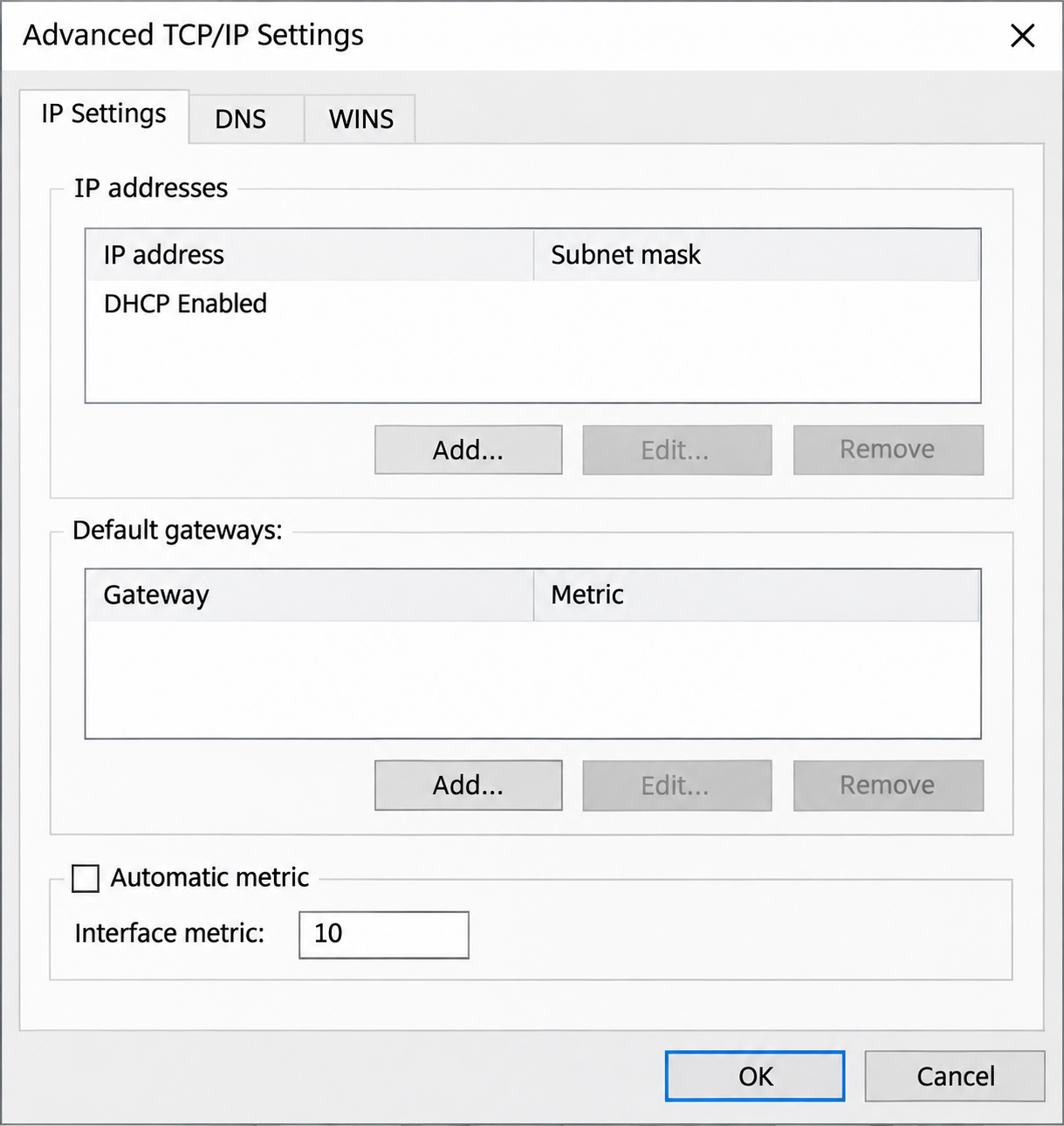
- Select OK, OK again, and then Close.
- Repeat steps 2 to 7 for the adapter you want used less (for example, Wi-Fi), and give it a higher number, such as 50.
Setting both adapters by hand removes any guesswork, because the automatic value on the other adapter can change when its link speed changes. Leave a gap between the numbers (10 and 50 rather than 10 and 11) so a route metric difference is less likely to flip the order.
If your network also uses IPv6, the IPv6 protocol has its own Advanced button and its own metric. Set it the same way on Internet Protocol Version 6 (TCP/IPv6) if you want IPv6 traffic to follow the same order. A broader walkthrough of this Properties window is in the article on changing adapter settings in Windows 11.
Windows 11 Settings can also reach the adapter properties on many versions: go to Settings > Network & internet > Advanced network settings, select the adapter to expand it, and look for an Edit button next to “More adapter options”. The labels can differ by build, so ncpa.cpl is the more predictable route.
Set an Adapter Priority With PowerShell
PowerShell does the same job in one line per adapter, which is handy on several PCs. Open Terminal as administrator (right-click Start, then Terminal (Admin)), because changing an interface usually needs elevated rights.
- Run
Get-NetIPInterface -AddressFamily IPv4and note the ifIndex of each adapter. In this example, Ethernet is 12 and Wi-Fi is 7. - Give the preferred adapter a low metric:
Set-NetIPInterface -InterfaceIndex 12 -InterfaceMetric 10 - Give the other adapter a higher metric:
Set-NetIPInterface -InterfaceIndex 7 -InterfaceMetric 50 - Run
Get-NetIPInterface -AddressFamily IPv4again to confirm the new numbers.
You can use the adapter name instead of the index, for example Set-NetIPInterface -InterfaceAlias "Wi-Fi" -InterfaceMetric 50. According to Microsoft’s Set-NetIPInterface reference, setting a value for InterfaceMetric automatically turns AutomaticMetric off for that interface, so there’s no separate step for that. Without -AddressFamily, the command can change both the IPv4 and IPv6 entries for that adapter; add -AddressFamily IPv4 if you only want one.
Change the Order of Saved Wi-Fi Networks
Metrics don’t decide which Wi-Fi network your wireless adapter joins. Say your home has a 5 GHz network and an older 2.4 GHz network, and the laptop keeps picking the older one. That is the profile order, and Windows 11 Settings doesn’t offer a reorder list for it. The netsh wlan command reference covers the command that changes it.
- Open Terminal or Command Prompt.
- Run
netsh wlan show profiles. Windows lists the saved networks for each wireless interface; the User profiles section normally shows them in priority order. - Note the exact network name and the interface name shown in the header (often “Wi-Fi”).
- Run
netsh wlan set profileorder name="HomeNet-5G" interface="Wi-Fi" priority=1, using your own network and interface names. Priority 1 puts that network at the top of the user profiles for that interface. Group Policy profiles still take precedence. - Run
netsh wlan show profilesagain. The network you moved should now be first in the user profiles list.
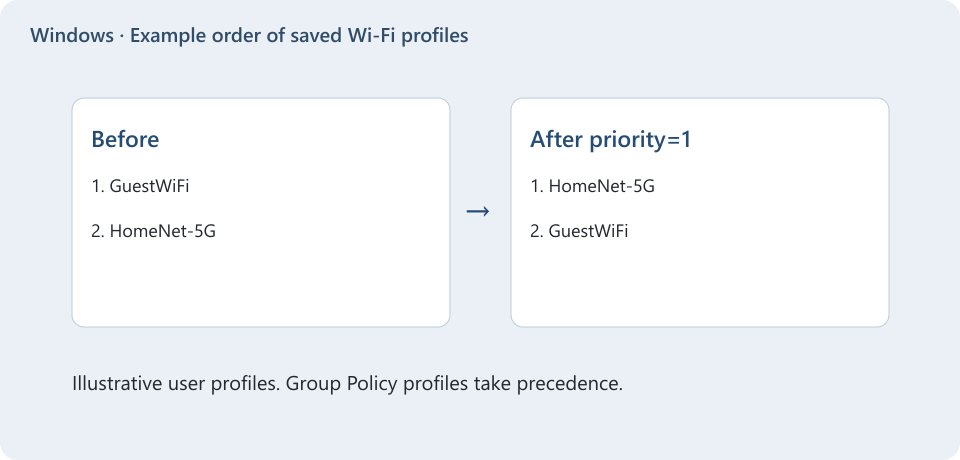
All three values (name, interface and priority) are required, and the name must match exactly, including spaces and capitals. Only user profiles can be reordered. Profiles pushed by Group Policy on a work or school PC are read-only and always rank ahead of user profiles, so they will stay on top whatever you do.
Stop Windows From Joining a Wi-Fi Network by Itself
Sometimes the simplest fix is to tell Windows not to join an unwanted network automatically, such as a slow guest network or a neighbor’s open hotspot you once used.
- Open Settings and go to Network & internet > Wi-Fi.
- Select Manage known networks.
- Select the network you don’t want Windows to join on its own.
- Turn off the automatic connection option (on most versions it reads “Connect automatically when in range”).
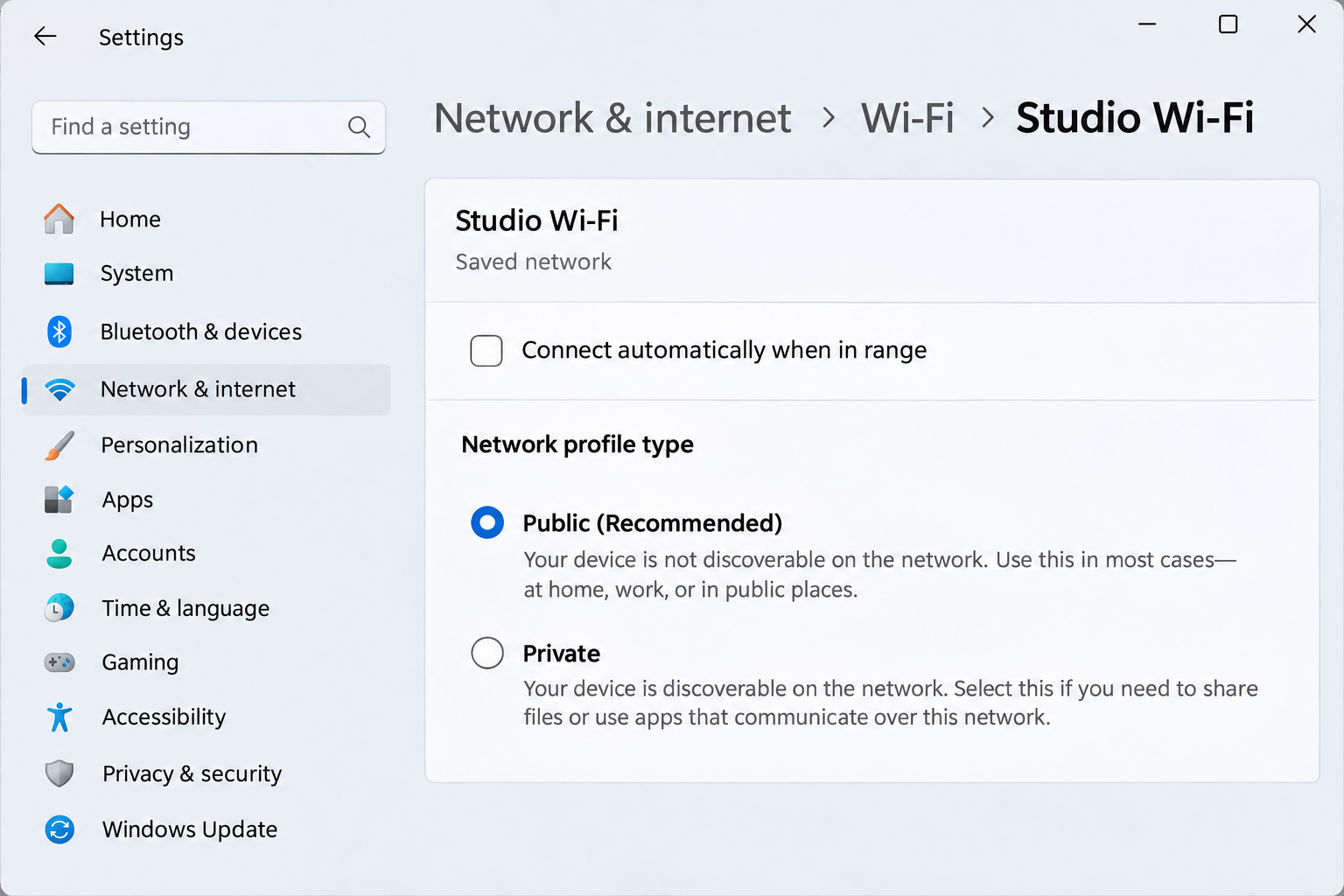
The network stays saved with its password, so you can still pick it manually from the Wi-Fi list. If you never want it again, forget the Wi-Fi network in Windows 11 instead, which deletes the saved profile entirely.
Undo the Change
Going back to the default is quick, and it’s worth doing if you move the laptop to a different setup where the manual numbers no longer make sense.
- In Network Connections: return to the adapter’s TCP/IPv4 Properties > Advanced and check Automatic metric again. Do this for every adapter you changed, and for IPv6 if you set it.
- In PowerShell (admin): run
Set-NetIPInterface -InterfaceIndex 12 -AutomaticMetric Enabledfor each adapter, using its own index. - Wi-Fi order: run the profileorder command again with a different network at priority 1, or turn Connect automatically back on in Manage known networks.
If Windows Still Uses the Wrong Connection
Work through these checks in order:
- Confirm the cable link is up. If the Ethernet icon in ncpa.cpl shows “Network cable unplugged” or an unidentified network, Windows has no working route over it and will use Wi-Fi no matter what the metric says. Checking that the adapter has a valid address (see finding your IP address on Windows 11) tells you quickly.
- Look for VPN and virtual adapters. A VPN client may set its own low metric so that traffic goes through the tunnel while it is connected. That is usually intended, so disconnect the VPN before judging whether your change worked.
- Check both IP versions. If you only set IPv4 and your network uses IPv6, some traffic can still follow the automatic IPv6 order.
- Disconnect and reconnect, or restart. Existing connections may keep using the old path until they are reopened.
- Update or reset as a last step. A misbehaving wireless card may need a newer driver (see updating the Wi-Fi driver on Windows 11). If settings are tangled beyond repair, resetting network settings in Windows 11 removes and reinstalls the network adapters with default settings, and you might need to set up VPN software again afterward.
One more thing this article doesn’t cover: giving one app more bandwidth than another. That is a different feature (quality of service policies), and changing the metric won’t do it.
Network Priority Questions
Does Windows 11 use Ethernet and Wi-Fi at the same time?
Both adapters can stay connected, but for ordinary internet traffic Windows sends each connection over the route with the lowest combined metric. It doesn’t normally combine both links to speed up a single download. Keeping Wi-Fi connected is useful as a fallback: if the cable comes out, traffic moves to Wi-Fi.
What number should I use for the metric?
The exact value matters less than the gap. Any number lower than the other adapter’s works. Using clearly separated values, such as 10 for the preferred adapter and 50 for the backup, keeps the order stable even when route metrics differ.
Why can’t I reorder Wi-Fi networks in Settings?
Settings lets you manage, forget and stop auto-joining known networks, but it doesn’t show a priority list you can rearrange. The netsh wlan set profileorder command is the built-in way to change that order.
Will the setting survive a restart or Windows update?
A manual metric is stored with the adapter, so it normally stays after a restart. Reinstalling the network driver or running a network reset can return the adapter to Automatic metric, so check Get-NetIPInterface after either one.
Does the metric affect devices on my local network?
It only affects traffic leaving this PC. Other computers, phones and printers on the network keep their own settings. If both adapters connect to the same router, local devices are reachable either way.
Once Windows is using the connection you want, run Get-NetIPInterface one more time and keep a note of the numbers, so you can spot the change quickly if a driver update or VPN install resets them.

Matthew Burleigh is the founder, head writer, and editor of Solve Your Tech, which he launched in 2012. He has written technology tutorials since 2008 and worked in IT since 2003, including small-business support, IT management, and consulting. He holds Bachelor’s and Master’s degrees in Computer Science from Arizona State University.
Matthew writes practical guides for Windows, iPhone and iPad, Microsoft Office, Outlook, Google apps, and Android. Solve Your Tech’s guides are checked step by step against the device or app maker’s own documentation and tested on his own devices whenever he has the hardware or software, with clear steps, sources, and update dates.
Read more about Matthew and how Solve Your Tech writes and updates its guides, or report a correction.