You spot an iPad left on a train seat or a café table, and you want to get it back to the person who lost it. Start by waking the screen and looking for a message or phone number the owner may have added with Lost Mode. If there is nothing, hand it to the staff where you found it or to the police. Don’t try to get past the passcode or reset it: Activation Lock keeps it tied to the owner.
First, Check the Lock Screen for a Message or Phone Number
Most iPads are protected by Find My, Apple’s service for locating lost devices. When an owner realizes the iPad is missing, they can turn on Lost Mode from another device. Lost Mode locks the iPad and, if the owner chooses, shows a custom message and a phone number on the screen so that whoever finds it can get in touch. This is the single most useful thing a finder can check.
- Press the top button (or the Home button on models that have one) to wake the screen. You don’t need to open the iPad to see the Lock Screen.
- Read the screen for a message such as a request to call, a name or a phone number. Lost Mode messages are written by the owner, so they can say anything.
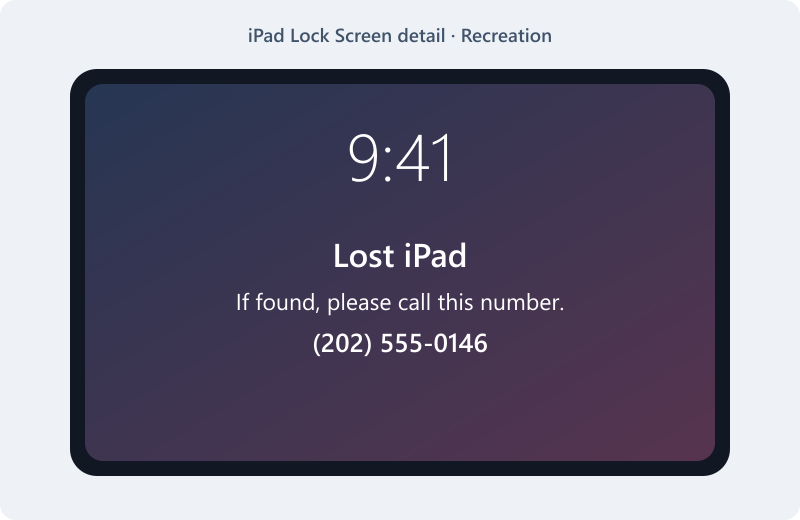
- If a number appears, call or text it from your own phone. Say where you found the iPad and how they can collect it.
- If nothing appears yet, check again later. Lost Mode only reaches the iPad while it is turned on and connected to Wi-Fi or cellular data, so the owner’s message may show up after they notice the loss.
Look at the outside of the iPad too. A case may hold a business card, a school or company asset tag, or a name label. Those are fair to use. Contact a school or employer through its main office or published number, not through a stranger who claims to know the owner.
Example: Jordan finds an iPad on a bus bench. The screen shows a short note asking the finder to call, with a phone number. Jordan calls from a personal phone, leaves a message describing the bench and the bus line, and keeps the iPad on until the owner calls back that afternoon.
Keep It Safe, Charged and Powered On
While you are deciding what to do, how you handle the iPad matters, because the owner’s own tools work through it.
- Leave it turned on. The owner can see the last known location, play a sound, or add a Lost Mode message only while the iPad can connect. A powered off iPad can’t receive any of that.
- If it rings, you can answer. An owner may call their own device through FaceTime or a calling app. If a call comes in, answering and saying where you found it is the fastest way to return it; don’t make calls from it.
- Charge it if the battery is low. Any compatible charger works, and charging doesn’t require the passcode.
- Don’t switch on Airplane Mode or turn off Wi-Fi. That cuts the owner off from their device.
- Don’t erase, reset or restore it. It won’t help you, and it can destroy the owner’s photos and files if they had no backup.
- Keep it somewhere secure. Treat it like a found wallet. It holds someone’s messages, photos and accounts.
If the iPad starts playing a loud sound, that is likely the owner using Find My to locate it. Leave it on; it means they are actively looking, and a Lost Mode message may follow.
What About Siri and Medical ID?
Older advice often tells finders to ask Siri “Whose iPad is this?” or to open Medical ID for an emergency contact. Both are less useful than they sound.
Siri: Some guides say Siri may share the owner’s name when asked on a locked device. Apple doesn’t document this as a way to identify an owner, and whether Siri answers at all depends on how the owner set it up, including whether Siri is allowed when the device is locked. Don’t rely on it, and don’t use Siri to call or message people from the owner’s contacts. The Lock Screen message, the venue and the police are better routes.
Medical ID: Apple describes Medical ID as an iPhone feature in the Health app, available from the Lock Screen only when the owner turns on Show When Locked. Apple’s Medical ID page doesn’t describe it on iPad, so there is usually no emergency contact screen to check on a found iPad.
Hand It to the Place You Found It
People who lose something usually retrace their steps and call the place they were. That makes the venue’s lost property desk one of the best places to leave an iPad.
- Find a staff member: the café counter, the train conductor or station office, a mall security desk, a school front office, the airline or airport lost property team, or the hotel front desk.
- Ask whether they log found items and how long they keep them.
- Ask for a receipt, a reference number or at least the name of the person you handed it to, and note the date and time.
- If the Lock Screen shows a contact number, tell the staff, and consider calling it yourself so the owner knows where to go.
On public transport, items left on a vehicle normally go to the operator’s lost property office. Handing it to the driver or station staff keeps it where the owner will look first.
Report It to the Police or a Lost Property Office
If you found the iPad on the street, in a park or anywhere without staff, contact your local police on their non-emergency line or visit a station. Many areas also have a municipal lost property office.
- Give the date, time and exact place you found it, plus a description (model if you know it, color, case).
- Ask for a report or reference number. If the owner reported the iPad missing, the police can match the two.
- Many people who lose a device report it to the police as well as using Find My, so this is often where an owner checks.
Rules about found property vary by country, state and city. In many places you are expected to hand in valuable items, and keeping them can be treated as theft. Ask the police what applies where you live rather than relying on a general rule.
Don’t expect Apple to act as a go-between. Apple’s support pages describe no service for finders to reach an owner, and they warn owners that Apple will never contact them to say a lost iPhone or iPad has been found. That warning exists because scammers send fake “your device was found” messages. If you are trying to help, go through the venue or the police, not through someone posing as Apple.
Why You Can’t Use or Reset a Found iPad
Activation Lock is part of Find My. Apple explains that it is designed to stop anyone else from using a lost or stolen iPhone or iPad. Turning off Find My, erasing the iPad or setting it up again all need the owner’s Apple Account password. Even if someone erases the iPad, it asks for that password during setup and won’t go further without it.
In practice this means:
- A found iPad that is protected by Activation Lock is of no use to a finder. You can’t sign in, set it up as new or use it for parts in any normal way.
- On iPadOS 15 or later, Apple says a device locked this way shows a message that it is locked to its owner, and Lost Mode can add the owner’s own message and phone number.
- Don’t try to guess the passcode. Repeated wrong entries can lock the iPad, which only makes things harder for the real owner.
- Software or services that claim to get around Activation Lock or a passcode are not a legitimate route, and using them on someone else’s device can be illegal.
- Selling, giving away or buying a found iPad is a bad idea. Apple tells buyers not to take ownership of a used iPhone or iPad protected by Activation Lock, and the device stays tied to its owner’s account.
Only the owner can release the iPad, by turning off Find My with their password. The steps an owner follows are in how to turn off Find My iPhone, which works the same way for an iPad. Apple’s own explanation is on its Activation Lock for iPhone and iPad page.
Returning It Safely to the Owner
If you reach the owner yourself, a few precautions protect both of you.
Make Sure It’s Really Theirs
If you called the number on the Lock Screen, that already links the person to the iPad. If someone contacts you after a post or a notice, ask them to describe things you can check without opening the iPad: the case, stickers, scratches, the wallpaper on the Lock Screen, or the Lost Mode message text. The simplest proof is that the owner can open it with their passcode in front of you, once you meet.
Meet Somewhere Public
- Choose a busy place with staff or cameras, such as a café, a library or the lobby of a police station.
- Tell a friend where you are going, or bring one along.
- Don’t share your home address.
- Don’t ask for money. If the owner offers a reward, that is their choice.
Posting About It Online
A short post in a local community group or on the venue’s page can help. Keep it vague: “Found an iPad near the north entrance of the station on Tuesday. Contact me with a description.” Don’t post photos of the Lock Screen, the serial number, any notifications showing names or messages, or the exact case. Keeping those back is what lets you check who the real owner is.
If you handed the iPad to the venue or the police, simply point anyone who contacts you to them with the reference number. They will handle checking ownership.
If You’re the Owner: Use Find My and Lost Mode
If you are on the other side of this and your iPad is missing, the steps you take now decide how easy it is for a finder to help. Apple’s page on what to do if your iPhone or iPad is lost or stolen covers the full process.
- Open the Find My app on another Apple device, or sign in at icloud.com/find in a web browser.
- Tap Devices and choose the missing iPad. Its location appears on a map if it is online; Apple says the last known location is kept for up to seven days.
- If it may be nearby, choose Play Sound.
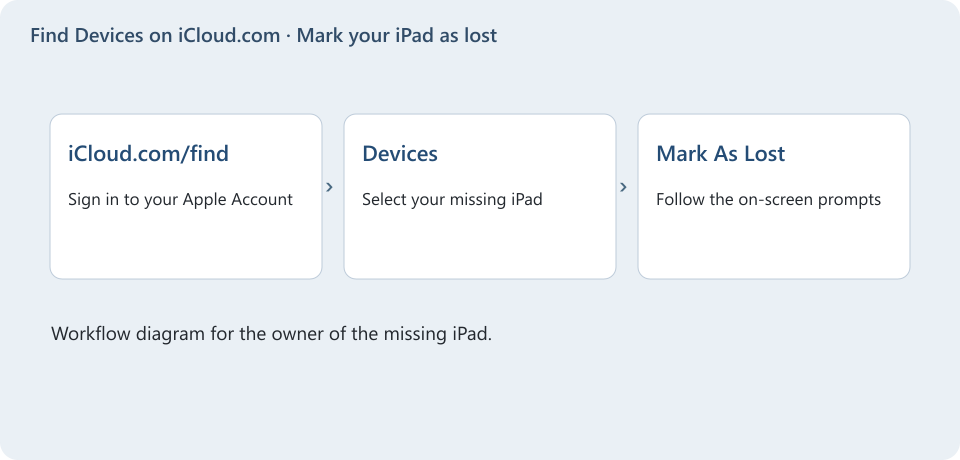
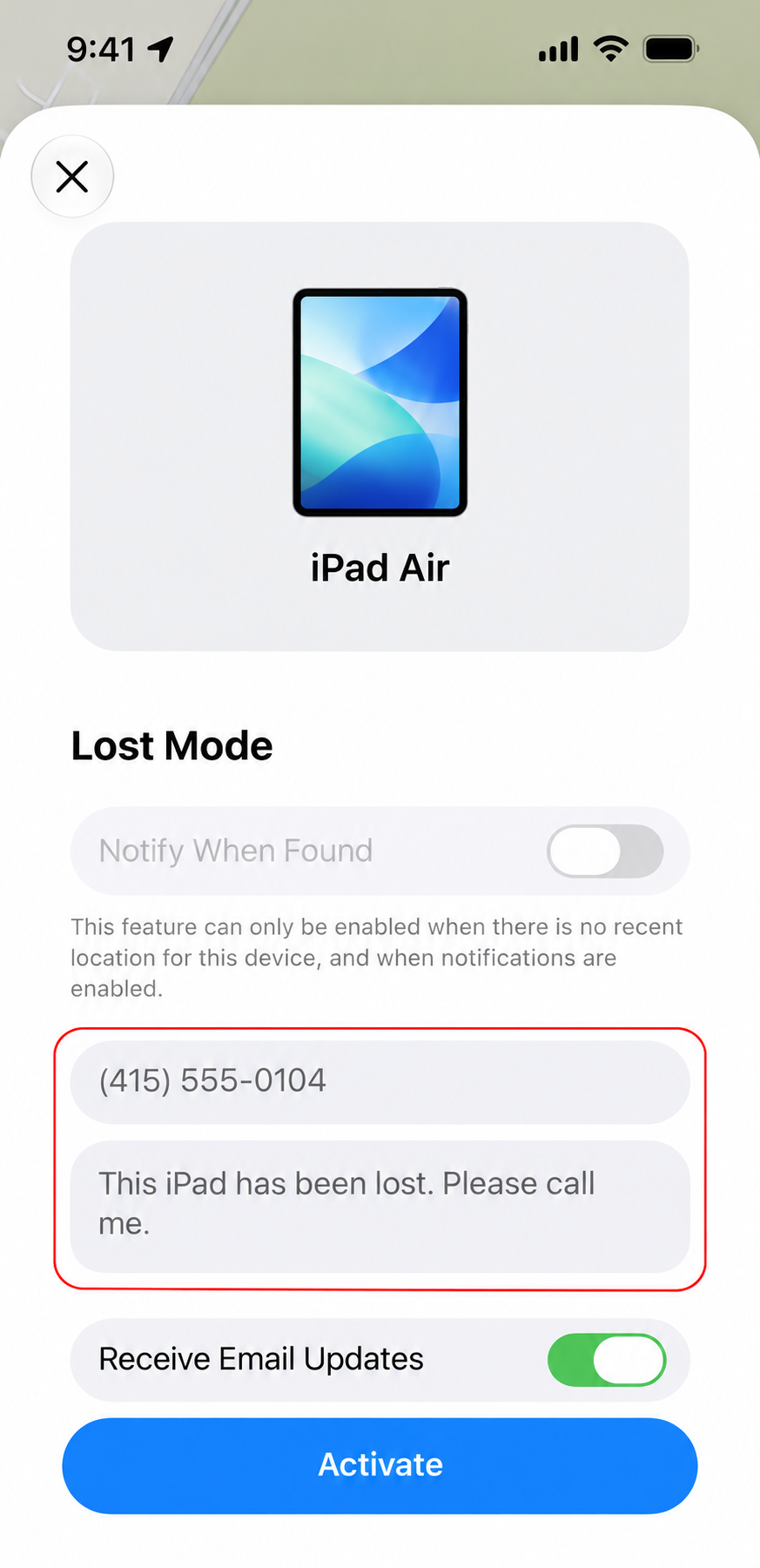
- Tap the More button, scroll down to Lost iPad, turn on Lost Mode, then tap Activate. On icloud.com/find, choose the iPad and select Mark As Lost.
- Enter a phone number where you can be reached, such as a partner’s phone or a work line, and a short message. Both appear on the iPad’s screen.
- Report the loss to the police if it may have been stolen, and call the place you last had it.
Lost Mode locks the iPad with its passcode and, on devices with Apple Pay, suspends payment cards and passes. Don’t remove the iPad from Find My while you are still hoping to get it back: Apple notes that removing it also removes Activation Lock.
Erasing the iPad remotely is a last resort. Apple warns it can’t be undone, so try Lost Mode first. Before you ever erase anything, it helps to have iCloud Backup turned on for the iPad, so a lost or erased iPad doesn’t mean lost photos. If you get it back and want to set it up fresh, see how to wipe an iPad clean.
Prevention matters too. A passcode protects your data if the iPad goes missing, so if you don’t have one, follow how to set a passcode on your iPad. A name label or a contact card in the case also gives an honest finder an easy route back to you.
Apple’s support page on finding a lost iPhone or iPad also covers how Lost Mode works when the device is offline: the commands take effect once it is turned on and connected again.
Questions about returning a found iPad
Can I Keep the iPad if No One Claims It?
In some places, unclaimed property handed to the police may be returned to the finder after a waiting period, but that depends on local law and the police decide. Either way, an iPad still protected by Activation Lock will stay locked to the original owner, so it wouldn’t be usable.
Can Apple Tell Me Who Owns It?
Apple’s support pages offer no way for a finder to look up an owner. Hand the iPad to the police or the venue instead; they are the people an owner is likely to contact.
The iPad Has a Cellular SIM. Should I Contact the Carrier?
You can ask, but carriers have their own privacy rules and may not pass on a message. Don’t remove the SIM or put it into another phone; leave the iPad as it is so the owner’s Find My connection keeps working.
How Soon Should I Hand It In?
As soon as is practical. If the Lock Screen shows a number, give the owner a short window to reply, such as the same day. If not, handing it to the venue or police quickly puts it where the owner is most likely to look.
Someone Says They Are the Owner but Can’t Describe It
Don’t hand it over. Suggest they collect it through the police or lost property office instead, where they can prove ownership with a receipt, an Apple Account sign-in or a police report.
I Found an Android Tablet or Phone Instead
The same finder steps apply: check the Lock Screen, keep it on, and hand it in. Owners have their own tools, described in how to find a lost Android phone.
If you have the iPad in your hand right now, wake the screen, read it, and then take it to the nearest staff desk or police station with the details of where you found it.

Matthew Burleigh is the founder, head writer, and editor of Solve Your Tech, which he launched in 2012. He has written technology tutorials since 2008 and worked in IT since 2003, including small-business support, IT management, and consulting. He holds Bachelor’s and Master’s degrees in Computer Science from Arizona State University.
Matthew writes practical guides for Windows, iPhone and iPad, Microsoft Office, Outlook, Google apps, and Android. Solve Your Tech’s guides are checked step by step against the device or app maker’s own documentation and tested on his own devices whenever he has the hardware or software, with clear steps, sources, and update dates.
Read more about Matthew and how Solve Your Tech writes and updates its guides, or report a correction.