To map a network drive in Windows 11, open File Explorer, select This PC, then select More (…) > Map network drive. Pick an unused drive letter, enter the shared folder’s path, such as \\ComputerName\ShareName, choose whether to reconnect at sign-in, and select Finish.
A mapped network drive gives a shared folder on another computer, server, or NAS its own drive letter in File Explorer. Before you begin, you need access to an existing network share and its path, usually in the form \\ComputerName\ShareName.
How to Map a Network Drive in Windows 11
The File Explorer method is the easiest option for most people.
- Open File Explorer.
Press Windows + E, click the File Explorer icon on the taskbar, or search for File Explorer from Start. - Select This PC.
Choose This PC in the navigation pane on the left side of File Explorer. - Open Map network drive.
Click the More button (the three dots) on the File Explorer command bar and select Map network drive. If you do not see the command there, right-click This PC in the navigation pane and look for Map network drive. - Choose a drive letter.
Select any unused letter from the Drive list. Windows often suggests a letter automatically, but you can choose another available one. - Enter the shared folder path.
In the Folder box, enter the complete network path, such as\\ComputerName\ShareName. You can also click Browse to look for an available computer and shared folder on the network. - Choose the connection options.
Enable Reconnect at sign-in if you want Windows to restore the mapping when you sign in. Enable Connect using different credentials if the share requires a username and password different from the account you are currently using in Windows. - Click Finish.
If Windows asks for network credentials, enter the username and password that has permission to use the shared folder.
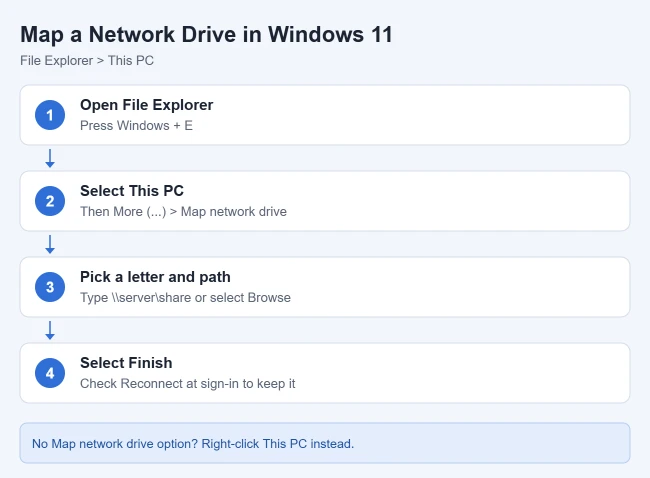
These steps follow Microsoft’s file sharing guide, which also notes that the command appears when you right-click This PC if it’s missing from the More menu.
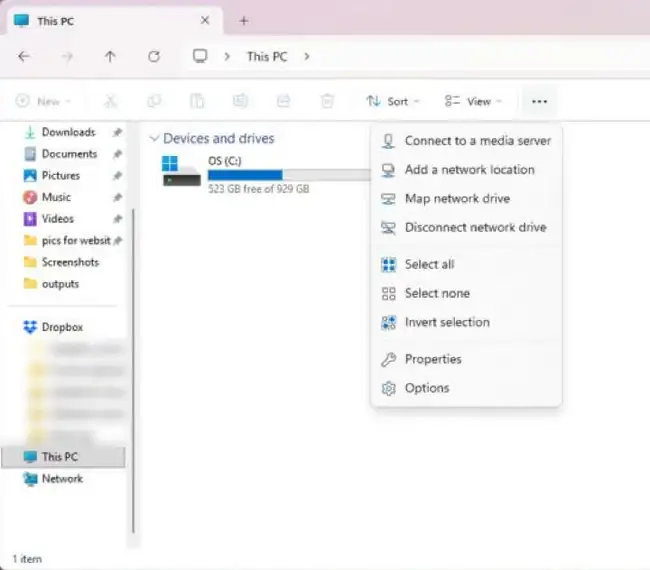
After the connection succeeds, the mapped drive should appear in This PC with the drive letter you selected. You can open it from File Explorer much like a local drive, although the files themselves remain on the network device.
What Path Should You Enter?
Windows normally maps a shared folder by using a UNC path. A typical path looks like this:
\\ComputerName\ShareNameFor example, a shared folder named Documents on a computer named Office-PC could use \\Office-PC\Documents. A network device can also sometimes be reached by IP address, such as \\192.168.1.50\Documents.
If you do not know the share name or the credentials required to access it, ask the person who manages the computer, NAS, server, or workplace network. The folder must already be shared and accessible; mapping a drive does not create the network share itself.
If you only need the shared folder occasionally, you do not have to assign it a drive letter. Open File Explorer, click the address bar, type a path such as \\ComputerName\ShareName, and press Enter.
Mapping is more useful when you visit the same share frequently or when you want it to appear consistently in This PC with a familiar drive letter.
How to Map a Network Drive with Command Prompt
Windows also includes the net use command. This can be useful for scripts or when you already know the exact share path. Open Command Prompt, then use a command like the one below. Microsoft documents every option in its net use reference.
net use Z: \\ComputerName\ShareName /persistent:yesReplace Z: with the drive letter you want and replace the example network path with your actual share. The /persistent:yes option tells Windows to remember the connection for future sign-ins.
If the share requires another account, you can use the /user: option. It is safer to let Windows prompt for the password instead of placing a password directly in a command that could be saved in command history or a script.
How to Map a Network Drive with PowerShell
PowerShell can create the same kind of mapped drive with the New-PSDrive command. Open Windows Terminal or PowerShell and run a command like this:
New-PSDrive -Name "Z" -PSProvider FileSystem -Root "\\ComputerName\ShareName" -PersistUse the drive letter without a colon for -Name. The -Persist option makes it a regular Windows mapped drive that shows up in File Explorer. Microsoft notes in its New-PSDrive reference that if you run the command inside a script, you should add -Scope Global so the drive stays after the script ends. Add -Credential (Get-Credential) if the share needs a different account.
What Does Reconnect at Sign-In Do?
Reconnect at sign-in tells Windows to remember the mapping and try to restore it when you sign in again. It does not guarantee that the remote device will always be reachable.
If the server, NAS, or other computer is turned off, asleep, disconnected, or unavailable through your current network or VPN, the mapped drive may temporarily appear disconnected. It can become available again when the network resource is reachable.
How to Use Different Network Credentials
Select Connect using different credentials in the Map Network Drive window when the network share uses a different account from your current Windows sign-in. After you click Finish, Windows can prompt you for the appropriate username and password.
If a saved password later changes, Windows may repeatedly ask for credentials or fail to reconnect. You can review saved network sign-ins through Credential Manager > Windows Credentials and update or remove an obsolete entry when appropriate.
How to Disconnect a Mapped Network Drive
- Open File Explorer.
- Select This PC.
- Right-click the mapped network drive.
- Select Disconnect.
Disconnecting the mapping removes the drive letter from your PC. It does not delete the shared folder or the files stored on the remote computer or server.
What to Do If Map Network Drive Is Missing
In current versions of Windows 11, the command may be inside the More menu rather than displayed as a separate toolbar button. Open File Explorer, select This PC, click the three-dot More button, and look for Map network drive.
You can also right-click This PC in the File Explorer navigation pane and use the Map network drive command from there.
Why Can’t Windows Connect to the Network Drive?
If the mapping fails, check these common causes before changing advanced Windows settings:
- Incorrect path: Confirm the computer or server name and the shared folder name. A mapped share normally uses a path such as
\\ComputerName\ShareName. - Remote computer is unavailable: Make sure the computer, NAS, or server hosting the folder is turned on and connected.
- Wrong credentials or permissions: The account you use must have permission to access the share.
- Different network: A home or office share normally requires a connection to the appropriate local network. Workplace resources may require a company VPN when you are away from the office.
- Name-resolution problem: If a valid computer-name path does not work, an administrator may have you test the share using the device’s IP address to help diagnose the connection.
On a home network, make sure network discovery is turned on on both PCs. If Windows asks for a password you don’t know, see how to find network credentials in Windows 11. To find a computer’s IP address for testing, see how to find your IP address on Windows 11.
If the folder opens when you type its network path directly into File Explorer but the mapped drive does not work as expected, disconnect the old mapping and create it again with the correct drive letter, reconnection setting, and credentials.
Mapped Network Drive vs. Network Location
A mapped network drive assigns a drive letter such as Z: to a network share. A network location can provide a File Explorer shortcut without giving the location a drive letter.
If an application expects a drive letter or you want the share to behave like a familiar drive in This PC, mapping the network drive is usually the better choice.
Frequently Asked Questions
Do I need administrator rights to map a network drive?
Not necessarily. The important requirement is that your account has permission to access the network share. Managed workplace computers can have additional policies set by an administrator.
Can I map more than one network drive?
Yes. You can map multiple shares as long as each mapped drive uses an available drive letter.
Why does my mapped drive show a red X?
A persistent mapping can appear disconnected when Windows signs in before the remote resource is available. Try opening the drive after the network, server, NAS, or VPN connection is ready. If it continues to fail, verify the path, permissions, and saved credentials.
Does disconnecting a mapped drive delete files?
No. Disconnecting removes the mapping from your PC but does not delete the remote shared folder or its contents.

Matthew Burleigh is the founder, head writer, and editor of Solve Your Tech, which he launched in 2012. He has written technology tutorials since 2008 and worked in IT since 2003, including small-business support, IT management, and consulting. He holds Bachelor’s and Master’s degrees in Computer Science from Arizona State University.
Matthew writes practical guides for Windows, iPhone and iPad, Microsoft Office, Outlook, Google apps, and Android. Solve Your Tech’s guides are tested on current devices or checked against official product documentation, with clear steps, sources, and update dates.
Read more about Matthew and how Solve Your Tech writes and updates its guides, or report a correction.