You click the arrow next to the clock to hide the battery icon on your Windows 11 laptop, and it isn’t in the list of icons you can switch off. That’s expected: the battery, network and volume icons belong to Quick Settings, and Microsoft’s taskbar settings don’t offer a toggle for them. The documented way to remove the battery icon is the “Remove the battery meter” Group Policy, which is available on Windows 11 Pro, Enterprise and Education.
Why the Battery Icon Has No On/Off Switch
The right end of the Windows 11 taskbar holds two different groups of icons, and they follow different rules.
- System tray icons come from apps and a few Windows tools, such as OneDrive, a VPN client, Bluetooth or the touch keyboard. You can show these, hide them, or drag them into the hidden icon menu (the “overflow area” that opens when you click the up arrow).
- Quick Settings icons are the network, volume and battery icons grouped together next to the clock. Clicking any of them opens the Quick Settings panel. Microsoft describes the battery icon as representing “the battery status on laptops and tablets.”
Microsoft’s taskbar customization page for Windows says you can’t remove Quick Settings from the taskbar, and it doesn’t describe a way to hide the network, volume or battery icon on its own. Some older tutorials tell you to turn off a “Power” switch under Taskbar corner overflow. Microsoft doesn’t list that option for Windows 11, so if you don’t see it, nothing is wrong with your PC.
Which Route Fits Your PC
| Your situation | What to do |
|---|---|
| Windows 11 Pro, Enterprise or Education, and you want the icon gone | Turn on the “Remove the battery meter” policy (next section) |
| Windows 11 Home | No Microsoft-documented way to hide it; tidy the other tray icons instead |
| A work or school PC | Ask your IT department; they may already control this policy |
| You only want less clutter | Hide app icons in the overflow menu and turn off Widgets or Task view |
| You want more battery detail, not less | Show the battery percentage instead |
To check your edition, open Settings > System > About and look at Edition under Windows specifications.
Remove the Battery Icon With Group Policy
Microsoft’s taskbar policy settings reference lists a policy called “Remove the battery meter.” When it’s enabled, the battery meter isn’t displayed in the system notification area. It’s a user-level setting (it sits under User Configuration), and the matching ADMX policy entry lists the Pro, Enterprise, Education and IoT Enterprise editions. You’ll probably need to sign in with an administrator account, because Windows asks for admin approval when you open the Local Group Policy Editor.
- Press Windows key + R to open the Run box.
- Type
gpedit.mscand press Enter. Choose Yes if User Account Control asks for permission. - In the left pane, go to User Configuration > Administrative Templates > Start Menu and Taskbar.
- In the right pane, double-click Remove the battery meter. The list is long, so click the Setting column header to sort it alphabetically if that helps.
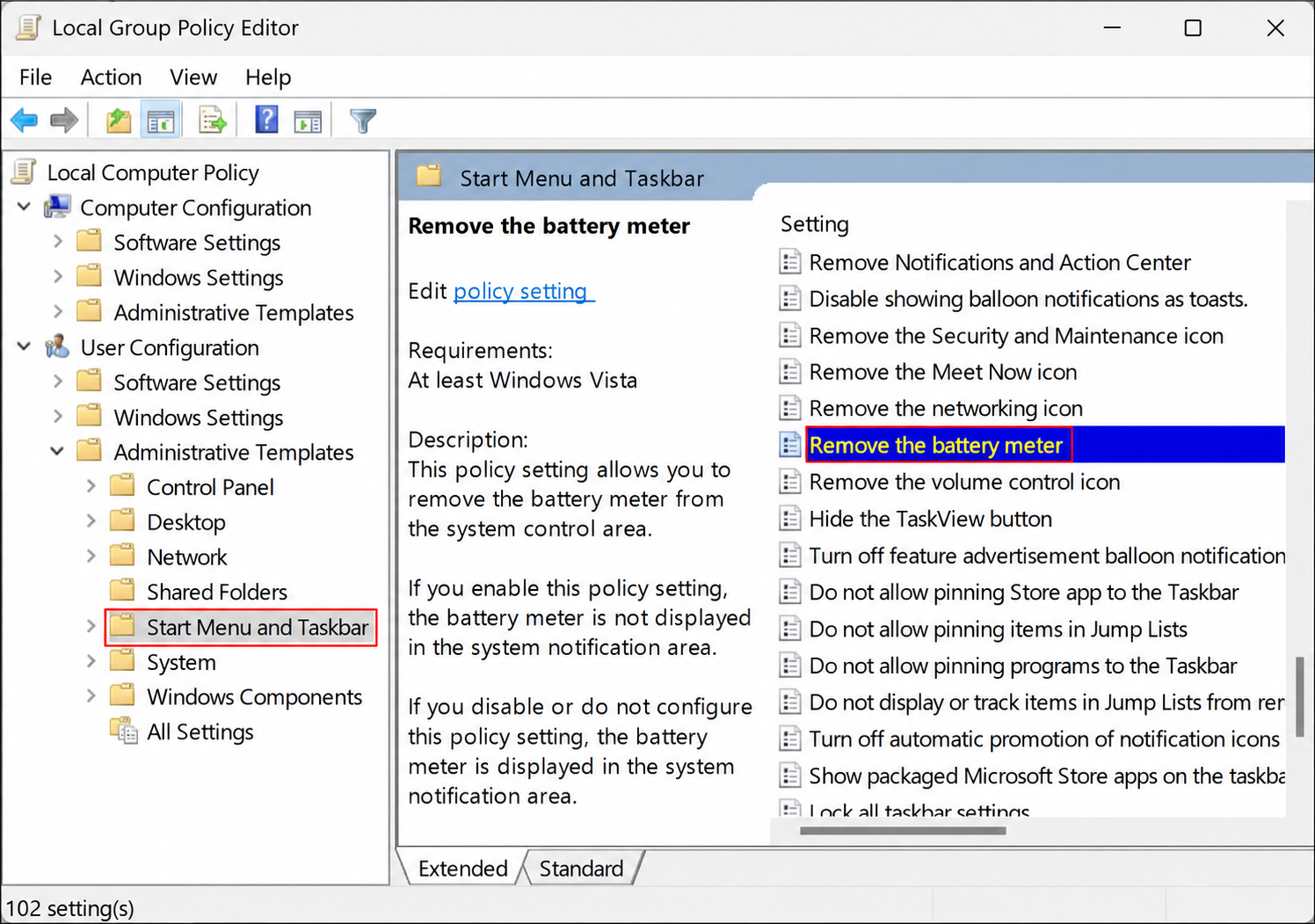
- Select Enabled, then click OK.
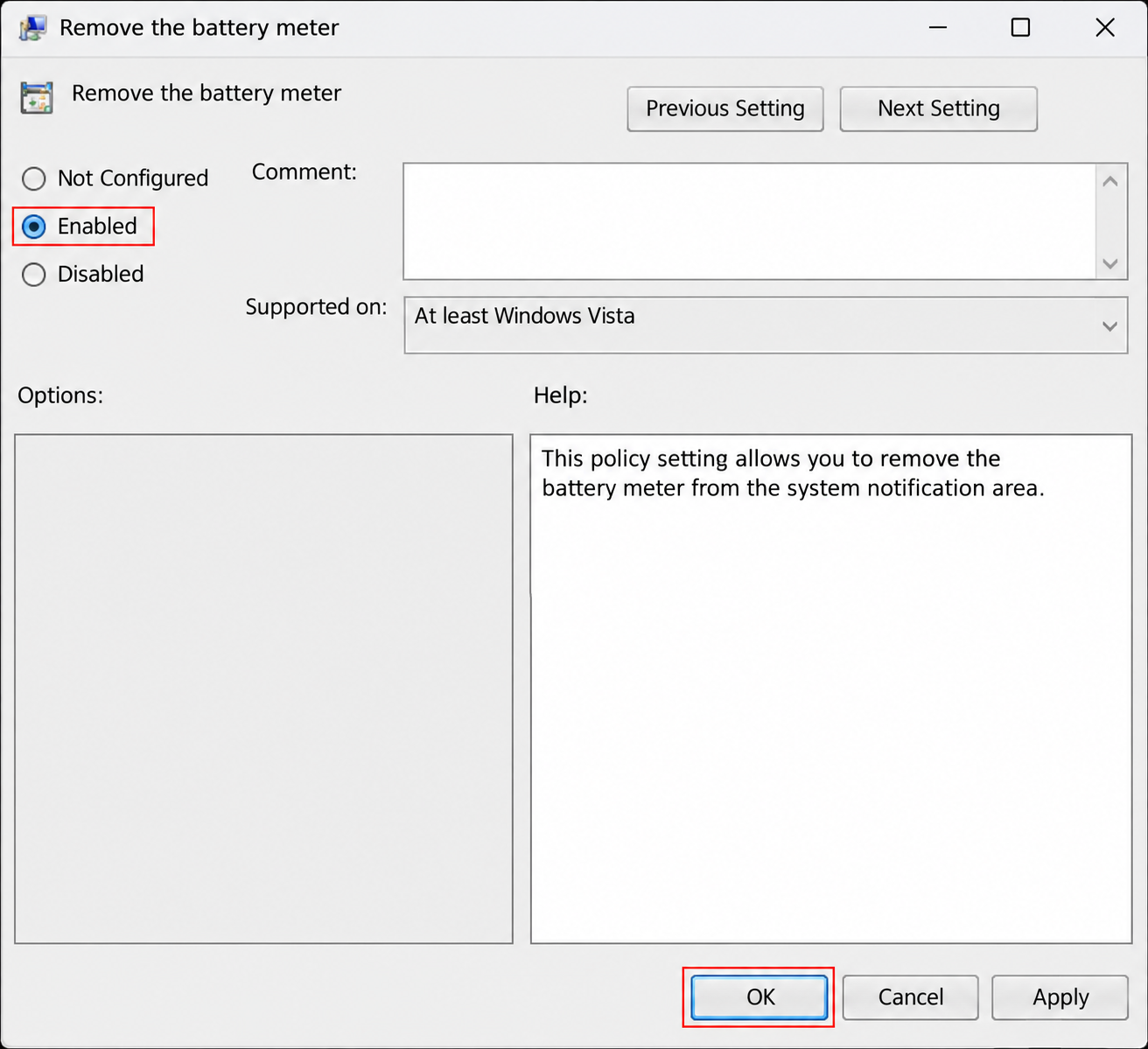
- Sign out and sign back in, or restart the PC, if the icon is still on the taskbar.
Once it takes effect, the network and volume icons stay where they were and only the battery indicator disappears. Your power mode, energy saver and charging behavior don’t change; you’ve only removed the visual gauge.
Here’s a typical case. Priya uses a Windows 11 Pro laptop docked to a monitor all day and finds the battery gauge distracting. She enables the policy, signs out, and the corner now shows Wi-Fi, volume and the clock. When she travels, she can still check the charge by opening Settings, as described below.
Bring the Battery Icon Back
- Open
gpedit.mscagain and go to User Configuration > Administrative Templates > Start Menu and Taskbar. - Double-click Remove the battery meter.
- Select Not Configured (the default) and click OK.
- Sign out and back in, or restart, if the icon doesn’t return right away.
If the battery icon vanished and you never touched Group Policy, check the same setting anyway. Someone else with admin rights, or your organization, may have turned it on. On a managed work PC the setting can be locked, and your IT team is the only one who can change it.
Avoid Removing All of Quick Settings
The same policy folder has neighbors that sound tempting: Remove the networking icon, Remove the volume control icon, Hide the notification area and Remove Quick Settings. Microsoft notes that Remove Quick Settings takes out the whole Quick Settings area and needs a restart. That also takes away the fastest way to reach Wi-Fi, Bluetooth, airplane mode and the volume slider, so it’s a poor trade if all you wanted was to lose the battery gauge.
Registry edits and third-party taskbar tools also circulate for this. Microsoft documents the Group Policy route, so stick with it; hand-edited registry keys are easy to get wrong and hard to trace later.
Hide the Icons You Can Control
If you’re on Windows 11 Home or just want a cleaner corner, the taskbar settings still let you clear out plenty.
- Right-click an empty spot on the taskbar and choose Taskbar settings. You can also go to Settings > Personalization > Taskbar.
- Under Taskbar items, turn off anything you don’t use, such as Task view or Widgets.
- Under System tray icons, turn off Pen menu, Touch keyboard or Virtual touchpad if your laptop shows them.
- Expand Other system tray icons and switch app icons off, or turn on the hidden icon menu so extra icons collect behind the up arrow.

- Back on the desktop, drag any remaining app icon from the tray onto the up arrow to move it into the overflow area.
For alignment, Start menu placement and the rest of the layout options, see these Windows 11 taskbar customization options. If notification counts on app buttons bother you too, you can turn off taskbar badges.
Why a Desktop PC Might Show a Battery Icon
Microsoft ties the battery icon to laptops and tablets, so a desktop normally doesn’t show one. If yours does, look at what’s plugged in. Some users report that a USB-connected uninterruptible power supply (UPS) is detected as a battery, which would make Windows show a charge level. Check the UPS maker’s documentation before unplugging its USB cable, because that cable is often what lets the PC shut down safely during an outage. On Pro editions, the Group Policy above hides the icon without disconnecting anything.
Check the Battery Without the Icon
Hiding the gauge doesn’t hide the information. Open Settings > System > Power & battery to see the current charge, energy saver options and battery usage by app. For a breakdown of which apps drain power, see how to view battery usage on Windows 11.
If your real complaint is that the icon is too vague, go the other way and show the battery percentage on Windows 11 so you can read the exact level at a glance.
When the Policy Doesn’t Work
- “Windows cannot find gpedit.msc”: you’re most likely on Windows 11 Home. Microsoft lists this policy only for the Pro, Enterprise and Education editions, and Home doesn’t come with the Local Group Policy Editor.
- The icon is still there: sign out completely or restart. Also confirm you edited User Configuration, not Computer Configuration, since the policy lives under the user branch.
- The setting keeps reverting: a work or school device can receive policies from its organization that override local changes.
Questions About the Windows 11 Battery Icon
Will I still get low battery warnings?
Microsoft’s description of the policy only covers removing the battery meter from the notification area; it doesn’t say anything about turning off power warnings or energy saver. Keep an eye on Settings when you’re unplugged, since you lose the at-a-glance gauge.
Does hiding the icon save battery?
Microsoft doesn’t say it does, and the policy only removes the gauge from the taskbar. If longer runtime is the goal, settings like energy saver and screen brightness matter far more; these ways to extend battery life in Windows 11 are a better place to start.
Can I rearrange the battery icon instead?
Microsoft says you can rearrange the elements inside the Quick Settings panel, but the network, volume and battery cluster on the taskbar itself stays together next to the clock.
Does this work on Windows 11 Home if I upgrade later?
It should. The policy is listed for Pro, Enterprise and Education, so once you upgrade to Pro, the Local Group Policy Editor is available and the steps above apply.
If you’d like to free up even more screen space after tidying the corner, you can also set Windows 11 to automatically hide the taskbar until you move the pointer to the bottom of the screen.

Matthew Burleigh is the founder, head writer, and editor of Solve Your Tech, which he launched in 2012. He has written technology tutorials since 2008 and worked in IT since 2003, including small-business support, IT management, and consulting. He holds Bachelor’s and Master’s degrees in Computer Science from Arizona State University.
Matthew writes practical guides for Windows, iPhone and iPad, Microsoft Office, Outlook, Google apps, and Android. Solve Your Tech’s guides are checked step by step against the device or app maker’s own documentation and tested on his own devices whenever he has the hardware or software, with clear steps, sources, and update dates.
Read more about Matthew and how Solve Your Tech writes and updates its guides, or report a correction.