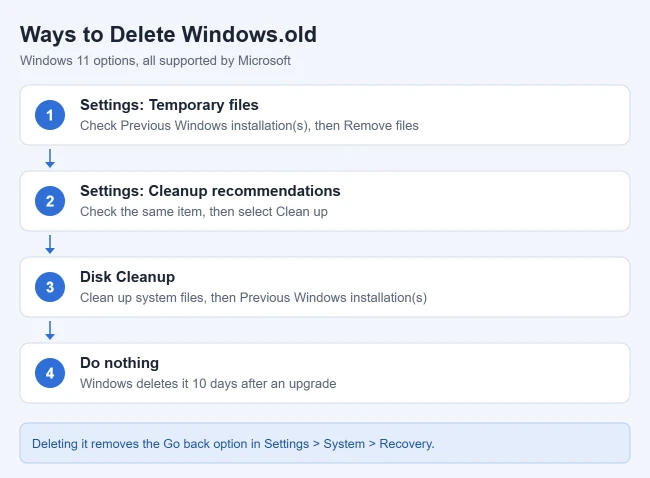
To delete the Windows.old folder in Windows 11, open Settings > System > Storage > Temporary files, check Previous Windows installation(s), and select Remove files. Deleting it frees space, but you can no longer go back to the Windows version you had before the upgrade.
These steps apply to all supported versions of Windows 11, including version 26H2, on Home and Pro. You need an administrator account. Disk Cleanup, covered below as Method 3, works the same way in Windows 10.
What Windows.old Is
When you upgrade to Windows 11, or install a major update that reinstalls Windows, Windows moves the old installation into a folder called C:\Windows.old. It holds the previous system files, programs and user profiles. That copy is what makes the Go back button in Settings > System > Recovery work.
Microsoft says the previous version is deleted automatically 10 days after you upgrade. Until then, the folder can take up a lot of room, often 10 to 30 GB. If you did a clean install from a USB drive, there’s usually no Windows.old folder at all.
Before You Delete It
- Make sure you’re staying on this version. Deleting the previous version can’t be undone. If anything about the upgrade bothers you, such as a missing driver or an app that won’t run, decide first whether you want to roll back the update instead.
- Rescue any files. Open File Explorer, go to
C:\Windows.old\Users\, open the folder with your user name, and copy anything that didn’t carry over, such as files in Documents, Desktop or Downloads. - Consider waiting. If you don’t need the space right away, Windows removes the folder on its own after 10 days. Leave the folder alone in the meantime. Answers on Microsoft’s Q&A forum point out that moving or partly deleting files inside it can stop the automatic cleanup.
Which Method Should You Use?
| Method | Best for | Where |
|---|---|---|
| Temporary files | Most people | Settings > System > Storage |
| Cleanup recommendations | A quick one-click cleanup | Settings > System > Storage |
| Disk Cleanup | When Settings doesn’t list the item | cleanmgr |
| Command line | A leftover folder the other tools miss | Terminal (Admin) |
All three Settings and Disk Cleanup methods do the same job. Try the next one only if the first doesn’t show the item.
Method 1: Delete Windows.old in Temporary Files
- Press Windows key + I to open Settings.
- Select System, then Storage. A chart of what’s using space on your C: drive appears.
- Select Temporary files and wait for Windows to finish scanning.
- Check Previous Windows installation(s). On some PCs it’s labeled Previous version of Windows. Uncheck anything you want to keep, like Downloads or Recycle Bin. The Remove files button shows the total space you’ll free.
- Select Remove files, then Continue. After a few minutes, the item disappears from the list and the C: drive shows more free space.
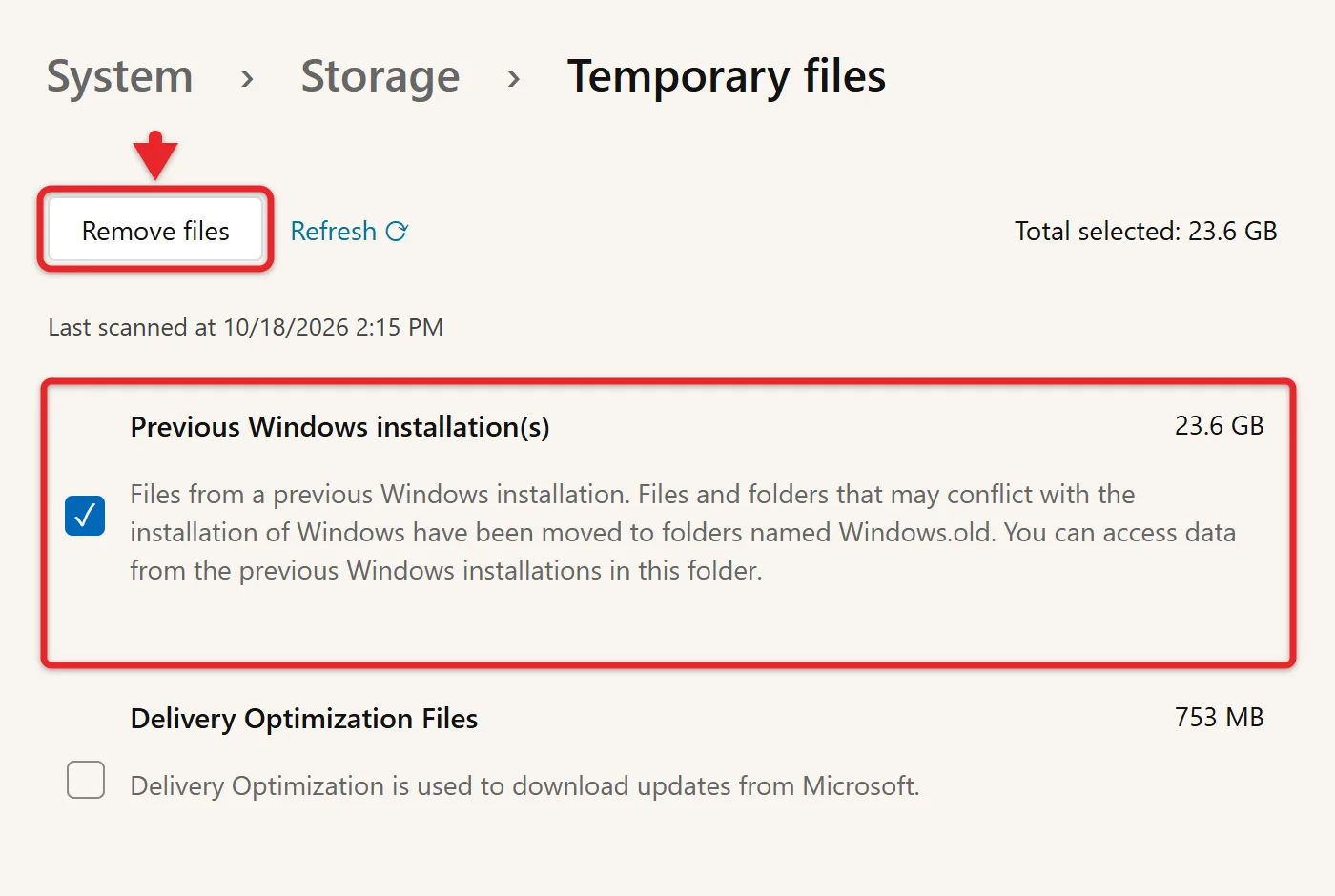
These are the steps in Microsoft’s Delete your previous version of Windows guide.
Method 2: Use Cleanup Recommendations
- Go to Settings > System > Storage > Cleanup recommendations.
- Under Temporary files, check Previous Windows installation(s).
- Select the Clean up button, which shows the file size. Windows removes the previous installation and the button disappears.
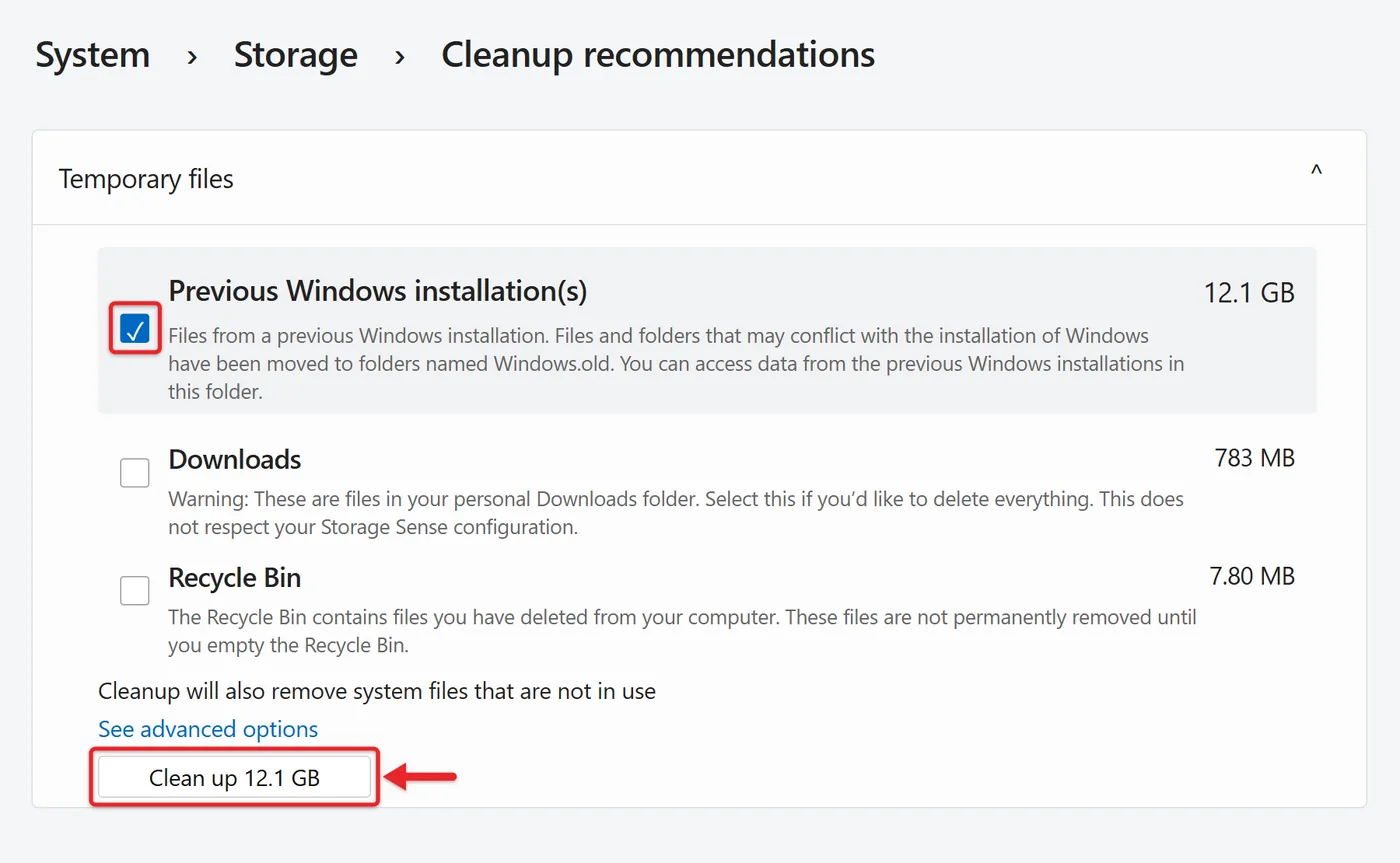
Microsoft calls this the easiest method in KB5012334. The list only shows items Windows considers safe to remove, so Windows.old won’t appear here if it’s already gone.
Method 3: Use Disk Cleanup
- Press Windows key + R, type
cleanmgr, and press Enter. You can also search the Start menu for Disk Cleanup. - Choose the C: drive and select OK.
- Select Clean up system files. If Windows asks for permission, select Yes. Choose C: again if asked. This second scan takes longer than the first.
- Check Previous Windows installation(s). While you’re here, Windows Update Cleanup is also safe to check and can free more space.
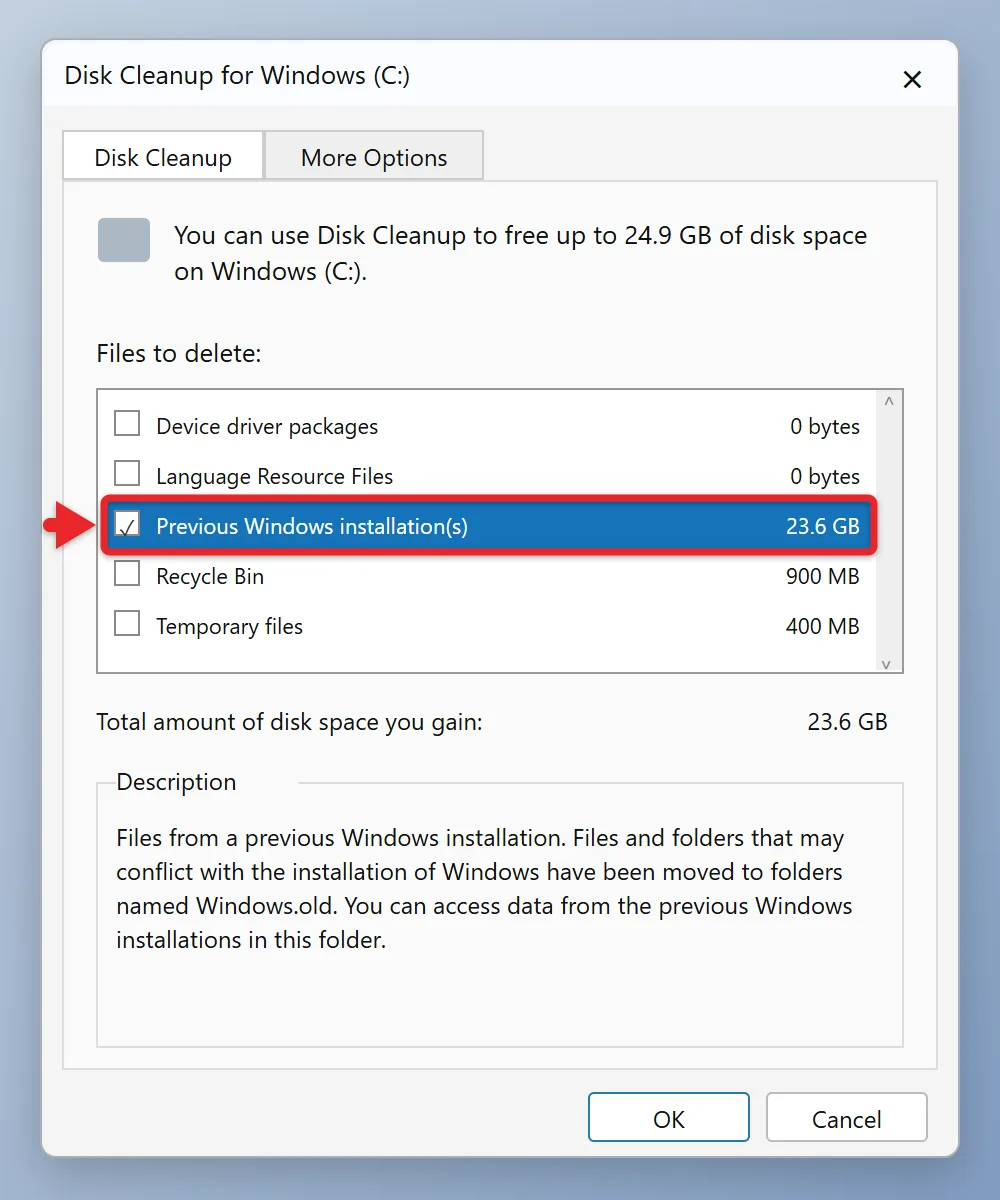
- Select OK, then Delete Files. Disk Cleanup removes the folder’s contents. Large folders can take 10 minutes or more.
How to Confirm It Worked
- Open File Explorer, select This PC, and open C:. Windows.old should be gone.
- Check Settings > System > Storage. Free space on C: should have gone up by about the size the cleanup showed.
- In Settings > System > Recovery, the Go back option is no longer available.
If Windows.old Won’t Go Away
File Explorer says you need permission
Windows.old contains protected system files owned by Windows, so dragging it to the Recycle Bin usually fails with an access message. Use one of the methods above instead of changing the folder’s permissions by hand.
The option isn’t listed in Settings
Windows may have already removed it after 10 days, or there was never a previous installation to keep. If you can still see a Windows.old folder on C:, run Disk Cleanup with Clean up system files, which can list items that Settings doesn’t.
An empty or partly deleted folder is left behind
Restart the PC after the cleanup, then check C: again. If the folder is empty, you can delete it in File Explorer like any other folder.
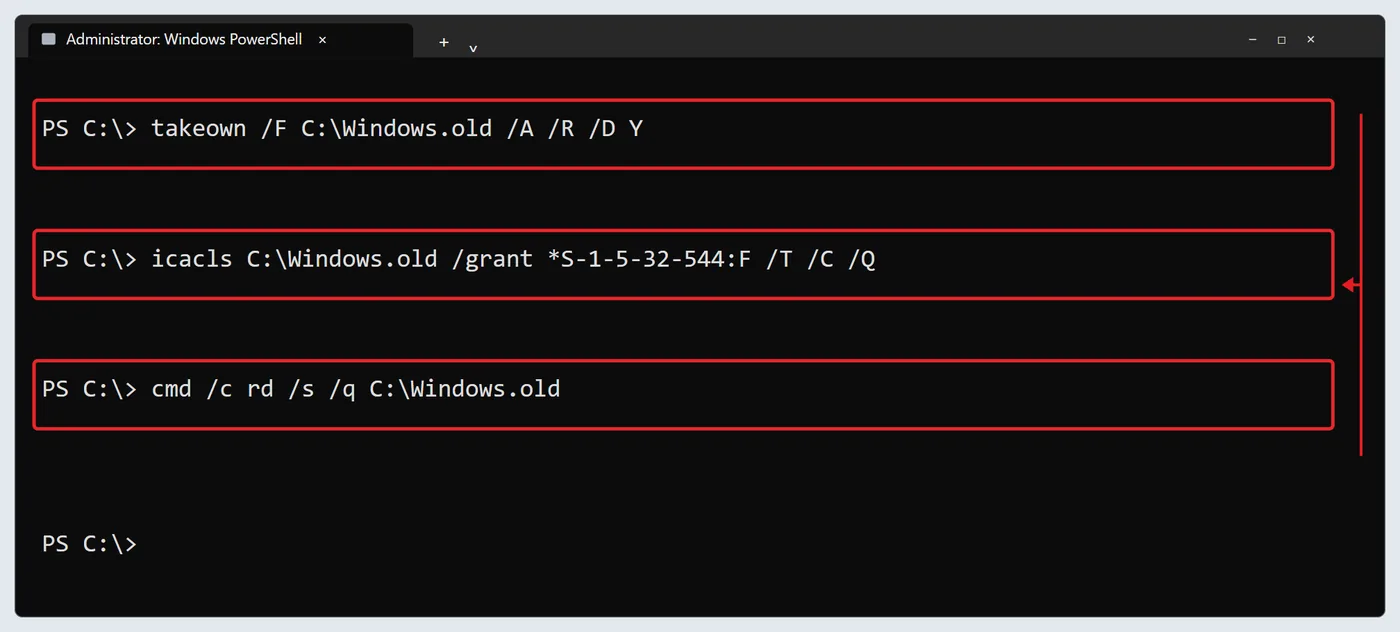
If a leftover folder still won’t delete and you’ve already copied out your files, you can remove it from the command line. This is permanent, so double-check that each command says C:\Windows.old before you press Enter:
- Right-click Start and select Terminal (Admin). Select Yes at the prompt.
- Run
takeown /F C:\Windows.old /A /R /D Yto give the Administrators group ownership. Microsoft’s takeown documentation explains each switch. - Run
icacls C:\Windows.old /grant *S-1-5-32-544:F /T /C /Qto give administrators full control. - Run
cmd /c rd /s /q C:\Windows.oldto delete the folder.
Free space didn’t go up
Restart the PC, empty the Recycle Bin, then check Settings > System > Storage again. If something else is filling the drive, check what’s taking up space on your PC. If the drive is too small for your files, extending the C drive is another option.
Frequently Asked Questions
Is it safe to delete Windows.old?
Yes, once you’re happy with the new version and have copied any files you need from it. Windows only uses it to go back to the previous version. Your current apps and files aren’t affected.
How much space does it free?
It depends on how much was on the old installation. Expect roughly 10 to 30 GB, and sometimes more if old user files were left inside it.
Can I still go back after deleting it?
No. The Go back option needs Windows.old. After it’s deleted, returning to the older version means a clean install of that version, which erases the drive.
Why did Windows.old come back?
A new version upgrade or an in-place reinstall can create a fresh Windows.old. Remove it the same way once you’re happy with the update.
What else can I clean up at the same time?
Temporary files lists other safe cleanups too. Two related cleanups are deleting temp files in Windows 11 and deleting junk files in Windows 11.

Matthew Burleigh is the founder, head writer, and editor of Solve Your Tech, which he launched in 2012. He has written technology tutorials since 2008 and worked in IT since 2003, including small-business support, IT management, and consulting. He holds Bachelor’s and Master’s degrees in Computer Science from Arizona State University.
Matthew writes practical guides for Windows, iPhone and iPad, Microsoft Office, Outlook, Google apps, and Android. Solve Your Tech’s guides are checked step by step against the device or app maker’s own documentation and tested on his own devices whenever he has the hardware or software, with clear steps, sources, and update dates.
Read more about Matthew and how Solve Your Tech writes and updates its guides, or report a correction.