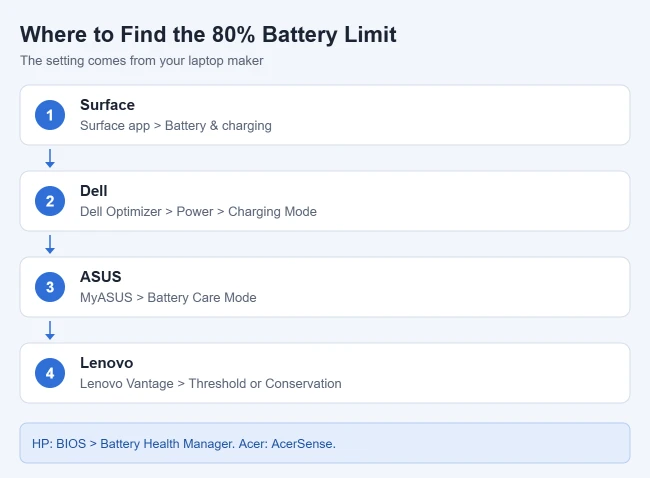
Windows 11 doesn’t have its own setting to stop charging at 80%. The option comes from your laptop maker, usually in its app (such as the Surface app, Dell Optimizer, MyASUS, or Lenovo Vantage) or in the BIOS. Find your brand below. If you don’t see an 80% option for your model, your laptop may not support a charge limit.
Battery Saver (called Energy saver on newer versions of Windows 11) isn’t a charge limit. It reduces power use while you’re on battery, but it doesn’t stop a plugged-in laptop from charging to 100%. For other power options, see how to change advanced power settings in Windows 11.
If you want to reduce energy use as the battery runs down, change when Battery saver or Energy saver turns on. That remaining-charge trigger is separate from the manufacturer’s charging cap.
Check Whether a Limit Is Already On
- Open Settings > System > Power & battery.
- Look under the battery percentage. If your laptop maker has turned on smart charging, you’ll see Smart charging is on, and the battery icon on the taskbar may show a small heart.
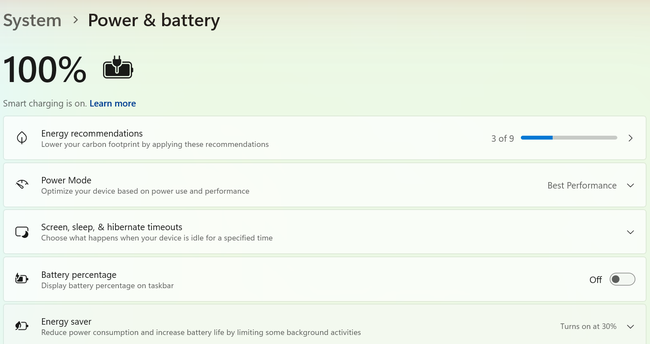
Windows only reports this setting. Microsoft’s Smart charging in Windows page confirms that each device maker sets it up differently, so you change it in the maker’s app or firmware, as shown below.
Microsoft Surface
- Open the Surface app from Start.
- Select Battery & charging.
- Under charging mode, choose Limit to 80%. Choose Adaptive to let smart charging decide, or Charge to 100% before a trip.
Not every Surface model has these options. See Microsoft’s Surface smart charging guide.
Dell (Dell Optimizer)
- Open Dell Optimizer.
- Go to Power, then Charging Mode, and select Custom.
- Set the start charging slider (for example, 75) and the stop charging slider to 80.
Your BIOS sets a minimum gap between the two values. Older Dell laptops use Dell Power Manager with a similar Custom setting. Steps are from Dell’s Optimizer user guide.
ASUS (MyASUS)
- Open MyASUS and go to Device Settings.
- Find Battery Care Mode (Battery Health Charging).
- Choose Balanced Mode, which stops charging above 80% and resumes below 78%.
Maximum Lifespan Mode stops at 60% for laptops that stay plugged in, and Full Capacity Mode charges to 100%. See ASUS’s Battery Health Charging guide.
HP
Most HP business laptops put the limit in the BIOS, under HP Battery Health Manager.
- Save your work and restart the laptop.
- Press F10 repeatedly as it starts to open BIOS setup.
- Open the power or advanced settings and find Battery Health Manager.
- Choose Maximize Battery Health, which caps the battery at 80% of its design capacity.
- Save the change and exit. The laptop restarts.
HP also offers an HP Intelligent Charging mode that lets the battery drop to 80% after it has been kept full for several days. See HP’s Battery Health Manager page. Consumer HP laptops vary, and some list an Adaptive Battery Optimizer option in the BIOS instead.
Lenovo (Lenovo Vantage)
- Open Lenovo Vantage from Start.
- Go to the device’s power or battery settings.
- On many ThinkPad models, turn on Battery Charge Threshold and set the start and stop values, such as 75 and 80.
- On many IdeaPad, Yoga, and Legion models, turn on Conservation Mode instead. It holds the battery at a lower level that Lenovo sets for each model.
Lenovo shows the threshold setting in its Vantage Battery Charge Threshold video.
If Conservation Mode is missing
Lenovo says the option can disappear when a power driver is missing. Not every model supports it, so check your manual first.
- Right-click Start and open Device Manager.
- Expand System devices and look for Lenovo ACPI-Compliant Virtual Power Controller.
- If it isn’t there, open Settings > Windows Update > Advanced options > Optional updates, expand Driver updates, and install the Lenovo item.
- Restart and check Lenovo Vantage again.
These steps follow Lenovo’s Conservation mode support article.
Acer
Acer says most of its laptops come with preinstalled software that can cap the battery at 80%. On current models, open AcerSense (or press the AcerSense key if your keyboard has one) and turn on the battery charge limit or optimized charging option. Older models have the same switch in Acer Care Center. See Acer’s battery charge limit article for your model.
Other Brands
MSI, Samsung, Razer, and other makers offer similar features in their own apps, often called battery care, battery protection, or charge limit. Search your model’s support page for “charge limit” or “battery care.”
Frequently Asked Questions
Is limiting the charge to 80% worth it?
It helps most when your laptop stays plugged in for long periods, because keeping a lithium-ion battery at 100% for days speeds up wear. If you often need all-day battery life, switch to a full-charge mode before you leave. For more ways to make a charge last, see how to extend battery life in Windows 11.
Why does my laptop stop charging at 80% when I didn’t set it?
Smart charging or a battery-care mode is on. Check the Power & battery page and your maker’s app to confirm and change it. To watch the charge level as you test, show the battery percentage on the taskbar.
How do I turn off the 80% limit so my laptop charges to 100%?
Go back to the same app or BIOS setting you used to turn it on and pick the full-charge option. That’s Charge to 100% in the Surface app, Standard in Dell Optimizer, Full Capacity Mode in MyASUS, or turning off the threshold or Conservation Mode in Lenovo Vantage. On HP BIOS settings, switch Battery Health Manager away from Maximize Battery Health.

Matthew Burleigh has been writing tech tutorials since 2008. His writing has appeared on dozens of different websites and been read hundreds of millions of times.
After receiving his Bachelor’s and Master’s degrees in Computer Science he spent several years working in IT management for small businesses. However, he now works full time writing content online and creating websites.
His main writing topics include iPhones, Microsoft Office, Google Apps, Android, and Photoshop, but he has also written about many other tech topics as well.