To install Active Directory Users and Computers (ADUC) on Windows 11, open Settings > System > Optional features, select View features, search for Active Directory, and add RSAT: Active Directory Domain Services and Lightweight Directory Services Tools. When it finishes, press Windows + R, type dsa.msc, and press Enter to open ADUC.
This covers Windows 11 Pro and Enterprise on standard (x64) PCs and on new Arm PCs that shipped with Windows 11, version 26H1. Arm PCs running versions 24H2 or 25H2 use the Windows Features dialog instead, and Windows 11 Home can’t install ADUC at all.
What ADUC Is and What You Need
ADUC is the console administrators use to manage user accounts, computers, groups, and organizational units (OUs, the folders that organize objects) in an Active Directory domain. It’s part of RSAT, short for Remote Server Administration Tools, which Windows 11 includes as optional features. There’s no separate download. To add DNS, DHCP, Group Policy, or other server tools too, you can install RSAT tools on Windows 11.
Installing ADUC adds management tools only. It doesn’t create a domain, join your PC to one, or give your account any rights in it.
Microsoft’s RSAT prerequisites list:
- Windows 11 Pro or Enterprise. Check yours in Settings > System > About under Windows specifications. Home isn’t supported.
- Administrator rights on the PC to add the feature.
- Network access and permissions for the servers you’ll manage. In practice that means the office network or a VPN, and a domain account your IT team has given rights to.
The installer also downloads from Windows Update, so the PC needs internet access, or on a managed work PC, an update setup that allows optional features (see troubleshooting).
The single RSAT item installs ADUC along with related Active Directory tools: Active Directory Administrative Center, Active Directory Domains and Trusts, Active Directory Sites and Services, ADSI Edit, and the Active Directory module for Windows PowerShell.
How to Install ADUC in Settings
Use this method on x64 PCs and on Arm PCs running Windows 11, version 26H1.
- Press Windows + I to open Settings.
- Select System, then Optional features. On older versions of Windows 11, it’s under Apps > Optional features.
- Scroll the list of installed features. If RSAT: Active Directory Domain Services and Lightweight Directory Services Tools is already there, ADUC is installed; skip to opening it.
- Next to Add an optional feature, select View features. A search window opens. Select Yes if Windows asks for administrator permission.
- Type Active Directory in the search box.
- Check RSAT: Active Directory Domain Services and Lightweight Directory Services Tools, then select Next.
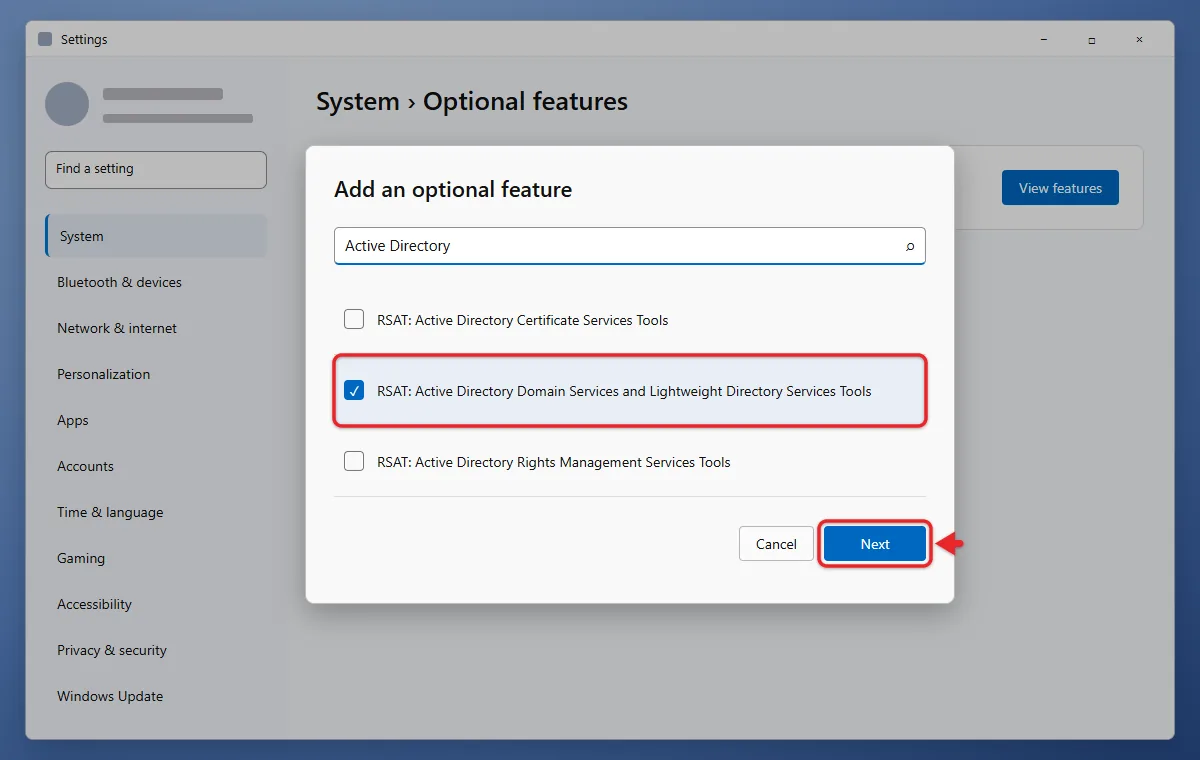
- Select Add (some builds label it Install). The Optional features page shows the download progress, which can take several minutes, and then shows the tool as added.
- Restart the PC if Windows asks you to. Save your work first.
Microsoft’s RSAT support article confirms these tools are optional features on Windows 11 and can’t be installed on Home editions.
Hyper-V is another Windows feature that Home editions lack, and you can turn off Hyper-V in Windows 11 on Pro and higher.
Arm-Based PCs Running Windows 11 24H2 or 25H2
On Arm PCs, such as Copilot+ PCs with Snapdragon processors, Microsoft added five RSAT tools, including the Active Directory tools, starting with the February 2026 non-security preview update for versions 24H2 and 25H2. On these versions they’re Windows features rather than optional features, so they don’t appear in the Settings search above. To check your version and processor type, open Settings > System > About. The steps to tell whether your Windows 11 PC is x64 or ARM-based explain how to read that screen.
- Open Settings > Windows Update and select Check for updates. Install everything offered so the PC has the February 2026 update or a later one, and restart if asked.
- Press Windows + R, type
optionalfeatures.exe, and press Enter. The Windows Features dialog opens. (You can also go to Control Panel > Programs > Turn Windows features on or off.) - Check RSAT: Active Directory Domain Services and Lightweight Directory Services Tools.
- Select OK. Windows applies the change and shows a message when it’s done. Restart if prompted.
To do the same from Terminal (Admin), Microsoft’s announcement gives this command: Enable-WindowsOptionalFeature -Online -FeatureName ActiveDirectory-DS-LDS-Tools -All. See Microsoft’s Arm RSAT announcement for the version details.
If your Arm PC runs a different version and you can’t find the tool in one place, check the other: Settings > Optional features first, then the Windows Features dialog.
How to Install ADUC With PowerShell
PowerShell is faster if you set up admin workstations often or want to script the install. This uses the same optional feature as the Settings method, so it applies to x64 PCs and Arm PCs on 26H1.
- Right-click Start and select Terminal (Admin). Select Yes in the User Account Control prompt.
- Check whether the tool is installed:
Get-WindowsCapability -Online -Name Rsat.ActiveDirectory*. The State line reads NotPresent if it isn’t installed. - Install it:
Add-WindowsCapability -Online -Name Rsat.ActiveDirectory.DS-LDS.Tools~~~~0.0.1.0. The four tildes are part of the name, so copy the command exactly. - Wait for the progress bar to finish. The output ends with RestartNeeded; if it says True, restart the PC.
- Run the command from step 2 again. State : Installed confirms success.
The Get-WindowsCapability command only reads the status; it doesn’t install anything. If you prefer Command Prompt, open it as an administrator and run the DISM equivalent: DISM /Online /Add-Capability /CapabilityName:Rsat.ActiveDirectory.DS-LDS.Tools~~~~0.0.1.0.
How to Open Active Directory Users and Computers
- Press Windows + R, type
dsa.msc, and press Enter. - Or search Start for Active Directory Users and Computers.
- Or open Windows Tools and select Active Directory Users and Computers.
When it opens, the left pane shows your domain with containers such as Users and Computers and your organization’s OUs. Two settings help most new users:
- View > Advanced Features shows hidden system containers and adds the Attribute Editor tab to an object’s Properties window.
- If you sign in to Windows with a standard account but have a separate admin account for the domain, open ADUC with that account from a normal Command Prompt:
runas /netonly /user:YOURDOMAIN\adminname "mmc dsa.msc". The /netonly switch uses those credentials only when ADUC talks to the domain.
Opening the console is separate from having permission to manage a domain. Microsoft’s ADUC account-management guide assumes a domain-joined computer and an account with the appropriate domain permissions. Local administrator rights alone don’t grant those. Usually the PC is joined to the domain first. If you don’t know your domain’s exact name, you can find the domain name in Windows 11.
Troubleshooting
RSAT isn’t in the list
- Windows 11 Home: the RSAT items don’t appear. Upgrade to Pro, or use a Pro or Enterprise PC for administration.
- Arm PC on 24H2 or 25H2: use the Windows Features method above.
- Wrong list: the search box at the top of Optional features searches what’s already installed. Select View features to search what you can add.
The install fails, stays at 0%, or shows 0x800f0954
Work PCs often get updates from the organization’s own update server (WSUS) instead of Windows Update. If that server doesn’t offer optional features, the download stalls or fails with error 0x800f0954. The usual fix is the Group Policy setting Specify settings for optional component installation and component repair, under Computer Configuration > Administrative Templates > System, which lets the PC download optional features from Windows Update; Microsoft explains it in its Features on Demand guidance. On a managed PC, give the error code to IT rather than changing policies yourself.
Without internet access, IT can install from the Languages and Optional Features ISO that matches the PC’s exact Windows build, by adding -Source and -LimitAccess to the Add-WindowsCapability command.
Access denied (0x80070005)
The window isn’t running as administrator, or your account is a standard user. Reopen Terminal with Terminal (Admin), or ask someone with an administrator account to install it.
ADUC is installed but you can’t find it
Restart the PC, then run dsa.msc. If that fails, run the Get-WindowsCapability check above to confirm State : Installed.
ADUC opens but can’t reach the domain
Messages such as “The specified domain either does not exist or could not be contacted” mean the PC can’t find a domain controller. Check that you’re on the office network or VPN and that the PC uses the organization’s DNS servers, not a public one. Then right-click Active Directory Users and Computers at the top of the left pane and select Change Domain to enter the domain name. If it still fails, ask IT to confirm your account’s permissions.
How to Uninstall ADUC
- Open Settings > System > Optional features.
- Find RSAT: Active Directory Domain Services and Lightweight Directory Services Tools in the installed list, expand it, and select Remove.
In PowerShell, run Remove-WindowsCapability -Online -Name Rsat.ActiveDirectory.DS-LDS.Tools~~~~0.0.1.0. On an Arm PC running 24H2 or 25H2, clear the check box in Windows Features instead and select OK.
Frequently Asked Questions
Can I install ADUC on Windows 11 Home?
No. Microsoft supports RSAT only on Pro and Enterprise editions, and Home can’t join a domain either. Upgrade to Pro, or manage the domain from a different PC.
Is there a separate ADUC download for Windows 11?
No. The standalone RSAT installers were for Windows 10 versions before 1809. On Windows 11, ADUC comes from Optional features (or Windows Features on some Arm PCs).
Does my PC need to be joined to the domain?
ADUC installs on any Pro or Enterprise PC, but it’s only useful when it can reach a domain controller with an account that has rights. Most admins use a domain-joined PC; the runas /netonly method can work from a PC that isn’t joined, as long as it can reach the domain’s DNS.
What’s the difference between ADUC and Active Directory Administrative Center?
Both manage the same users, groups, and computers, and both install with the same RSAT item. Active Directory Administrative Center is the newer console with a different layout, a built-in PowerShell history viewer, and access to features such as the Active Directory Recycle Bin. ADUC is the classic console most guides and IT teams still refer to.
Does installing ADUC give me administrator rights in the domain?
No. What you can change depends on the permissions your domain account has. Domain administrators can delegate specific tasks, such as password resets, to other accounts.

Matthew Burleigh is the founder, head writer, and editor of Solve Your Tech, which he launched in 2012. He has written technology tutorials since 2008 and worked in IT since 2003, including small-business support, IT management, and consulting. He holds Bachelor’s and Master’s degrees in Computer Science from Arizona State University.
Matthew writes practical guides for Windows, iPhone and iPad, Microsoft Office, Outlook, Google apps, and Android. Solve Your Tech’s guides are checked step by step against the device or app maker’s own documentation and tested on his own devices whenever he has the hardware or software, with clear steps, sources, and update dates.
Read more about Matthew and how Solve Your Tech writes and updates its guides, or report a correction.