To check whether your computer is 32-bit or 64-bit in Windows 11, open Settings > System > About and read the System type line. On Windows 11 the operating system part always says 64-bit, because Microsoft says Windows 11 doesn’t have a 32-bit version. The more useful half of the line is the processor type, x64-based or ARM-based, since that decides which app and driver downloads fit your PC.
This guide follows Microsoft’s 32-bit and 64-bit Windows FAQ and its developer documentation on running 32-bit applications and emulation on Arm. It applies to Windows 11 Home and Pro. You don’t need an administrator account for any of the checks, and none of them changes a setting, so there is nothing to undo afterward.
Check System Type in Settings
This is the official route, and it is the quickest for most people.
- Press Windows key + I to open Settings, or select Start > Settings.
- Select System in the left column. If the column is hidden because the window is narrow, widen the window or select the menu button at the top left.
- Scroll to the bottom of the list on the right and select About.
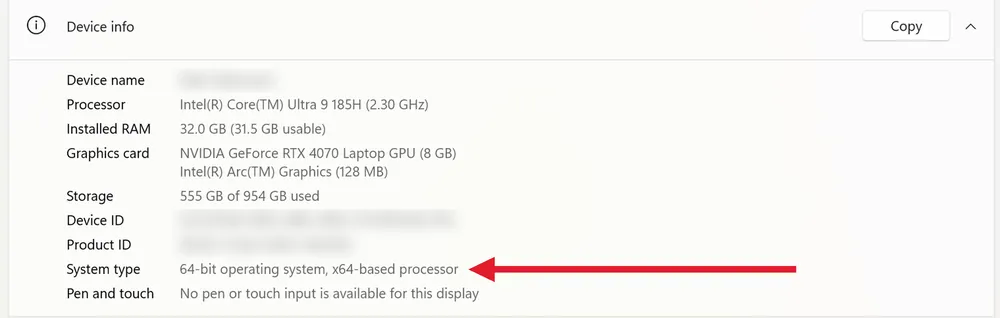
- Find System type near the top of the page. Current builds list it under Device info; Microsoft’s FAQ calls the section Device specifications.
The line reads something like 64-bit operating system, x64-based processor. The first part is the operating system type and the second is the processor type.
Shortcut: Microsoft’s keyboard shortcut list says Windows key + Pause opens Settings straight to the System > About page. Many laptop keyboards have no Pause key, so use the steps above if nothing happens. You can also press Windows key + X to open the Quick Link menu (the same menu you get by right-clicking Start) and choose System if your menu lists it.

Example: What a 64-Bit Laptop Shows
On an Alienware m16 R2 running Windows 11 Home 25H2, Settings > System > About listed System type as 64-bit operating system, x64-based processor. The same Device specifications box showed an Intel Core Ultra 9 185H processor and 32.0 GB of installed RAM (31.5 GB usable).
The first half of that line is the version of Windows that’s installed, and the second half is what the processor supports. Windows 11 is only sold as a 64-bit operating system, so any Windows 11 PC should show 64-bit operating system here; a 32-bit result means you are looking at Windows 10 or older.
What the System Type Line Means
The two halves of the line answer two different questions.
- 64-bit operating system: the version of Windows that is installed. Windows 11 is 64-bit only, so this half never changes.
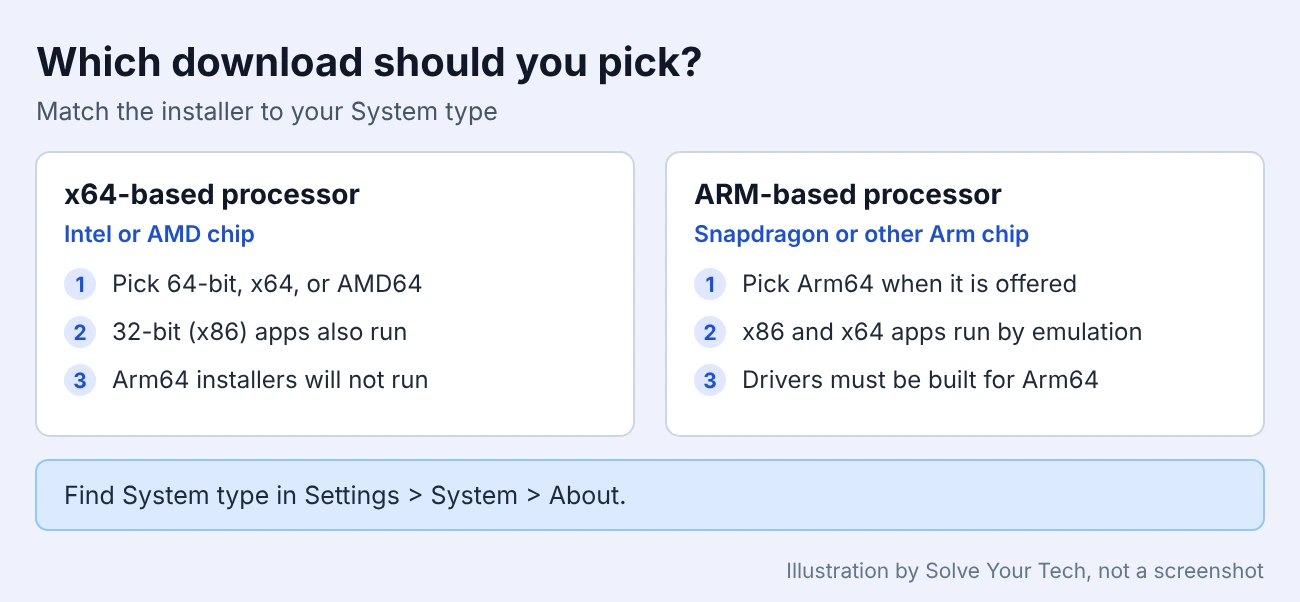
- x64-based processor: an Intel or AMD chip. Most Windows apps are made for this type. Download pages may label the matching installer 64-bit, x64, or AMD64; all three names mean the same thing, even on an Intel PC.
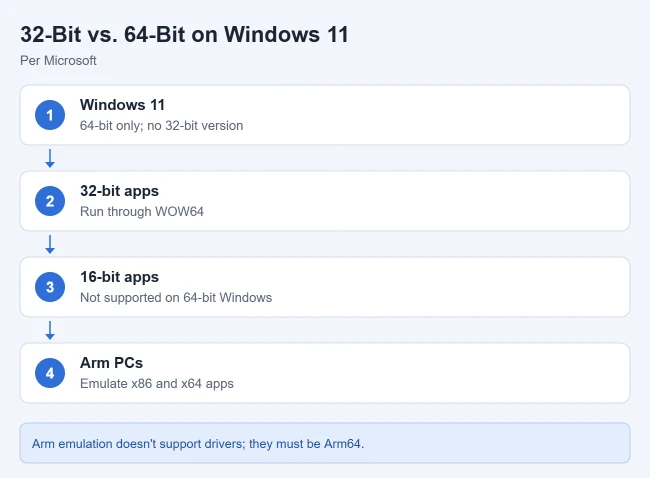
- ARM-based processor: a Snapdragon or other Arm chip. Windows 11 on Arm can emulate both x86 and x64 apps, so most regular Windows apps still run. When an Arm64 version of an app is offered, pick it for native performance.
Two more labels are worth knowing. x86 is the usual name for 32-bit Intel and AMD software. Emulation means Windows translates an app built for one processor type so it can run on another; it is built into Windows on Arm and needs no extra components.
Check 32-Bit or 64-Bit Windows 10
In Windows 10, open Start > Settings > System > About. Under Device specifications, read System type. Distinguish the installed operating system from the processor: a 32-bit operating system can run on an x64-capable processor, and you need the operating-system value when selecting a compatible driver. Unlike Windows 11, Windows 10 exists in both 32-bit and 64-bit editions. Microsoft’s 32-bit and 64-bit FAQ documents this check.
Legacy Windows 7 System-Type Check
On Windows 7, open Start, right-click Computer, select Properties, and read System type. Windows 7 no longer gets security updates.
If the PC still runs Windows 7, plan your move from Windows 7 to Windows 11 before you buy a license.
Check With System Information
System Information is a built-in report of your hardware and software. It is handy when you already have it open to look up other details.
- Press Windows key + R to open the Run box.
- Type
msinfo32and press Enter. This method is one of several listed among the system configuration tools in Windows. - Stay on System Summary, which opens first, and find System Type in the right pane.
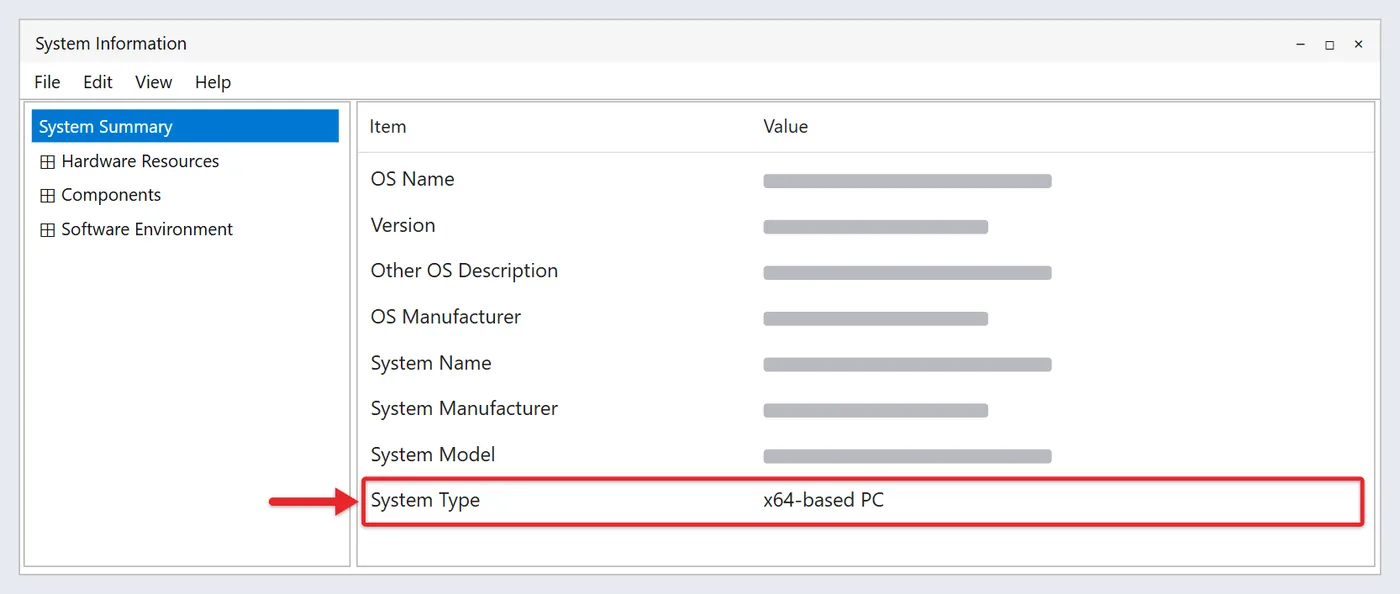
A 64-bit version shows x64-based PC and a 32-bit version shows x86-based PC. An Arm computer should show an ARM-based value instead. The rest of the fields on this screen are explained in checking system configuration in Windows 11.
Check With a Command
Two commands give the same answer without opening Settings. Neither needs to be run as administrator.
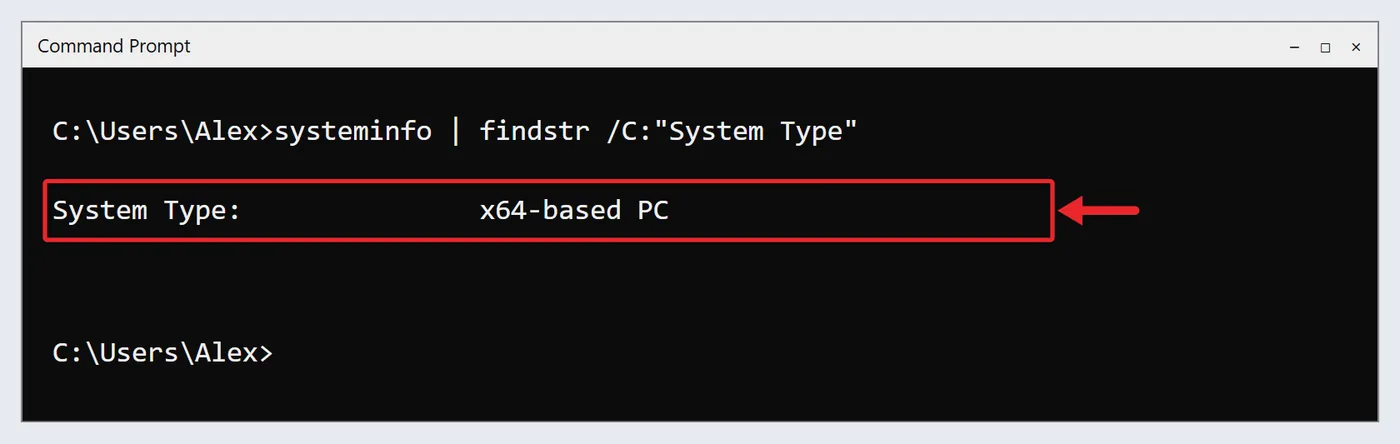
- systeminfo: open Terminal or Command Prompt and run
systeminfo. The systeminfo command shows detailed configuration information, including hardware properties. Look for the System Type line, or runsysteminfo | findstr /C:"System Type"to show only that line. The command can take a few seconds to finish.
- Processor variable: open Command Prompt and run
echo %PROCESSOR_ARCHITECTURE%. Microsoft’s WOW64 documentation lists the values: AMD64 for a 64-bit Intel or AMD process and ARM64 for an Arm one. A 32-bit program reports x86 even on a 64-bit PC, so use the standard Command Prompt. If the command just prints its own text back, you are in PowerShell, which reads variables differently; typecmd, press Enter, and try again.
Check Whether an App Is 32-Bit or 64-Bit
Sometimes the question is about one program, not the whole computer. Task Manager can show that for anything currently running.
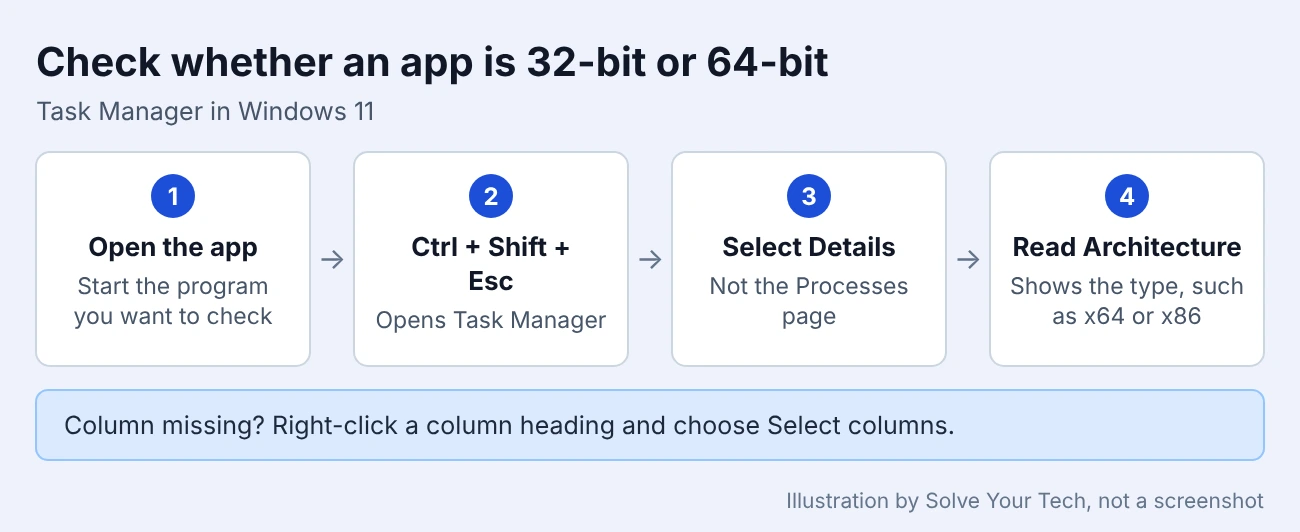
- Open the app you want to check.
- Press Ctrl + Shift + Esc to open Task Manager.
- Select Details.
- Read the Architecture column on the app’s row. If the column is missing, right-click any column heading, choose Select columns, and turn on Architecture.
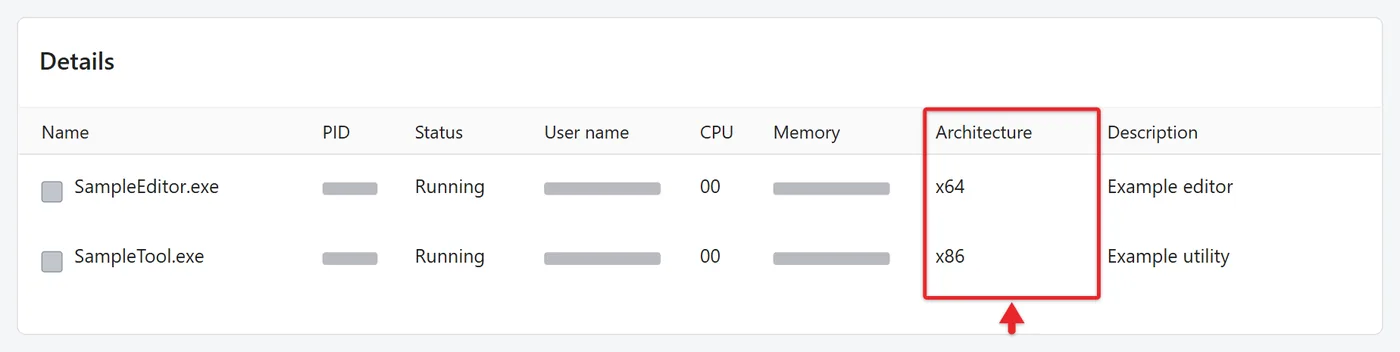
The column names the processor type the app was built for, such as x64 or x86. On Arm PCs, Microsoft’s Arm64EC documentation says some apps show ARM64 (x64 compatible) here. Exact wording can vary by Windows build.
A second clue is where the app is installed. 64-bit Windows keeps a separate Program Files (x86) folder on the system drive, and 32-bit apps are normally placed there, while 64-bit apps go in Program Files. Installers can choose other locations, so treat this as a hint and rely on Task Manager.
Can 64-Bit Windows 11 Run 32-Bit Apps?
Yes. A built-in layer called WOW64 lets 32-bit Windows apps run seamlessly on 64-bit Windows, with nothing to turn on. You don’t need compatibility mode just because an app is 32-bit. Two limits to know:
- 64-bit Windows doesn’t support 16-bit Windows apps. Trying to launch one fails with an error.
- On Arm PCs, emulation covers apps but not drivers. Hardware drivers must be built for Arm64, which is why a printer or graphics tool made only for x64 may refuse to install. The Arm route for printers is part of updating a printer driver in Windows 11.
Older 16-bit DOS programs are different, so a tool like Turbo C++ needs an emulator to run on Windows 11.
Microsoft also says emulation performance improved with a new emulator called Prism in Windows 11 version 24H2, so keeping an Arm PC updated helps older apps run better.
Why 32-Bit vs. 64-Bit Matters
The main practical difference is memory. Microsoft’s memory limits table shows 32-bit editions of Windows 10 capped at 4 GB of RAM, while Windows 11 Home supports up to 128 GB and Windows 11 Pro up to 2 TB. That is also why Microsoft’s Windows 11 specifications require a compatible 64-bit processor and at least 4 GB of RAM. A PC with a 32-bit processor can’t be upgraded to Windows 11.
For downloads, the rule is simple: a 64-bit app can’t run on 32-bit Windows, but 64-bit Windows runs both kinds. On Windows 11 you can always take the 64-bit option when a site offers a choice.
Should You Install 32-Bit or 64-Bit Office?
Pick 64-bit Office unless an add-in you rely on only comes in 32-bit. Microsoft 365 installs the 64-bit version by default, and Microsoft’s guide to choosing 32-bit or 64-bit Office recommends it for large files. Switching later means uninstalling the version you have first.
If Something Doesn’t Match
- No System type line: make sure you are on Settings > System > About and look at the top group of details, above the Windows edition and version.
- The line says 32-bit operating system: the PC is not running Windows 11. Here’s how to tell whether you have Windows 10 or 11.
- Settings is blocked: on a work or school PC your organization may restrict some pages. The
systeminfocommand or System Information usually still works; otherwise ask your IT administrator. - An installer says it isn’t compatible: compare its label with your processor type. An x64-only driver won’t install on an ARM-based PC, and an Arm64 installer won’t run on an x64-based PC.
- The Architecture column is missing: it is on the Details page of Task Manager, not Processes.
Note your processor type, then use it the next time a download page asks you to choose. Planning to move an older computer up? The full requirements are listed with the steps to install Windows 11.
32-Bit and 64-Bit Questions
Is there a 32-bit version of Windows 11?
No. Windows 11 doesn’t come in a 32-bit version, and installs are always 64-bit. Any PC running Windows 11 has a 64-bit processor.
Can I upgrade from 32-bit to 64-bit Windows?
Only with a clean install. Moving from 32-bit to 64-bit requires reformatting your drive, installing 64-bit Windows, and reinstalling everything else. That erases the drive, so back up your files first. Windows 11 is 64-bit only, so it’s already 64-bit if you have it.
Which download should I pick, 32-bit or 64-bit?
Pick 64-bit (sometimes labeled x64 or AMD64) on an Intel or AMD PC, and ARM64 on an Arm PC, when those versions are available. If only a 32-bit (x86) version exists, it runs on both.
Does x64 mean my PC has an AMD processor?
No. x64 and AMD64 are names for the 64-bit design used by both Intel and AMD chips. The Processor line on the same About page names the actual manufacturer and model.
Is an ARM-based PC 64-bit?
Yes. Windows 11 on Arm is a 64-bit operating system. It is a different processor type from x64, which is why some downloads offer a separate Arm64 installer.

Matthew Burleigh is the founder, head writer, and editor of Solve Your Tech, which he launched in 2012. He has written technology tutorials since 2008 and worked in IT since 2003, including small-business support, IT management, and consulting. He holds Bachelor’s and Master’s degrees in Computer Science from Arizona State University.
Matthew writes practical guides for Windows, iPhone and iPad, Microsoft Office, Outlook, Google apps, and Android. Solve Your Tech’s guides are checked step by step against the device or app maker’s own documentation and tested on his own devices whenever he has the hardware or software, with clear steps, sources, and update dates.
Read more about Matthew and how Solve Your Tech writes and updates its guides, or report a correction.