If Snipping Tool is not working in Windows 11, start with the simple fixes before reinstalling anything: close and reopen the app, restart the PC, update Windows and Snipping Tool, and then use Windows’ built-in Repair and Reset options. If the problem is limited to the Print Screen key or Windows + Shift + S, check the shortcut-related settings as well.
This guide is for Windows 11 Home and Pro. It walks through the fixes in order from least to most disruptive, then covers specific symptoms: a shortcut that does nothing, captures that don’t show a pop-up or don’t save, and an app that crashes. You don’t need any third-party software.
Snipping Tool missing entirely? Jump to the installation steps instead of working through repairs for an app that is absent.
How to Fix Snipping Tool in Windows 11
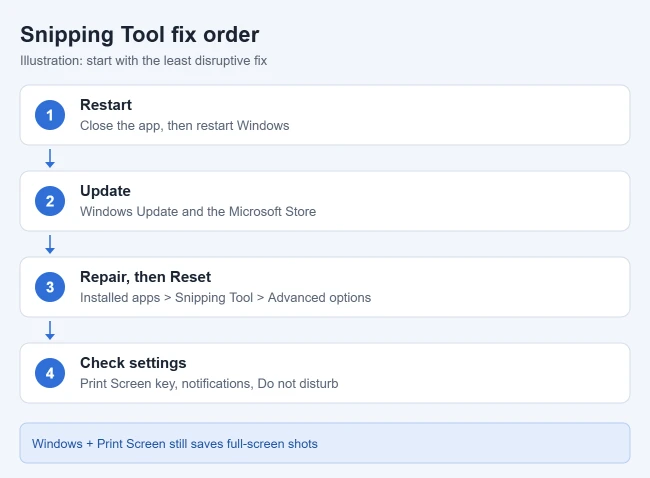
Work through these fixes in order. Test Snipping Tool after each step so you can stop as soon as the problem is resolved.
Step 1: Close Snipping Tool and Restart the Computer
Close Snipping Tool completely, restart Windows 11, and try the app again.
A restart clears temporary app and Windows processes that can interfere with screenshots. After Windows loads again, open Start, search for Snipping Tool, and test a new capture.
Step 2: Test Windows + Shift + S and the App Separately
Press Windows + Shift + S. Then separately open Snipping Tool from Start.
This helps narrow down the problem. If the app opens normally but the shortcut does not, concentrate on keyboard and shortcut settings. If neither works, continue with the app repair steps below. In the meantime, Windows + Print Screen still saves full-screen shots without Snipping Tool; see how to take a screenshot on Windows 11 for every shortcut.
Step 3: Install Windows Updates
Go to Settings > Windows Update, select Check for updates, install available updates, and restart the computer if Windows asks you to.
Snipping Tool is closely integrated with Windows, so keeping Windows current is a sensible early troubleshooting step.
Step 4: Update Snipping Tool
Open the Microsoft Store, go to your library or updates area, and install an available Snipping Tool update.
Microsoft continues to add and change Snipping Tool features through app updates. If your problem started because the installed app version is old or damaged, updating can resolve it without changing your settings.
Step 5: Repair Snipping Tool
Open Settings > Apps > Installed apps, find Snipping Tool, select its menu, and open Advanced options. Choose Repair if the option is available. Result: a check mark appears next to the button when it finishes.
Microsoft’s guide to repairing apps says to try Repair first, and Reset if Repair isn’t available or doesn’t fix the problem. Test Snipping Tool again after Repair finishes.
Step 6: Reset Snipping Tool
If Repair does not solve the problem, return to the same Advanced options page and select Reset, then confirm. Result: the app’s data is cleared and it starts like a fresh install.
Reset is a stronger step than Repair because it returns the app to a cleaner state. Review your Snipping Tool preferences afterward because app settings can need to be configured again.
Step 7: Check the Print Screen Setting
If the problem happens when you press Print Screen, open Settings > Accessibility > Keyboard and find the option that controls whether Print Screen opens screen snipping.
Turn the setting on if you want Print Screen to launch screen snipping. If Print Screen is unexpectedly opening Snipping Tool and you want the classic Print Screen behavior instead, turn the setting off.
Step 8: Check Notifications If the Capture Works but Nothing Opens
If Windows + Shift + S lets you select an area but you never see the post-capture notification, check Windows notification settings for Snipping Tool.
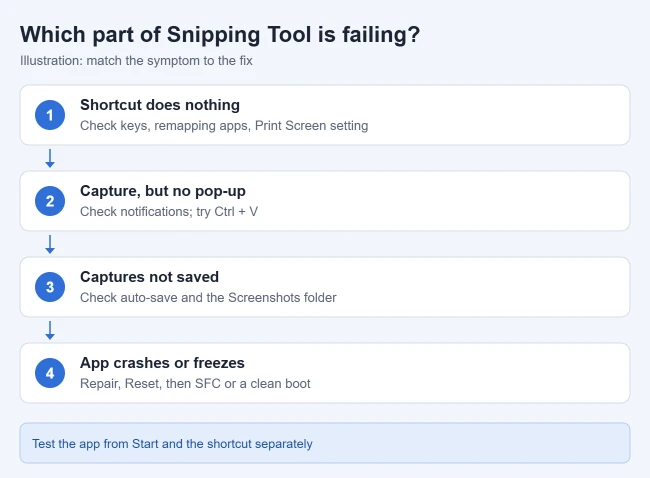
The screenshot may still be on the clipboard even when the notification does not appear. Try pressing Ctrl + V in Paint or another app to see whether the capture succeeded.
Step 9: Turn Off Do Not Disturb and Restart Windows Explorer
In Windows 11, Do not disturb (the replacement for Focus Assist) hides notifications, including the Snipping Tool pop-up after a capture. It is a common cause. Go to Settings > System > Notifications, turn off Do not disturb, and make sure Snipping Tool is allowed to send notifications. If it keeps switching back on, see how to turn off Do not disturb in Windows and clear its automatic rules.
If the screen-capture overlay won’t appear at all, restarting Windows Explorer can help: press Ctrl + Shift + Esc, find Windows Explorer under Processes, right-click it, and choose Restart. Result: the taskbar disappears briefly and comes back.
Step 10: Install or Reinstall Snipping Tool
If Snipping Tool is missing, install Microsoft’s app from Microsoft Store. It normally comes with Windows 11, so first search Start for Snipping Tool. If it opens, you already have it; use the earlier update or repair steps for a malfunctioning copy. Microsoft’s screen-recording alternatives guide confirms the built-in app and Store route for a missing copy.
Before removing an installed copy: save any open capture and note your app preferences. Try Repair first, then Reset if needed. Reset or reinstallation can require you to configure app settings again. On a work or school PC, check with IT if app installation is restricted.
- Open Microsoft Store from Start. Search for Snipping Tool. Microsoft’s support page linked above also provides the official Store link under Snipping Tool. Choose the Microsoft app, not a similarly named third-party screenshot utility.
- Select the available Get or Install control. Complete the Store’s sign-in prompt if required and let the download finish. If you see Open, the app is already installed; check the Store’s library or updates area for an update instead. For a previously acquired app, Microsoft also documents Library > Install in its Store app troubleshooting guide.
- Open Snipping Tool from Start after installation. Choose an image snipping mode, select New, and capture a harmless area of the screen. Save a copy to a folder you choose and confirm that the file opens. Test Windows + Shift + S separately if the original problem involved that shortcut.
If repair and reset failed and your Windows build offers removal, use Settings > Apps > Installed apps, open Snipping Tool’s menu, and choose Uninstall. Read the confirmation, restart, then follow the Store installation steps above. If Uninstall is unavailable, use the available repair/update options rather than forcing removal with package commands.
Missing listing, disabled installation, or download error? Record the exact message. Finish pending Windows updates and restart when requested. Check Store sign-in and device compatibility; account, region, and management restrictions can also affect availability. Microsoft’s missing or blocked Store app guide covers those conditions. Avoid downloading an unofficial replacement installer to bypass the restriction.
If Windows + Shift + S Is Not Working
If the Snipping Tool app opens but Windows + Shift + S does nothing, test the Windows, Shift, and S keys in other shortcuts or typing situations. Also check whether another screenshot utility, keyboard manager, gaming utility, or remapping program is intercepting the key combination.
You can still open Snipping Tool from Start while you troubleshoot the shortcut. If Print Screen is easier for you, Windows can also be configured to make that key open screen snipping under Settings > Accessibility > Keyboard.
If Snipping Tool Captures but Does Not Save
Open Snipping Tool Settings and review the automatic screenshot-saving options and the Screenshots folder. You can also select Save As after a capture and choose a folder manually. If a capture seems lost, press Windows + V: with clipboard history turned on, recent snips are listed there.
If manual saving works but automatic saving does not, the issue is likely different from a complete Snipping Tool failure. Check the destination folder, available disk space, folder permissions, and any sync software that manages the Pictures or Screenshots folder.
If Snipping Tool Opens and Immediately Closes or Freezes
For crashes or freezing, prioritize updating the app, then use Repair and Reset. Temporarily close third-party screenshot, overlay, clipboard, or keyboard-remapping utilities while testing, because those apps can compete for the same capture shortcuts or screen hooks.
When to Use System File Repair
If Snipping Tool is only one of several built-in Windows apps that are failing, the problem may be broader than Snipping Tool itself. At that point, Windows system repair tools may be appropriate. Do not jump to system-file repair as the first fix when only Snipping Tool is affected; Repair, Reset, updates, and reinstalling the app are more targeted first steps.
When you do need it, open Terminal (Admin) and run DISM.exe /Online /Cleanup-image /Restorehealth, then sfc /scannow, as Microsoft’s System File Checker guide describes. Let each command finish before closing the window, then restart.
If Snipping Tool works after a clean boot, a startup app or service is interfering. Turn those back on a few at a time to find the culprit, often a screenshot, overlay, or keyboard utility.
Frequently Asked Questions
Why is Snipping Tool not opening in Windows 11?
Common causes include a temporary app problem, an outdated app or Windows build, damaged app data, or conflicts with software that uses screenshot shortcuts. Restart first, then update, Repair, and Reset the app.
Why does Windows + Shift + S do nothing?
The shortcut can fail because of a keyboard problem, a conflicting shortcut/remapping utility, or a Snipping Tool issue. Test the app from Start separately so you know whether the failure is the shortcut or the app itself.
Should I use Repair or Reset first?
Use Repair first when it is available. Microsoft recommends trying Reset when Repair is unavailable or does not fix the problem.
Is Snip & Sketch a separate fallback in Windows 11?
No. Modern Windows 11 uses the current Snipping Tool experience rather than treating Snip & Sketch as a separate backup screenshot app. Older articles that tell Windows 11 users to switch to Snip & Sketch are outdated.
Can I reinstall Snipping Tool?
Yes, on Windows versions that expose the uninstall option. If you remove it, use Microsoft Store to reinstall or update the app afterward.
Summary
- Restart Snipping Tool and Windows.
- Test the shortcut and the app separately.
- Update Windows and Snipping Tool.
- Use Repair.
- Use Reset if Repair does not work.
- Check Print Screen and notification settings when the problem is shortcut-related.
- Reinstall Snipping Tool if the earlier fixes fail.
Most Snipping Tool problems do not require a major Windows repair. Start with the app-specific fixes, confirm exactly which part is failing, and escalate only when simpler steps do not work.
Related: How to Open Snipping Tool in Windows 11 and How to Use Snipping Tool on Windows 11.

Matthew Burleigh is the founder, head writer, and editor of Solve Your Tech, which he launched in 2012. He has written technology tutorials since 2008 and worked in IT since 2003, including small-business support, IT management, and consulting. He holds Bachelor’s and Master’s degrees in Computer Science from Arizona State University.
Matthew writes practical guides for Windows, iPhone and iPad, Microsoft Office, Outlook, Google apps, and Android. Solve Your Tech’s guides are tested on current devices or checked against official product documentation, with clear steps, sources, and update dates.
Read more about Matthew and how Solve Your Tech writes and updates its guides, or report a correction.