To change the screen saver in Windows 11, open Settings > Personalization > Lock screen, select Screen saver, pick one from the Screen saver menu, set the Wait time, and select OK. Windows 11 normally has no screen saver selected, so the menu may show (None) the first time you open it.
This guide covers Windows 11 and follows Microsoft’s Configure a Screen Saver in Windows page, checked in October 2026. It shows the main steps, faster ways to open the settings, how to use your own photos or a message, how to lock the PC when the screen saver ends, and what to check when the screen saver does not appear.
What a Screen Saver Does in Windows 11
A screen saver is an animation, picture, or pattern that covers the screen after the PC has been idle for a set time. Idle means nobody has touched the keyboard, mouse, or touchpad. Microsoft says screen savers were first made to stop burn-in on old CRT monitors, and that today they are mainly used for three things:
- Personalization: showing an animation or your own photos while you are away.
- Security: returning to the sign-in screen when the screen saver ends, so nobody can use your open session.
- OLED screens: keeping a static image from sitting on the display for long periods.
A screen saver does not save energy. Microsoft recommends sleep mode for that, because sleep uses much less power than a running screen saver.
You do not need an administrator account to change your own screen saver. The setting is saved for your user account, so other people who sign in to the same PC can pick their own.
How to Change the Screen Saver in Windows 11
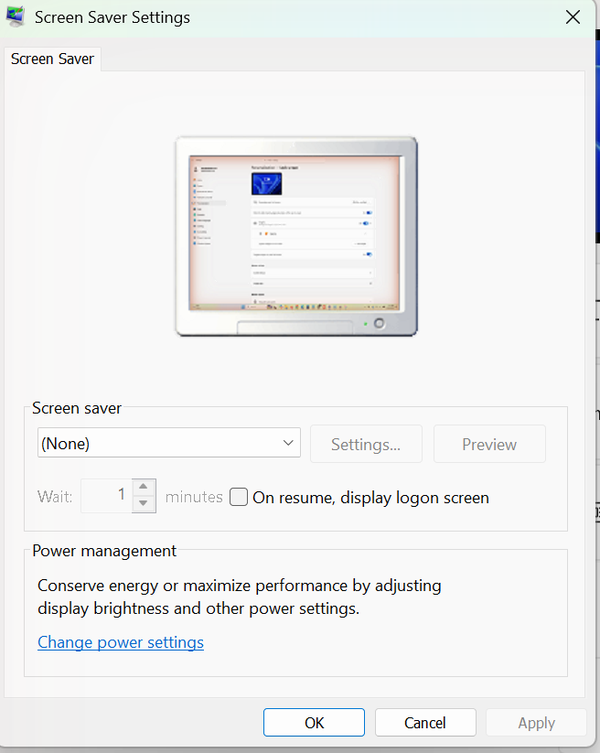
These steps open the Screen Saver Settings window, which is the same small window older versions of Windows used. Everything about the screen saver is controlled from it.
- Press Windows key + I to open Settings. You can also right-click an empty part of the desktop and select Personalize, which takes you straight to the Personalization page.
- Select Personalization in the left column, then select Lock screen on the right. You may need to scroll down to see it.
- Scroll to the Related settings section and select Screen saver. A separate Screen Saver Settings window opens on top of Settings.

Then finish in the Screen Saver Settings window:
- Open the Screen saver menu and choose one, such as Bubbles, Ribbons, or Photos. The small monitor picture at the top of the window shows what it looks like.
- Select Settings if you want to customize the screen saver you picked. Microsoft gives two examples: a custom message for 3D Text and a picture folder for Photos. Some screen savers have nothing to adjust.
- Set the Wait box to the number of minutes the PC must be idle before the screen saver starts.
- Optional: check On resume, display logon screen if you want Windows to ask for your PIN or password when the screen saver ends.
- Select Preview to see the screen saver full screen. Move the mouse or press a key to return.
- Select OK to save. The screen saver starts the next time the PC is idle for the Wait time you chose.
The Lock screen page is also where you change the picture you see when the PC is locked. That is a different setting, covered in how to set the lock screen on Windows 11.
Other Ways to Open Screen Saver Settings
Every route below opens the same Screen Saver Settings window, so use whichever is quickest for you.
- Search: select Start, type screen saver, and choose the result for changing the screen saver. The exact wording of the result can vary between Windows versions.
- Run command: press Windows key + R, type
control desk.cpl,screensaver,@screensaver, and press Enter. - Desktop shortcut: right-click the desktop, select New > Shortcut, and use
%windir%\system32\control.exe desk.cpl,screensaver,@screensaveras the location.
The command comes from Microsoft’s developer page on executing Control Panel items, which lists it as the way to open the Screen saver page. It is handy when the Screen saver link is hard to find in Settings.
Which Screen Savers Windows 11 Includes
The Screen saver menu on a standard Windows 11 PC usually lists the choices below. Microsoft’s support page only names 3D Text and Photos, so treat the rest of the list as what you should expect to see, not a guarantee. A PC maker or a work administrator can add or remove entries.
| Screen saver | What it shows | Can you customize it? |
|---|---|---|
| (None) | Nothing. The screen saver is off. | No |
| 3D Text | A rotating message or the current time | Yes |
| Blank | A black screen | No |
| Bubbles | Bubbles that drift over your desktop | No options in Settings |
| Mystify | Moving colored lines | No options in Settings |
| Photos | A slide show of pictures from a folder | Yes |
| Ribbons | Colored ribbons on a black background | No options in Settings |
If you select Settings for a screen saver that cannot be customized, Windows shows a short message saying it has no options. That is normal. Select OK and continue.
How to Use Your Own Photos as a Screen Saver
Put the pictures you want in one folder first. The Photos screen saver works from a folder, so a dedicated folder keeps receipts, screenshots, and other unrelated images off the screen.
- Open Screen Saver Settings and choose Photos in the Screen saver menu.
- Select Settings. A Photos options window opens.
- Select Browse, pick the folder with your pictures, and select OK.
- Choose a slide show speed, and check the shuffle option if you want the pictures in random order.
- Select Save, then select Preview to confirm the right pictures appear.
- Select OK in Screen Saver Settings.
Microsoft confirms that the Photos screen saver lets you choose pictures. The exact labels for speed and shuffle are not listed on its support page, so they may be worded a little differently on your PC.
How to Show a Custom Message With 3D Text
- Open Screen Saver Settings and choose 3D Text in the Screen saver menu.
- Select Settings.
- Select Custom Text and type your message, or select Time to show a clock instead.
- Change the font, size, motion, or surface style if you like. These are optional.
- Select OK, select Preview to check the result, then select OK again to save.
Keep the message short. Do not put a password, PIN, or other private detail in it, because anyone who walks past can read the screen.
How to Lock Your PC When the Screen Saver Ends
By itself, a screen saver only hides the screen. Moving the mouse brings your desktop right back. To make it protect your session, turn on the sign-in option.
- Open Screen Saver Settings.
- Check On resume, display logon screen.
- Set Wait to a short time, such as 5 minutes.
- Select OK.
Before you rely on this, make sure you know your PIN or password, since Windows asks for it every time the screen saver ends. The PC also stays unlocked for the whole Wait time after you walk away. To lock it immediately, press Windows key + L, which Microsoft lists in its Windows keyboard shortcuts as the shortcut to lock the computer.
How to Check That It Worked, or Turn It Off
To confirm the change, select Preview in Screen Saver Settings, or leave the PC untouched for the Wait time. Set Wait to 1 minute for a quick test, then raise it again afterward.
To turn the screen saver off again:
- Open Screen Saver Settings as shown above.
- Choose (None) in the Screen saver menu.
- Select OK.
Choosing (None) does not change when the screen turns off or when the PC sleeps. Those timers are separate, as the next section explains.
Screen Saver vs. Screen Timeout
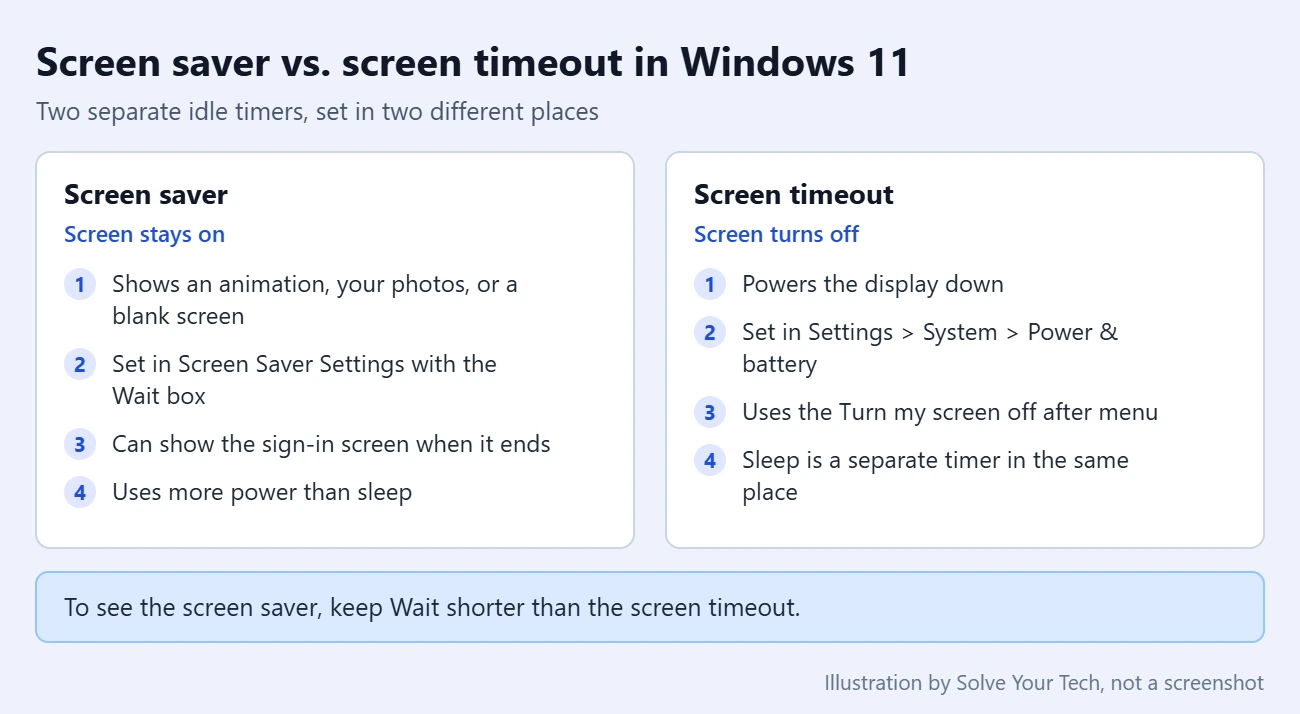
A screen saver shows an animation on a screen that stays on. The screen timeout turns the display off entirely, which saves more power. Windows 11 keeps the two in different places:
- Screen saver: the Wait box in Screen Saver Settings.
- Screen timeout and sleep: Settings > System > Power & battery > Screen, sleep, & hibernate timeouts, using the Turn my screen off after and Make my device sleep after menus. Microsoft describes them in Power settings in Windows 11.
Whichever timer is shorter happens first. If the screen is set to turn off after 5 minutes and the screen saver Wait is 10 minutes, the display goes dark and you never see the screen saver. Our guide to Windows 11 screen timeout settings shows how to change the screen-off time. On a laptop, check both the plugged-in and on-battery times.
Macs use the same two timers, and a separate guide explains how to choose when the screen saver turns on for a Mac.
If the Screen Saver Won’t Start
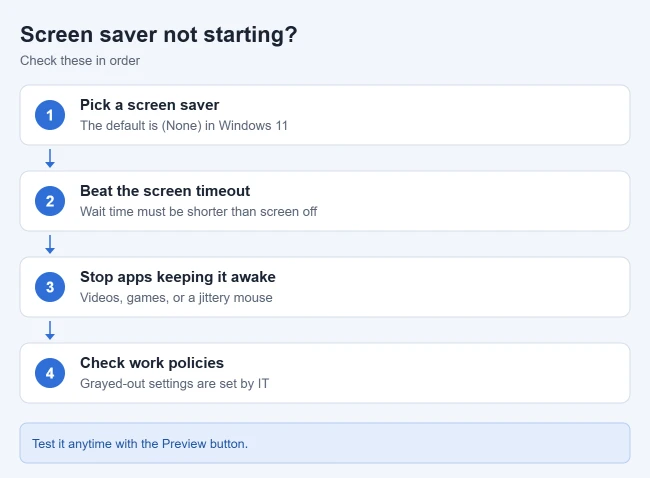
Work through these checks in order. Each one takes a minute or less.
- Make sure a screen saver is selected, not (None), and that you selected OK and not Cancel.
- Compare the Wait time with the screen timeout and sleep time in Settings > System > Power & battery. Lower the Wait time or raise the other two so the screen saver comes first.
- Close videos, games, and presentation apps. Apps like these can ask Windows to keep the display awake, so the PC may not count as idle while they run.
- Check for stray input. A mouse on an unsteady surface or a game controller can register as activity. Unplugging the device for a few minutes is a simple way to rule it out.
- To see what is keeping the PC awake, right-click Start, select Terminal (Admin), type
powercfg /requests, and press Enter. Microsoft’s powercfg reference says this lists the app and driver requests that stop the display from powering off or the PC from sleeping. The command only shows information. It does not change anything. - Try a different built-in screen saver. If another one starts normally, the problem is with the first screen saver, not with your settings.
If the Settings Are Grayed Out or Missing
On a work or school PC, an administrator can control the screen saver with policies. Microsoft’s policy documentation describes what each one does to the Screen Saver Settings window:
- The window will not open: the Prevent changing screen saver policy blocks it. A screen saver can still run.
- The Screen saver menu is grayed out: the Force specific screen saver policy has chosen one for you, or Enable screen saver has been disabled so that none can run.
- The sign-in check box is grayed out: the Password protect the screen saver policy forces it on or off.
- The Wait time is fixed: the Screen saver timeout policy sets it.
These policies are set by your organization on purpose, often to make sure unattended PCs lock. You cannot change them from Settings, and you should not try to work around them. Ask your IT help desk if the current behavior is a problem.
On a home PC, the Wait box can also look unavailable simply because (None) is selected. Choose a screen saver first.
Frequently Asked Questions
Can I get more screen savers for Windows 11?
Yes, but be careful. Third-party screen savers usually come as .scr files or installers, and a .scr file is a program that can run code like any other app. Only install one from a source you trust, and scan the download with your security software first. Microsoft’s support page does not document a way to add screen savers, so the safest choice is to customize the built-in Photos or 3D Text options.
Why is the Screen saver link missing in Settings?
The link is at the bottom of Settings > Personalization > Lock screen, under Related settings, so it is easy to miss. If you still cannot find it, press Windows key + R, type control desk.cpl,screensaver,@screensaver, and press Enter to open Screen Saver Settings directly. If nothing opens on a work PC, a policy is probably blocking it.
Is the screen saver the same as the lock screen?
No. The lock screen appears when you lock the PC or wake it up, and it shows a picture, the time, and the sign-in prompt. The screen saver runs while the PC is idle and unlocked. The two only connect if you check On resume, display logon screen, which sends you to the sign-in screen when the screen saver ends.
Does a screen saver turn off the monitor?
No. The display stays on and keeps using power while a screen saver runs, even with the Blank option. To power the display down, set Turn my screen off after in Settings > System > Power & battery.
Why did my screen saver change on its own?
A Windows theme can include a screen saver along with a background, colors, and sounds, so applying a new theme may replace your choice. Open Screen Saver Settings and pick your screen saver again. On a work PC, a policy that forces a specific screen saver will also override what you select.
Should I use a screen saver on a laptop?
It is your choice, but it costs battery life. A screen saver keeps the screen and the PC fully awake. On battery power, a short screen timeout and sleep time do more for you, and Microsoft recommends sleep for saving energy.
Next Step
Open Screen Saver Settings, pick a screen saver, and select Preview. Then compare your Wait time with the screen timeout in Power & battery so the screen saver has a chance to appear before the display turns off.

Matthew Burleigh has been writing tech tutorials since 2008. His writing has appeared on dozens of different websites and been read hundreds of millions of times.
After receiving his Bachelor’s and Master’s degrees in Computer Science he spent several years working in IT management for small businesses. However, he now works full time writing content online and creating websites.
His main writing topics include iPhones, Microsoft Office, Google Apps, Android, and Photoshop, but he has also written about many other tech topics as well.