To add widgets in Windows 11, press Windows key + W to open the Widgets board, select the + button in the top-right corner, and pick the widget you want from the widget picker. To resize, customize or remove it later, select the widget’s More options button (three dots).
These steps cover current Windows 11 on Home and Pro with the latest Widgets updates, and they follow Microsoft’s Stay up to date with Widgets in Windows support article. Windows 10 has a different feature, covered near the end.
What Widgets Are
Widgets are small cards that show live information, such as weather, calendar events, stocks, sports scores, traffic and photos, without opening the full app. They live on the Widgets board, a panel that slides in from the left side of the screen. Each widget is powered by an app or service, so the cards you can add depend partly on the apps installed on your PC.
How to Open the Widgets Board
You can open the board three ways:
- Select the Widgets area at the left end of the taskbar. It usually shows the current temperature.
- Press Windows key + W.
- On a touchscreen, swipe in from the left edge of the screen.
The board opens with a navigation bar down its left side. The Widgets dashboard holds your cards, and the Discover dashboard holds the news stream. To close the board, select anywhere outside it.
How to Add a Widget in Windows 11
- Press Windows key + W to open the Widgets board.
- Select Widgets in the navigation bar if the board opened on another dashboard.
- Select the + button in the top-right corner. The widget picker opens and lists the widgets available on your PC.
- Select a widget in the list to see a preview.
- Select the add button under the preview. Depending on your Widgets version, it’s labeled Pin or Add widget. On older boards, you select the + next to the widget’s name instead.
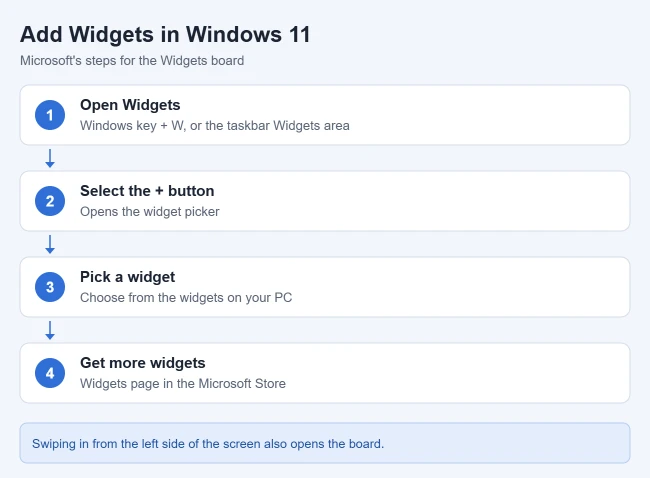
- Close the picker. The new widget appears in the pinned section of the board, usually at the bottom.
Widgets you’ve already added show as added or grayed out in the picker, so you can’t add a duplicate by mistake. To get more widgets, install apps that offer them. The Widgets page in the Microsoft Store lists supported apps, and once you install one, its widget shows up in the picker.
How to Resize, Customize, Move or Remove a Widget
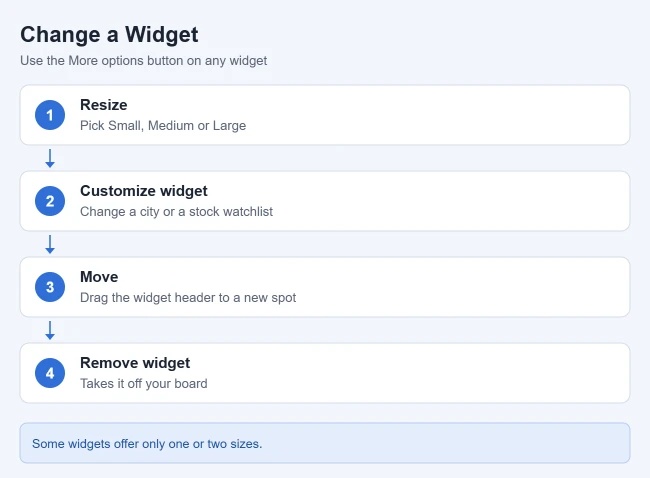
Each widget has a More options button (three dots) in its upper corner. Hover over the widget if you don’t see it.
- Resize: select More options, then Small, Medium or Large. Some widgets offer only one or two sizes, and there is no custom size.
- Customize: select More options, then Customize widget. For the weather widget, you can set the city and switch between Fahrenheit and Celsius. For sports, you can follow teams, and for stocks, you can edit your watchlist. Save or select Done when you finish.
- Move: point to the top edge of the widget, then drag it to a new spot in the pinned section. The other widgets shift and snap into a grid around it.
- Remove: select More options, then Remove widget. You can add it back at any time from the widget picker.
A good layout puts the cards you check every day, like weather and calendar, at the top and leaves out anything you’d scroll past. If two widgets show the same information, remove one.
How to Add Widgets to the Lock Screen
Windows 11 can also show a few widgets on the lock screen. These are separate from the Widgets board. Microsoft’s lock screen guide lists these steps:
- Open Start > Settings > Personalization > Lock screen.
- Under Widgets, select Add widget below the list and choose one. Only small widgets can go on the lock screen.
- Drag a widget higher in the list to show it earlier on the lock screen.
- To remove or customize one, select its More options button.
To turn lock screen widgets off, set the Widgets switch to Off. Pictures and other lock screen options are covered in setting the lock screen on Windows 11.
Widgets Board Settings Worth Knowing
Select the settings button on the board’s navigation bar to find these options:
- Open Widgets board on hover: turn it on to open the board when your pointer rests on the taskbar icon, or off to open it only when you select it.
- Dashboards: turn Discover off to remove the news stream from the navigation bar. Turning off the news feed in Windows 11 goes into more detail.
- Notifications: under More settings, select Notifications to turn Show badges on the taskbar and Show badges on the navigation bar on or off, and choose which dashboards can notify you.
The Discover feed is personalized with your Microsoft account. To switch or sign out of the account it uses, select the user account button on the Discover dashboard, then Manage accounts.
To show or hide the Widgets button itself, right-click the taskbar, select Taskbar settings, and toggle Widgets under Taskbar items. Even with the button hidden, Windows key + W still opens the board. There is more on showing or hiding Widgets on the taskbar, and you can customize the rest of the Windows 11 taskbar while you’re there.
The taskbar clock is set elsewhere. To make it show AM and PM, follow the steps to set a 12-hour clock in Windows 11.
What to Do If Widgets Isn’t Working
Try these in order if the board won’t open, a widget is blank, or the content looks out of date:
- Check the taskbar switch. If the Widgets button is missing, turn Widgets on under Taskbar items in Taskbar settings.
- Update the Windows Web Experience Pack. Widgets needs the latest versions of the Windows Web Experience Pack and the Start Experiences App. Open the Microsoft Store, select Library, and select Get updates, or search for Windows Web Experience Pack and select Update if it appears. Microsoft’s Web Experience Pack update steps also show how to keep App updates turned on in Store settings.
- Install Windows updates. Open Settings > Windows Update, select Check for updates, and restart.
- Check for a work or school policy. On Windows 11 Pro, Enterprise and Education, an administrator can turn off Widgets with the Allow widgets policy, listed in the Widgets policy reference. If your PC is managed, ask your IT department.
To see which app or service powers a widget, select its More options button and look for the Powered by message. Change that app’s privacy settings if you want to limit what it collects.
Windows 10: News and Interests
Windows 10 has no Widgets board. Its closest feature is News and interests, a weather and news panel on the taskbar. Right-click the taskbar and point to News and interests to show it or choose Turn off. Microsoft’s news and interests support page covers these controls. Windows 10 no longer gets free security updates.
Frequently Asked Questions
Can I put widgets on the desktop?
No. Windows 11 keeps widgets on the Widgets board and, for small widgets, the lock screen. For a reminder that stays on the desktop itself, put a sticky note on your desktop instead.
Is there a desktop clock widget?
The Windows 11 clock widget walkthrough covers the options, from supported cards on the Widgets board to the built-in Clock app.
Do I need a Microsoft account to use widgets?
Microsoft doesn’t list one as required for the widget cards. Signing in personalizes the Discover feed and keeps it consistent across your PCs.
Why don’t I see a widget I want in the picker?
The picker only lists widgets from apps installed on your PC. Install the app that provides the widget from the Microsoft Store, then open the picker again.
How do I change the weather widget to Fahrenheit?
Select the weather widget’s More options button, select Customize widget, choose Fahrenheit, and save.
Using a 2-in-1? Here is how Tablet mode works in Windows 10 and Windows 11, including Windows 11’s automatic switching.

Matthew Burleigh is the founder, head writer, and editor of Solve Your Tech, which he launched in 2012. He has written technology tutorials since 2008 and worked in IT since 2003, including small-business support, IT management, and consulting. He holds Bachelor’s and Master’s degrees in Computer Science from Arizona State University.
Matthew writes practical guides for Windows, iPhone and iPad, Microsoft Office, Outlook, Google apps, and Android. Solve Your Tech’s guides are checked step by step against the device or app maker’s own documentation and tested on his own devices whenever he has the hardware or software, with clear steps, sources, and update dates.
Read more about Matthew and how Solve Your Tech writes and updates its guides, or report a correction.