To invert colors on Windows 11, open Settings > Accessibility > Color filters, turn Color filters on, and choose Inverted. For a quick flip while zoomed in, start Magnifier and press Ctrl + Alt + I.
Your screen colors flipped after a stray key press, or you want white pages to turn black so your eyes can rest. Either way, the same few controls cause it and reverse it.
Invert the Whole Screen With Color Filters
Color filters are the steady option. They apply across the whole display, with no zooming, and they stay out of your way until you turn them off. The labels below match Microsoft’s page on making Windows easier to see.
- Open the Start menu and select Settings.
- Select Accessibility in the left column.
- Select Color filters.
- Turn the Color filters switch on.
- In the list of filters, select Inverted.
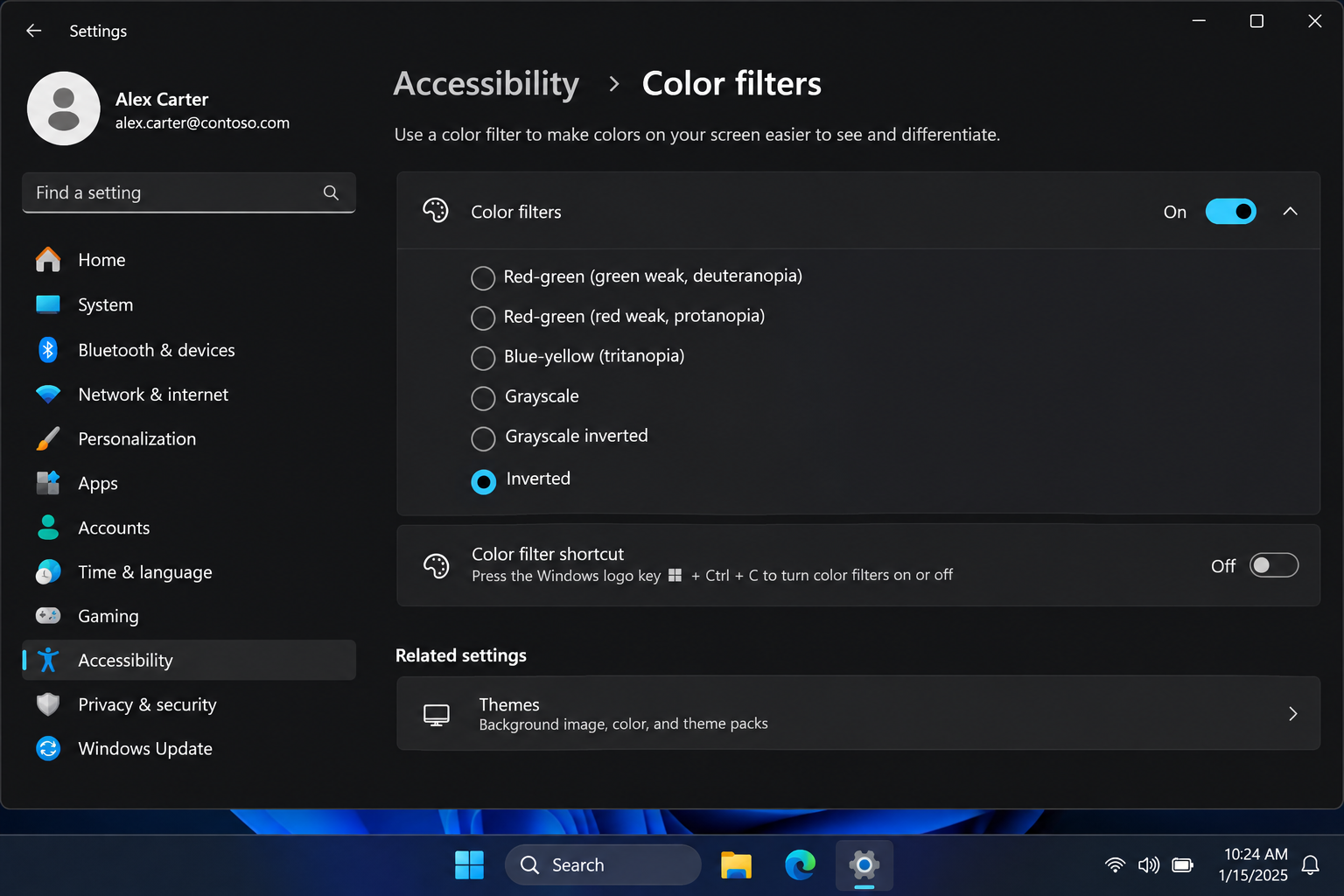
The change happens right away: white backgrounds go black, black text goes white, and other colors swap to their opposites. To go back, return to the same page and turn the switch off.
The word to look for is Inverted, not Invert. Right beside it you will see these other filters, described in Microsoft’s screen comfort appendix:
- Grayscale removes color without reversing anything.
- Grayscale inverted removes color and also flips light and dark, so you get a black and white negative.
- Red-green and blue-yellow filters are aimed at color vision deficiencies. They adjust colors rather than reversing them.
If you want dark pages but find strong colors distracting, Grayscale inverted is worth a look.
One limit to know about: Microsoft says Color filters and Screen Tint can’t be on at the same time. Screen Tint has its own page at Settings > Accessibility > Screen Tint, so if you already use it, expect to choose between the two.
Turn Inversion On and Off With Windows + Ctrl + C
A keyboard shortcut helps if you only want inversion for certain tasks, such as reading a long white document at night. It does not work until you switch it on, which older instructions often leave out.
- Go to Settings > Accessibility > Color filters.
- Turn the Color filters switch on and select Inverted, so it is the filter the shortcut will use.
- Turn on Keyboard shortcut for color filters.

- Press Windows + Ctrl + C to turn the filter off, and press it again to turn it back on.
Microsoft’s Windows accessibility shortcut list describes this combination as turning color filters on or off. It doesn’t say “invert,” and that matters: Microsoft doesn’t spell out which filter the keys apply, but other guides report that it is whichever one is currently selected. If someone last chose Grayscale, expect the same keys to turn your screen gray instead of inverting it.
Here is how that plays out. Say Dana proofreads a long white PDF after dark. She selects Inverted once, turns on the shortcut, and from then on presses Windows + Ctrl + C when she opens the PDF and again when she needs to check a photo in its real colors. She never goes back to Settings.
Invert Colors With Magnifier and Ctrl + Alt + I
Magnifier is the Windows zoom tool, and it has its own inversion control. This is the better pick if you are already zooming in, or if you want a flip for a minute or two without touching Settings.
- Press Windows + Plus (the plus key) to turn Magnifier on.
- Press Ctrl + Alt + I to invert the colors.

- Press Ctrl + Alt + I again to bring the normal colors back.
- Press Windows + Esc to turn Magnifier off when you are done.
These keys come from Microsoft’s Magnifier shortcut list. The catch, covered in its chapter on making content clearer, is that Ctrl + Alt + I only works while Magnifier is on. Pressing it with Magnifier closed does nothing. It’s also a Magnifier feature rather than a display setting, so the zoom comes along with it. If you need help starting the tool, there is more on turning Magnifier on in Windows 10 and Windows 11.
You may read about a Magnifier settings toggle for this. Microsoft’s Magnifier settings appendix lists those settings under Settings > Accessibility > Magnifier but doesn’t list a dedicated invert setting, so the shortcut is the documented route.
Which Method Fits What You Need
| What you want | Use this | Why |
|---|---|---|
| Dark pages everywhere, for a long stretch | Color filters, Inverted | Applies to the whole screen with no zoom |
| A fast switch on and off | Windows + Ctrl + C | Same filter, no trip to Settings, once the shortcut is enabled |
| Inversion while zoomed in | Magnifier, Ctrl + Alt + I | Works together with the zoom, and only while Magnifier runs |
| Colors you pick yourself | Contrast themes | Sets its own palette, and you can edit it |
| Dark windows, with normal photos | Dark mode | Changes the Windows look rather than reversing every color |
| Less blue light in the evening | Night light | A warmer tint, with a schedule |
| One picture reversed, not the screen | An image editor | Changes that image only |
Contrast Themes and Dark Mode Do Not Invert
These settings get mixed up with inversion because the end result can also be a dark screen. They work differently, and each one is the better answer for some people.
Contrast themes replace the Windows color palette with a high contrast one. Microsoft’s contrast guide puts them at Settings > Accessibility > Contrast themes. Pick Aquatic, Desert, Dusk, or Night sky and select Apply, and use Edit to change a theme’s colors. To remove one, choose None and select Apply. A “Please wait” screen can appear while the theme changes. For more on this, see how to enable a contrast theme.
The shortcut for contrast themes is Left Alt + Left Shift + Print Screen. It’s an easy one to hit by accident, and the result can look like inverted colors, so try it if your screen changed unexpectedly and the filter is off.
Dark mode lives at Settings > Personalization > Colors > Choose your mode. Choose Dark for everything, or Custom to set Windows and apps separately. Pictures keep their real colors because nothing is being reversed. If this is what you really wanted, here are the steps to change dark mode in Windows 11.
Night light is at Settings > System > Display > Night light, with controls for Strength and Schedule. It warms the screen and doesn’t touch light and dark, but if eye comfort is the goal it may be enough on its own. Glare can also be a plain brightness problem. Night light’s schedule doesn’t carry over to color filters, either: the Microsoft pages linked here show no way to schedule inversion.
Invert One Picture Instead of the Screen
Color filters change what you see, not the file. If you need an actual negative of an image to save or send, you have to edit the image.
Microsoft Paint is the obvious first stop, but Microsoft’s support pages don’t appear to document an invert command for current Paint, and the community answers about it are years old. So treat this as something to check rather than a fixed path:
- Work on a copy of the image, so the original stays safe.
- Open the copy in Paint and select the whole picture with Ctrl + A.
- Right-click the selection and look for a command with “invert” in its name.

- If you find one, apply it, confirm the result, and save. If not, use a dedicated photo editor.
If the Screen Stays Inverted or Colors Look Wrong
Most stuck screens come down to one of the controls above being on without you realizing it. Start with the one that matches what you see.
- Everything flipped and nothing is zoomed. Press Windows + Ctrl + C. If that does nothing, open Settings > Accessibility > Color filters and turn the switch off.
- The screen is zoomed as well as inverted. Magnifier is running. Press Ctrl + Alt + I, then Windows + Esc.
- Colors are still inverted after you closed Magnifier. Outside reports describe this when Magnifier is closed while inverted, and Microsoft’s pages don’t cover it. The suggested fix is to reopen it with Windows + Plus, press Ctrl + Alt + I, and then close it.
- The screen is gray, not inverted. The selected filter is Grayscale or Grayscale inverted. Select Inverted, or turn the switch off.
- Windows + Ctrl + C does nothing. The keyboard shortcut setting is off. Turn on Keyboard shortcut for color filters on the Color filters page.
- Ctrl + Alt + I does nothing. Magnifier isn’t on. Start it first.
- Backgrounds became solid black, or text changed color, but pictures look normal. That points to a contrast theme rather than inversion. Press Left Alt + Left Shift + Print Screen, or choose None and select Apply on the Contrast themes page.
- The color filter won’t stay on alongside your tint. Screen Tint and Color filters can’t be on together, so turn one off.
If none of those explain it, the problem may be outside these accessibility settings, such as the monitor’s own settings or a color profile. Check the options to change monitor color in Windows 11 next. To confirm that any fix worked, open a familiar photo: skin tones and skies are the fastest way to tell whether colors are back to normal.
Other Questions About Inverted Colors
Does inverting colors change my photos or documents?
A color filter changes how the screen looks while it is on. It isn’t an edit, so turning it off brings your photos and documents back as they were. The same is true of Magnifier’s inversion.
Why do photos and videos look strange when colors are inverted?
Inversion treats everything the same way, so pictures look like film negatives and faces can look odd. Some apps may look unusual too. Plan on using the shortcut to turn the filter off when color matters, such as during photo editing.
Can I invert only one window or app?
The Microsoft pages linked here document whole-screen filters and the Magnifier shortcut, and no per-window setting. If one app is the problem, check whether it has its own dark theme. For a picture, edit the image itself.
Is the Windows 10 path different?
Yes. Windows 10 puts Color filters under Settings > Ease of Access, a name that was changed to Accessibility in Windows 11. If instructions tell you to find Ease of Access on Windows 11, they are out of date. The filter is also called Inverted there.
Should I use inverted colors to reduce eye strain?
It depends on what bothers you. If bright white pages are the problem, inverted colors or dark mode can both help, and dark mode keeps pictures looking right. If evening blue light is the concern, try Night light first. Start with the mildest change that solves it. Persistent eye discomfort is worth raising with an eye doctor.
What should I try next?
Set up Windows + Ctrl + C with the Inverted filter selected and use it for a day. It takes a single press to undo, so you can find out quickly whether inversion suits you or whether dark mode is the better long-term choice.

Matthew Burleigh is the founder, head writer, and editor of Solve Your Tech, which he launched in 2012. He has written technology tutorials since 2008 and worked in IT since 2003, including small-business support, IT management, and consulting. He holds Bachelor’s and Master’s degrees in Computer Science from Arizona State University.
Matthew writes practical guides for Windows, iPhone and iPad, Microsoft Office, Outlook, Google apps, and Android. Solve Your Tech’s guides are checked step by step against the device or app maker’s own documentation and tested on his own devices whenever he has the hardware or software, with clear steps, sources, and update dates.
Read more about Matthew and how Solve Your Tech writes and updates its guides, or report a correction.